
UPSC CURRENT AFFAIRS – 05th July 2025

Home / UPSC / Current Affairs / Puducherry’s Community-Based TB Elimination Model

Puducherry’s Community-Based TB Elimination Model

tuberculosis printed above barcode

Why in News?

  • Puducherry became the first state to integrate tuberculosis screening into the Family Adoption Program, engaging medical students in long-term community-based TB detection and care.

Introduction

  • In a significant public health initiative, Puducherry has become the first Union Territory in India to integrate tuberculosis (TB) screening into the Family Adoption Program, an initiative where medical students adopt families as part of their community outreach. 
  • The move is aligned with the National Tuberculosis Elimination Programme (NTEP) and aims to strengthen early detection, diagnosis, and sustained treatment of TB within the community through institutional involvement and data-driven strategies.
  • This innovative step exemplifies how integrating medical education, community engagement, and public health strategy can improve disease surveillance and control, especially in high-burden areas.

The Family Adoption Program and TB Screening

Under the National Medical Commission (NMC) guidelines, medical students are mandated to adopt 3 to 5 families and monitor them over a period of three years. Puducherry has taken this initiative a step further by including systematic TB screening for all members of these adopted families.

  • Objective: To enhance early case detection and ensure community-level engagement in TB control.
  • Implementation: If any member of an adopted family is found to exhibit symptoms of TB, students assist in facilitating diagnosis, treatment initiation, and treatment adherence.
  • The initiative is being spearheaded by the Indira Gandhi Medical College (IGMC), Puducherry, under the leadership of the Department of Community Medicine.

Verbal Autopsy to Identify TB Death Causes

To understand and reduce TB mortality, Puducherry has initiated Verbal Autopsy investigations for TB-related deaths.

  • The process involves interviewing family members of deceased TB patients to determine the medical and social causes of death.
  • Key findings from 160 cases revealed:
    • Delayed presentation to healthcare facilities
    • Most deaths occur within 14 days of diagnosis, suggesting late-stage detection
    • This underscores the urgent need for early health-seeking behaviour and multipronged strategies for awareness, diagnosis, and access to care.
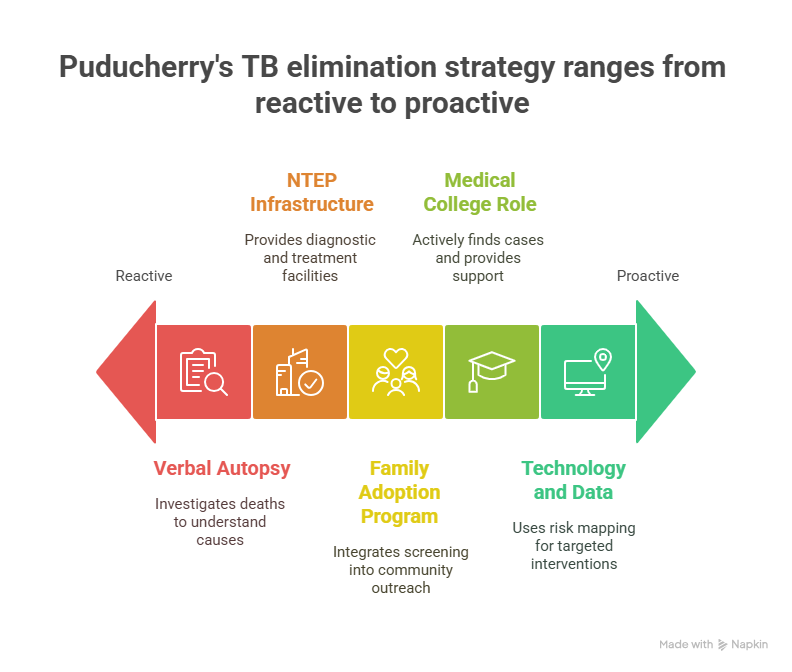
puducherry TB elimination strategy ranges from reactive to proactive

Role of Medical Colleges in TB Elimination

Puducherry’s nine medical colleges have become critical stakeholders in the UT’s TB elimination strategy. Their contributions include:

  • 45% of all TB notifications in the Union Territory
  • Active participation in Active Case Finding (ACF) drives
  • Providing diagnostic facilities, earmarked hospital beds for TB care
  • Conducting Information, Education, and Communication (IEC) activities
  • Supporting community-level outreach and treatment adherence

Colleges also assist the State TB Cell in:

  • Mapping vulnerable populations as moderate or high risk
  • Using advanced diagnostic tools such as:
    • AI-enabled handheld chest X-ray machines
    • Nucleic Acid Amplification Testing (NAAT) for molecular-level diagnosis

Use of Technology and Data for Targeted Interventions

The State TB Cell is building a risk-mapped database of individuals with:

  • Co-morbidities (such as diabetes, HIV, malnutrition)
  • Social vulnerabilities (such as poor housing, migration, etc.)

These individuals are:

  • Included in future case finding drives
  • Monitored for symptoms and treatment needs over time
  • Given priority access to high-sensitivity diagnostics

This data-driven approach allows for more efficient deployment of resources and continuous follow-up, helping prevent disease progression and community transmission.

Institutional Framework: National TB Elimination Programme in Puducherry

The National TB Elimination Programme (NTEP) in Puducherry has been operational since 20th February 2004 under the Department of Health and Family Welfare Services and the National Health Mission.

Key statistics:

  • Puducherry has one NTEP district covering 13.92 lakh population
  • The NTEP infrastructure in the UT includes:
    • 7 TB Units
    • 28 TB Diagnostic Centres
    • 1 Intermediate Reference Laboratory (IRL) at the Government Hospital for Chest Diseases
      • Equipped for culture and drug susceptibility testing (DST)

Significance of the Model

  1. Innovative Integration: By combining medical education with public health initiatives, the model promotes practical learning for students and improves community healthcare delivery.
  2. Enhanced Surveillance: Regular screening through adopted families ensures early detection, limiting community transmission.
  3. Community Trust and Participation: Long-term engagement builds trust in the health system, making patients more likely to seek early care.
  4. Replicable Model: The success in Puducherry may serve as a model for other states and UTs, especially where medical institutions and urban-rural divides co-exist.
  5. Public Health Impact: With medical colleges contributing nearly half of all TB case notifications, the integration of academic institutions in disease elimination efforts is proving to be a strategic asset.

Conclusion

Puducherry’s initiative to incorporate TB screening into the Family Adoption Program reflects a holistic, participatory, and data-driven approach to public health. By involving medical students, leveraging institutional infrastructure, and using advanced diagnostics and verbal autopsies, the UT is setting an example in community-based TB control. As India moves toward its goal of eliminating TB by 2025, such decentralised, community-rooted models can play a transformative role in enhancing public health outcomes.

Economic Implications

For Indian Exporters

  • These reforms reduce transaction costs and compliance hurdles
  • Encourage a more competitive and efficient export environment
  • Promote value addition in key sectors like leather

For Tamil Nadu

  • The reforms particularly benefit the state’s leather industry, a major contributor to employment and exports
  • Boost the marketability of GI-tagged E.I. leather, enhancing rural and traditional industries

For Trade Policy

  • These decisions indicate a shift from regulatory controls to policy facilitation

Reinforce the goals of Make in India, Atmanirbhar Bharat, and India’s ambition to become a leading export power

Recently, BVR Subrahmanyam, CEO of NITI Aayog, claimed that India has overtaken Japan to become the fourth-largest economy in the world, citing data from the International Monetary Fund (IMF). 

India’s rank as the world’s largest economy varies by measure—nominal GDP or purchasing power parity (PPP)—each with key implications for economic analysis.

Significance and Applications

Leave a Reply

Your email address will not be published. Required fields are marked *

Call Us Now !

Copyright © JICE ACADEMY FOR EXCELLENCE PRIVATE LIMITED