
UPSC CURRENT AFFAIRS – 07th August 2025

Home / UPSC / Current Affairs / RBI’s August 2025 Monetary Policy Review

RBI's August 2025 Monetary Policy Review

Why in News?

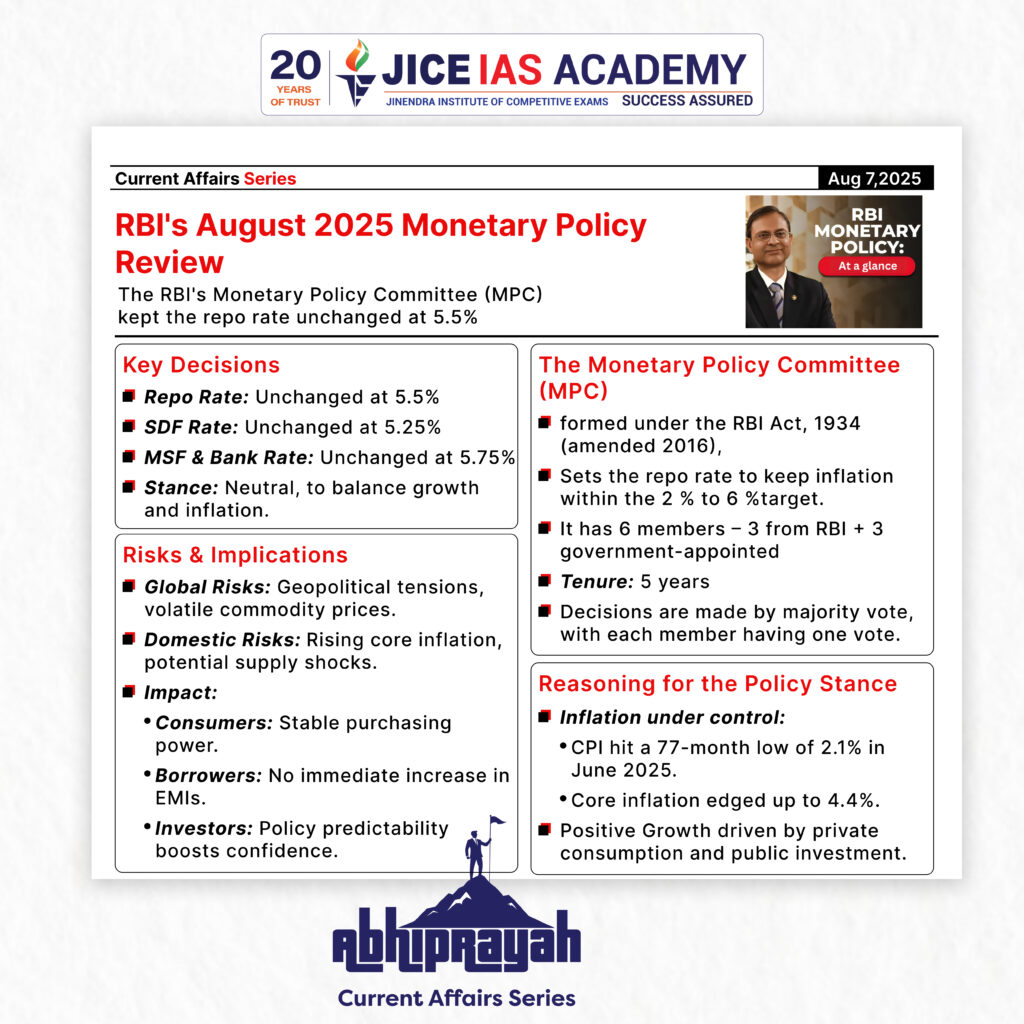
  • The RBI’s Monetary Policy Committee (MPC) kept the repo rate unchanged at 5.5% while projecting GDP growth at 6.5% and CPI inflation at 3.1% for 2025-26 amid global uncertainties.

About Monetary Policy Committee (MPC)

The Monetary Policy Committee (MPC) is a statutory body formed under the RBI Act, 1934 (amended in 2016) to decide the benchmark interest rate (repo rate) required to contain inflation within a target level.

Composition:

  • 6 members total
    • 3 from RBI:
      • RBI Governor (Chairperson)
      • Deputy Governor (in charge of monetary policy)
      • One RBI officer nominated by the Central Board
    • 3 appointed by the Government of India
      • Independent members with expertise in economics, banking, or finance

Set by Government of India in consultation with RBI for 5-year terms (currently till March 2026)

  • Each member has one vote and Decisions taken by majority

Key Decisions of the MPC

  • Recently, the Reserve Bank of India’s (RBI) Monetary Policy Committee (MPC) decided to maintain the repo rate at 5.5%, while continuing its neutral policy stance, indicating a careful balancing act between supporting economic growth and ensuring price stability.
  • Repo Rate: Held steady at 5.5%
  • Standing Deposit Facility (SDF): Unchanged at 5.25%
  • Marginal Standing Facility (MSF) & Bank Rate: Maintained at 5.75%
  • Stance: Neutral, allowing flexibility to respond to evolving macroeconomic conditions

Reasoning Behind the MPC’s Decision

The decision reflects a data-driven and cautious approach by the RBI, keeping in view the evolving domestic and global economic conditions:

1. Inflation Trends

  • CPI Headline Inflation dropped to a 77-month low of 2.1% (y-o-y) in June 2025, mainly due to:
    • A significant drop in food inflation
    • Improved agricultural output
    • Effective supply-side measures
  • Core inflation, however, inched up slightly to 4.4% in June due to:
    • Rising gold prices
  • Revised CPI Forecast for 2025-26: 3.1% (earlier 3.7%), still within RBI’s target band of 4% ± 2%
    • Q2: 2.1%
    • Q3: 3.1%
    • Q4: 4.4%
    • Q1:2026-27: 4.9%

2. Growth Outlook

  • Domestic growth remains resilient, supported by:
    • Private consumption
    • Public infrastructure investment
  • However, external headwinds continue to pose risks:
    • Geopolitical tensions
    • Trade barriers
    • Volatile global financial markets
  • GDP Growth Projection for 2025-26: 6.5% retained
    • Q1: 6.5%
    • Q2: 6.7%
    • Q3: 6.6%
    • Q4: 6.3%
  • Q1:2026-27 projected at 6.6%
  • Growth risks remain evenly balanced

RBI Governor’s Highlights

RBI Governor Sanjay Malhotra emphasized the MPC’s dual role:

  • Supporting growth in the face of global uncertainty
  • Ensuring price stability, the primary mandate of monetary policy

Monetary Policy Framework: A Balancing Act

India’s Flexible Inflation Targeting (FIT) framework mandates the RBI to:

  • Maintain CPI inflation at 4%, with a band of ±2%
  • Support growth while ensuring monetary and financial stability

The August 2025 decision reflects:

  • Confidence in the domestic growth momentum
  • Cautious optimism about continued inflation moderation
  • Willingness to act proactively as global dynamics shift

Risks and Challenges

  • Global risks:
    • Unresolved geopolitical conflicts
    • Sluggish disinflation in advanced economies
    • Volatile commodity prices
    • Continued trade tensions
  • Domestic concerns:
    • Core inflation creeping up
    • Risk of supply shocks (e.g., monsoon variability, food inflation)

Implications for the Indian Economy

Area

Likely Impact

Consumers

Lower inflation = stable purchasing power

Borrowers

Stable repo rate = no rise in EMIs for now

Investors

Predictability in policy = increased confidence

Government

Encouragement for continued capital spending

Financial Markets

Stability in interest rates = reduced volatility

Forward Guidance

The RBI emphasized:

  • Continued agility and data-dependence
  • Transparent, credible communication
  • Focus on medium-term price stability while nurturing growth.

Introduction

Economic Implications

For Indian Exporters

  • These reforms reduce transaction costs and compliance hurdles
  • Encourage a more competitive and efficient export environment
  • Promote value addition in key sectors like leather

For Tamil Nadu

  • The reforms particularly benefit the state’s leather industry, a major contributor to employment and exports
  • Boost the marketability of GI-tagged E.I. leather, enhancing rural and traditional industries

For Trade Policy

  • These decisions indicate a shift from regulatory controls to policy facilitation

Reinforce the goals of Make in India, Atmanirbhar Bharat, and India’s ambition to become a leading export power

Recently, BVR Subrahmanyam, CEO of NITI Aayog, claimed that India has overtaken Japan to become the fourth-largest economy in the world, citing data from the International Monetary Fund (IMF). 

India’s rank as the world’s largest economy varies by measure—nominal GDP or purchasing power parity (PPP)—each with key implications for economic analysis.

Significance and Applications

2 Responses

Leave a Reply

Your email address will not be published. Required fields are marked *

Call Us Now !

Copyright © JICE ACADEMY FOR EXCELLENCE PRIVATE LIMITED