

UPSC CURRENT AFFAIRS – 04th August 2025

Home / UPSC / Current Affairs / Recognising Repair as Knowledge and Justice in India’s Digital Economy

Recognising Repair as Knowledge and Justice in India’s Digital Economy

Why in News?

  • In May 2025, India advanced its sustainable electronics policy by adopting a Repairability Index and incentivising formal recycling.

Introduction

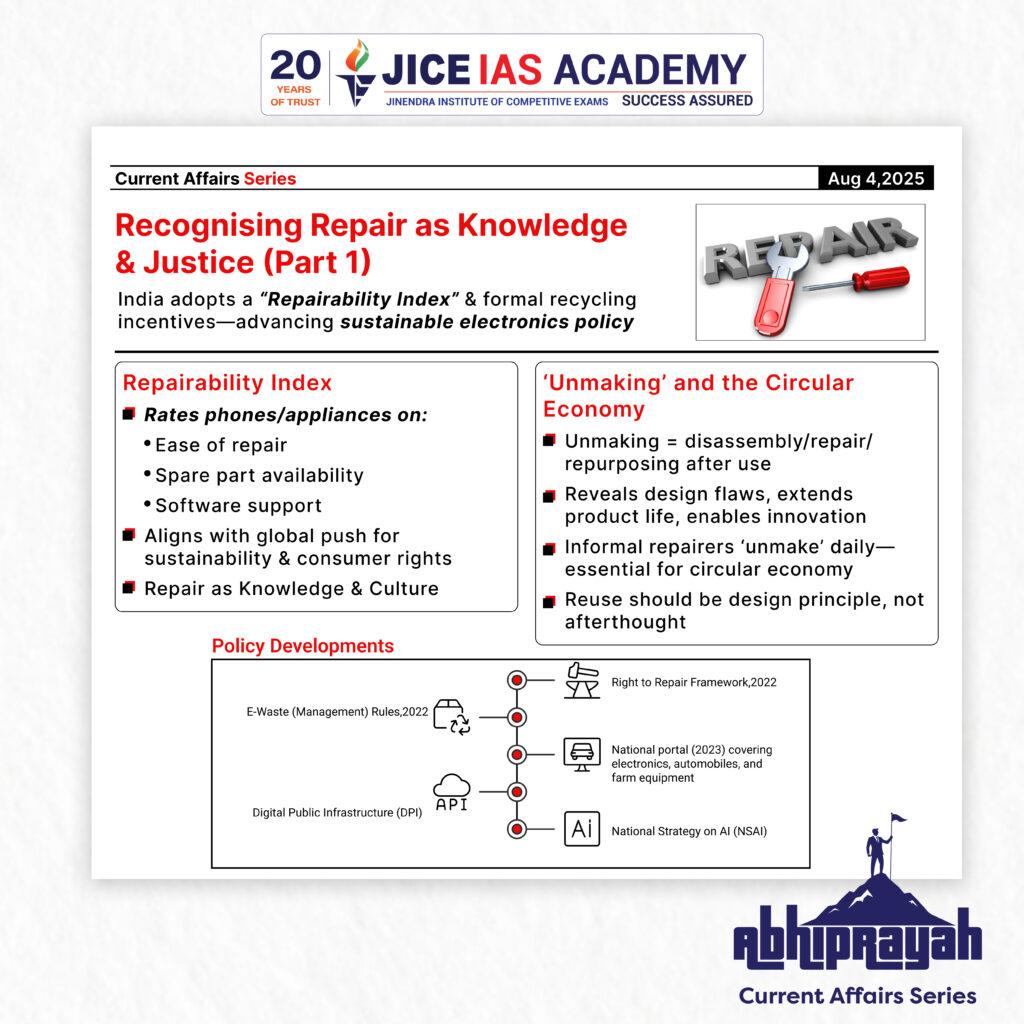
  • In May 2025, the Indian government took a progressive step by accepting a report that proposed a Repairability Index for mobile phones and household appliances.
  • This index evaluates products based on three key criteria:
    • Ease of repair
    • Availability of spare parts
    • Software support duration
  • Additionally, the government introduced new e-waste policies that include minimum incentive payments to promote formal recycling channels.
  • These policy developments reflect a growing alignment with global concerns around electronic waste, sustainability, and consumer rights.

Repair as a Cultural and Intellectual Resource

  • While these policy moves are commendable, the article argues that repair should not be viewed merely as a service or a right, but as a form of knowledge and cultural practice.
  • In India, the informal repair economy—consisting of mobile fixers in Delhi’s Karol Bagh, appliance technicians in Chennai’s Ritchie Street, and others—has historically played a vital role in prolonging the life of devices, often far beyond their planned obsolescence.
  • Repairers work with limited resources, without formal training, and rely heavily on experiential learning and improvisation. Their skills, though undocumented, form an essential part of India’s technological resilience.

Tacit Knowledge and Its Importance

  • Tacit knowledge refers to know-how and intuitive expertise that is learned through observation, repetition, and practice, rather than formal education.
  • For instance, an appliance repairer in Bhopal recalls learning by silently watching his uncle at work, rather than through explicit instruction. This form of knowledge is:
    • Context-specific
    • Adaptive
    • Deeply embodied in experience
  • Modern technologies such as Artificial Intelligence (AI) often benefit indirectly from such human knowledge, especially in diagnostics and decision-making systems.
  • However, the contributors of this tacit knowledge remain unrecognised and excluded from formal systems of reward or participation.
  • This creates an imbalance where AI systems continue to evolve, while the communities enabling them remain invisible and unsupported.

Current Indian Policies: Progress and Gaps

Positive Developments:

  • Right to Repair Framework (2022) and a national portal (2023) covering electronics, automobiles, and farm equipment
  • E-Waste (Management) Rules, 2022, which include Extended Producer Responsibility (EPR)
  • Broader technological initiatives like Digital Public Infrastructure (DPI) and National Strategy on AI (NSAI)

Policy Gaps:

  1. Limited Focus on Repair: The E-Waste Rules emphasise recycling but mention repair only in passing, missing its role as a preventive strategy.
  2. Skilling Mismatch: The Pradhan Mantri Kaushal Vikas Yojana (PMKVY) offers short-term courses aimed at formal industrial jobs. However, informal repair work requires improvisation and contextual problem-solving, which these courses do not accommodate.
  3. Lack of Support in Education Policy: The National Education Policy (NEP) 2020 promotes experiential learning and Indian knowledge systems but offers no concrete support for transmitting hands-on repair knowledge.
  4. Mission LiFE and Implementation Gaps: While the campaign promotes sustainable lifestyles, it lacks a mechanism to support the actual workforce—repairers—who make reuse and repair possible.

The result is a disconnection between policy intentions (circular economy) and policy execution (lack of support for repairers).

The Concept of ‘Unmaking’ and Circular Economy

Concept of “unmaking” — is the process of disassembling, repairing, or repurposing products after their initial use. This process:

  • Reveals design flaws
  • Extends product lifespan
  • Supports reuse and innovation

Unmaking turns repair from an act of maintenance into a form of insight and learning.

  • A discarded phone part can restore communication for someone. A salvaged circuit board can become a teaching aid.
  • Informal repairers practice unmaking daily.
  • Their work supports India’s circular economy, in which reuse is not an afterthought but a design principle. Recognising their role is crucial to sustainable development.

Repair Justice and AI Integration

  • Modern digital devices are increasingly difficult to repair. According to a 2023 report by iFixit, only 23% of smartphones sold in Asia are considered easily repairable.
  • This design bias towards compactness and proprietary systems restricts repair access.

To ensure repair justice, there is need for:

Policy Reforms and Institutional Action:

  • The Ministry of Electronics and Information Technology (MeitY) should include repairability in AI procurement and hardware standards.
  • The Department of Consumer Affairs should expand the Right to Repair framework by involving communities and creating a product classification system based on repairability.
  • The e-Shram portal, under the Ministry of Labour and Employment, should formally recognise informal repair workers and connect them to social protection and benefits.
  • The Ministry of Skill Development and Entrepreneurship should design training programmes tailored to the diagnostic and improvisational nature of repair work, not just formal industrial standards.

Technological Aids:

  • Use decision trees to standardise common repair processes without erasing local knowledge.
  • Deploy Large Language Models (LLMs) to document and translate tacit repair knowledge into structured formats, preserving it for wider learning.

This approach can ensure digital inclusivity and intergenerational knowledge preservation.

Ethical and Societal Implications

The issue of repair justice goes beyond technology and environment. It touches upon:

  • Social equity: Acknowledging marginalised but skilled labour
  • Knowledge preservation: Valuing non-formal, embodied knowledge systems
  • Environmental ethics: Promoting responsible consumption and waste reduction

Supporting the informal repair economy is therefore a step toward building a just, repair-ready technological future. It aligns with both environmental sustainability and social justice.

Introduction

Economic Implications

For Indian Exporters

  • These reforms reduce transaction costs and compliance hurdles
  • Encourage a more competitive and efficient export environment
  • Promote value addition in key sectors like leather

For Tamil Nadu

  • The reforms particularly benefit the state’s leather industry, a major contributor to employment and exports
  • Boost the marketability of GI-tagged E.I. leather, enhancing rural and traditional industries

For Trade Policy

  • These decisions indicate a shift from regulatory controls to policy facilitation

Reinforce the goals of Make in India, Atmanirbhar Bharat, and India’s ambition to become a leading export power

Recently, BVR Subrahmanyam, CEO of NITI Aayog, claimed that India has overtaken Japan to become the fourth-largest economy in the world, citing data from the International Monetary Fund (IMF). 

India’s rank as the world’s largest economy varies by measure—nominal GDP or purchasing power parity (PPP)—each with key implications for economic analysis.

Significance and Applications

Leave a Reply

Your email address will not be published. Required fields are marked *

Call Us Now !

Copyright © JICE ACADEMY FOR EXCELLENCE PRIVATE LIMITED