UPSC CURRENT AFFAIRS – 30th July 2025

Home / UPSC / Current Affairs / Rediscovery of world smallest snake- Barbados Threadsnake

Rediscovery of world smallest snake- Barbados Threadsnake

Why in News?

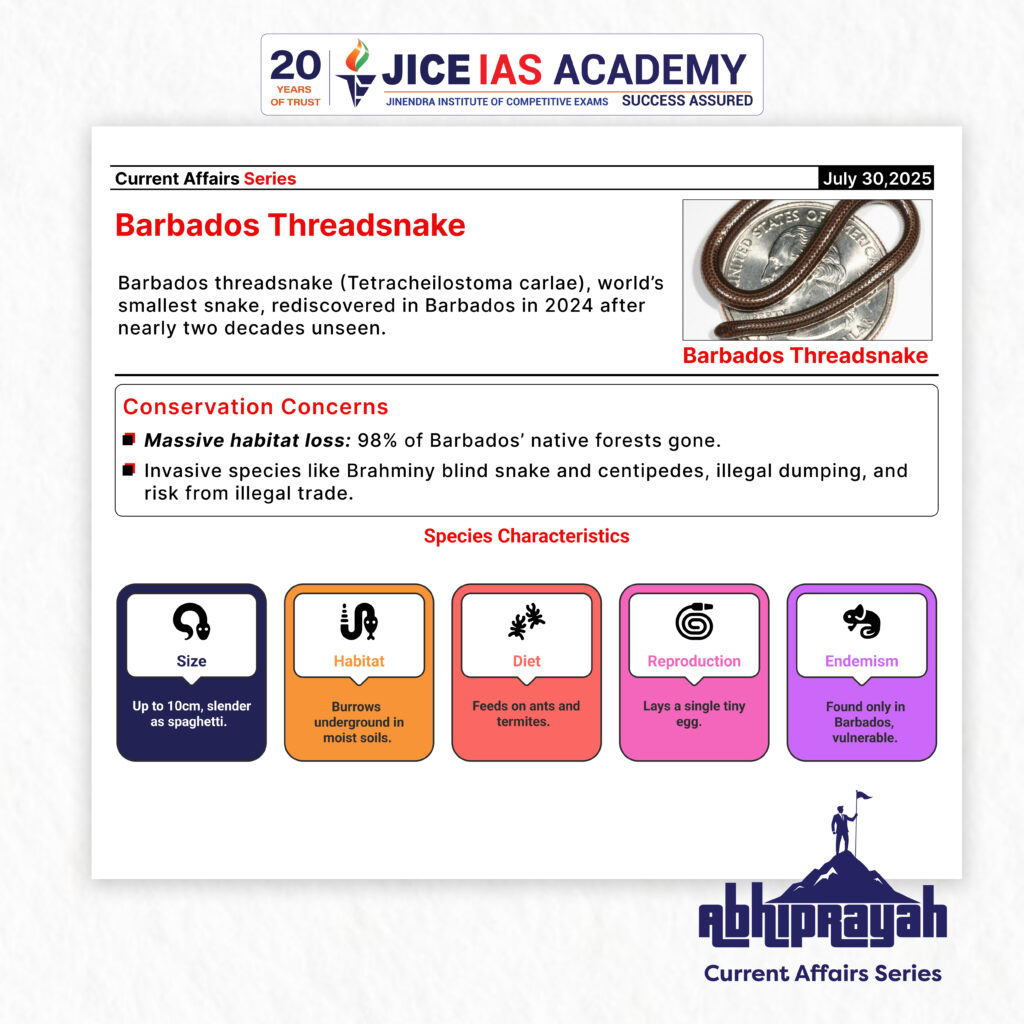
  • The Barbados threadsnake, the world’s smallest-known snake, was rediscovered in 2024 in Barbados after being unspotted for nearly two decades.

Introduction

  • In a remarkable rediscovery that has excited conservationists worldwide, the Barbados threadsnake (Tetracheilostoma carlae) — the world’s smallest-known snake — has been found again in its native habitat in Barbados after being unseen for nearly two decades.
  • The event marks a major victory for conservation biology and highlights the fragile nature of endemic island species.

Background of the Species

  • Scientific Name: Tetracheilostoma carlae
  • Discovered: First identified and formally described in 2008 by S. Blair Hedges, a professor at Temple University.
  • Named after: Carla, the wife of the discoverer.
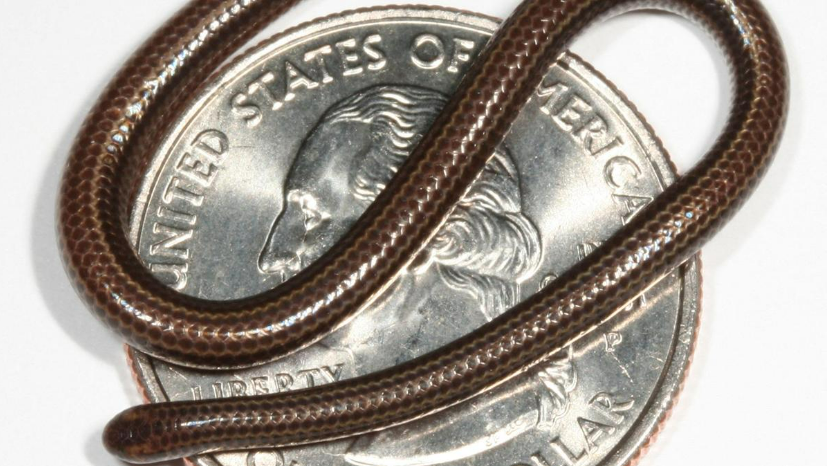
  • Size: Fully grown adults reach only up to 10 cm (4 inches) — small enough to rest on a coin.
  • Habitat: Burrows underground, prefers moist soils with leaf litter.
  • Diet: Feeds on ants and termites.
  • Reproduction: Lays a single slender egg — unusual among snakes.

Scientific and Conservation Significance

  1. Confirmation of Survival
  • The snake was feared extinct, having not been seen in the wild since 2006.
  • It was among 4,800 species listed by Re:wild as “lost to science”.
  1. Species Rarity and Challenges
  • The Barbados threadsnake is blind, cryptic, and extremely elusive.
  • It has been misidentified in the past, including confusion with the Brahminy blind snake (Indotyphlops braminus), a common invasive species.
  1. Ecological Role
  • Plays a role in controlling ant and termite populations.
  • Serves as an indicator species of soil health and forest ecosystem integrity.
  1. Endemism and Habitat Loss
  • Found only in Barbados, making it critically vulnerable to habitat destruction.
  • Barbados has lost most of its original forest cover — among the worst in the Caribbean, second only to Haiti.

Introduction

Economic Implications

For Indian Exporters

  • These reforms reduce transaction costs and compliance hurdles
  • Encourage a more competitive and efficient export environment
  • Promote value addition in key sectors like leather

For Tamil Nadu

  • The reforms particularly benefit the state’s leather industry, a major contributor to employment and exports
  • Boost the marketability of GI-tagged E.I. leather, enhancing rural and traditional industries

For Trade Policy

  • These decisions indicate a shift from regulatory controls to policy facilitation

Reinforce the goals of Make in India, Atmanirbhar Bharat, and India’s ambition to become a leading export power

Recently, BVR Subrahmanyam, CEO of NITI Aayog, claimed that India has overtaken Japan to become the fourth-largest economy in the world, citing data from the International Monetary Fund (IMF). 

India’s rank as the world’s largest economy varies by measure—nominal GDP or purchasing power parity (PPP)—each with key implications for economic analysis.

Significance and Applications

One Response

Leave a Reply

Your email address will not be published. Required fields are marked *

Call Us Now !

Copyright © JICE ACADEMY FOR EXCELLENCE PRIVATE LIMITED