

UPSC CURRENT AFFAIRS – 01st August 2025
Return of the Sacred Piprahwa Buddhist Relics to India (2025)
Why in News?
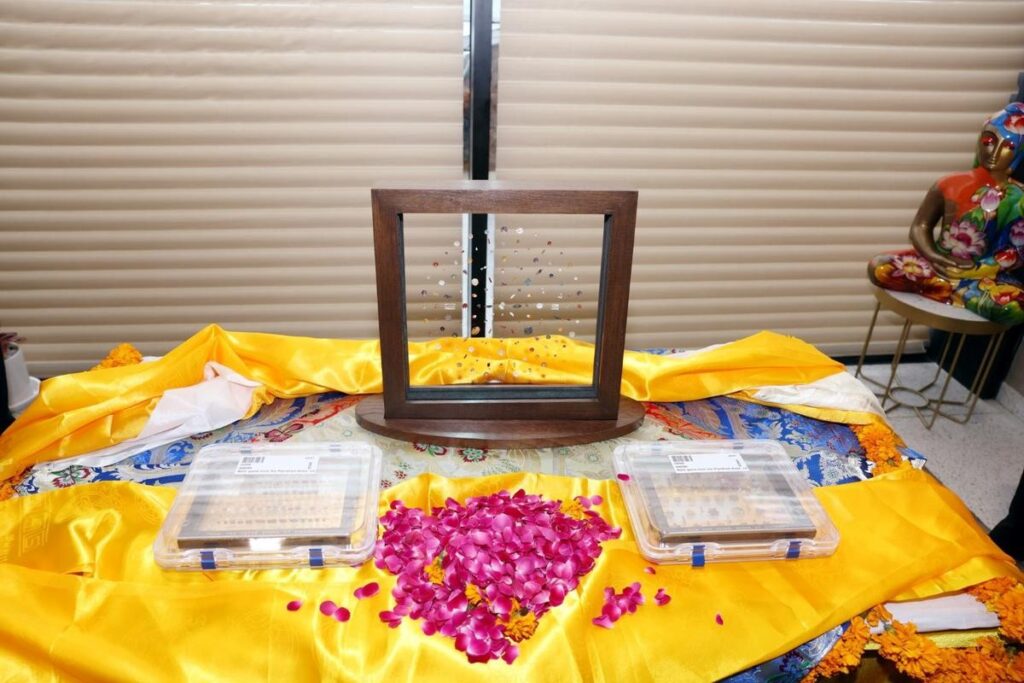
- The sacred Piprahwa Buddhist relics were repatriated to India from Hong Kong through government intervention and public-private partnership.
Overview
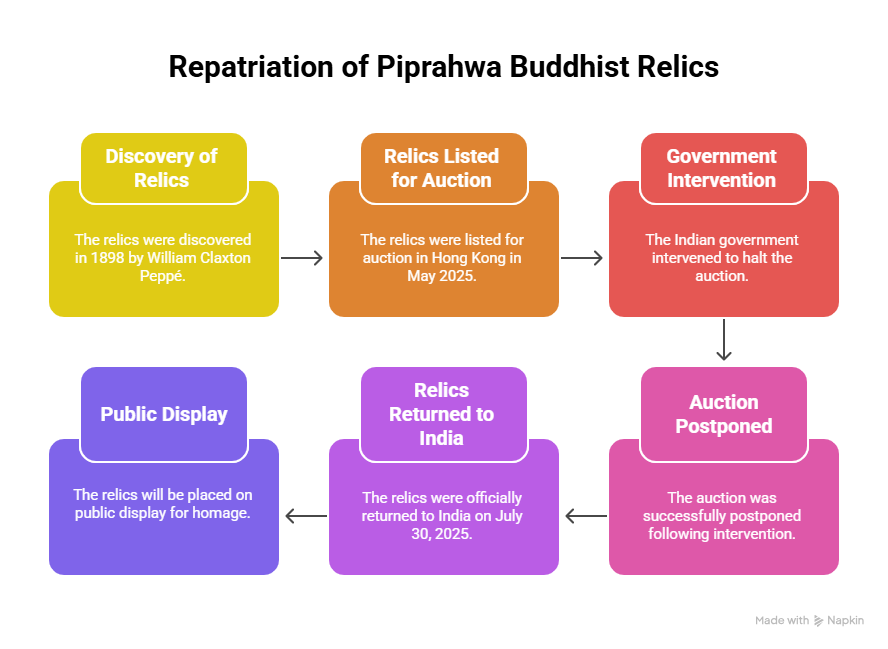
- India witnessed the historic repatriation of a portion of the sacred Piprahwa relics of Lord Buddha, which had been excavated in 1898 in present-day Uttar Pradesh.
- These relics, which were scheduled to be auctioned in Hong Kong in May 2025, were successfully returned following the decisive intervention of the Government of India, in partnership with the private sector.
Historical Background:
- The Piprahwa relics were discovered in 1898 by British civil engineer William Claxton Peppé in Piprahwa, near the Indo-Nepal border.
- Archaeological evidence and an inscription in the Brahmi script confirm these relics to be associated with the Sakya clan, identifying them as the mortal remains of Lord Buddha.
- The relics were originally enshrined by followers of the Buddha around the 3rd century BCE, likely during the Mauryan period.
- Most of these relics were transferred to the Indian Museum in Kolkata in 1899 and classified as “AA” antiquities under Indian law, which prohibits their sale or removal.
Significance of the Repatriation:
- Cultural and Spiritual Importance:
- The relics hold immense spiritual value for Buddhists around the world.
- They are regarded as symbols of peace, compassion, and enlightenment, central tenets of Buddha’s teachings.
- Cultural Diplomacy and Global Heritage:
- The return underscores India’s position as a global guardian of Buddhist heritage.
- Demonstrates the power of cultural diplomacy and collaboration in protecting global heritage.
- Preservation of Antiquities:
- Highlights India’s unwavering commitment to safeguard its ancient and sacred cultural artefacts.
- Reinforces the legal and moral claim of nations over their stolen or displaced heritage items.
- Public Engagement and Awareness:
- The relics will be formally unveiled and placed on public display, enabling Indian citizens and global visitors to pay homage.
Broader Context: India’s Cultural Repatriation Efforts:
- The initiative aligns with the Government of India’s broader mission to reclaim ancient artefacts taken during the colonial era or lost through illicit trade.
- India has successfully brought back over 350 artefacts since 2014 from countries like the USA, Australia, and Canada.
Conclusion:
- The return of the Piprahwa Buddhist relics is not merely a legal or diplomatic victory but a powerful reaffirmation of India’s cultural identity and civilizational pride.
- It represents a key moment in global efforts to restore sacred heritage to its rightful place, and sets a benchmark for public-private cooperation in heritage protection.

3rd UN conference on landlocked countries
UPSC CURRENT AFFAIRS – 08th August 2025 Home / 3rd UN conference on landlocked countries Why in News? At the

Issue of soapstone mining in Uttarakhand’s Bageshwar
UPSC CURRENT AFFAIRS – 08th August 2025 Home / Issue of soapstone mining in Uttarakhand’s Bageshwar Why in News? Unregulated

Groundwater Pollution in India – A Silent Public Health Emergency
UPSC CURRENT AFFAIRS – 08th August 2025 Home / Groundwater Pollution in India – A Silent Public Health Emergency Why

Universal banking- need and impact
UPSC CURRENT AFFAIRS – 08th August 2025 Home / Universal banking- need and impact Why in News? The Reserve Bank

India’s “Goldilocks” Economy: A Critical Appraisal
UPSC CURRENT AFFAIRS – 08th August 2025 Home / India’s “Goldilocks” Economy: A Critical Appraisal Why in News? The Finance

U.S.-India Trade Dispute: Trump’s 50% Tariffs and India’s Oil Imports from Russia
UPSC CURRENT AFFAIRS – 07th August 2025 Home / U.S.-India Trade Dispute: Trump’s 50% Tariffs and India’s Oil Imports from

Eco-Friendly Solution to Teak Pest Crisis: KFRI’s HpNPV Technology
UPSC CURRENT AFFAIRS – 07th August 2025 Home / Eco-Friendly Solution to Teak Pest Crisis: KFRI’s HpNPV Technology Why in

New Species of Non-Venomous Rain Snake Discovered in Mizoram
UPSC CURRENT AFFAIRS – 07th August 2025 Home / New Species of Non-Venomous Rain Snake Discovered in Mizoram Why in

Introduction
Economic Implications
For Indian Exporters
- These reforms reduce transaction costs and compliance hurdles
- Encourage a more competitive and efficient export environment
- Promote value addition in key sectors like leather
For Tamil Nadu
- The reforms particularly benefit the state’s leather industry, a major contributor to employment and exports
- Boost the marketability of GI-tagged E.I. leather, enhancing rural and traditional industries
For Trade Policy
- These decisions indicate a shift from regulatory controls to policy facilitation
Reinforce the goals of Make in India, Atmanirbhar Bharat, and India’s ambition to become a leading export power
Recently, BVR Subrahmanyam, CEO of NITI Aayog, claimed that India has overtaken Japan to become the fourth-largest economy in the world, citing data from the International Monetary Fund (IMF).
India’s rank as the world’s largest economy varies by measure—nominal GDP or purchasing power parity (PPP)—each with key implications for economic analysis.