UPSC CURRENT AFFAIRS – 22nd March 2025
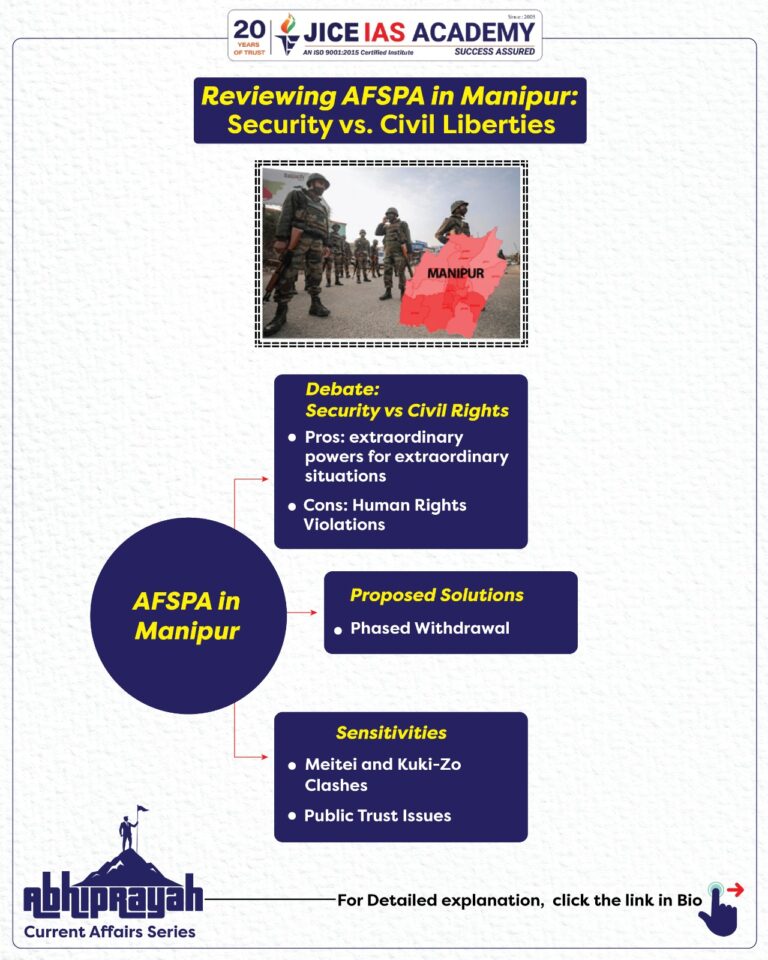
Reviewing AFSPA in Manipur: Security vs. Civil Liberties
Introduction
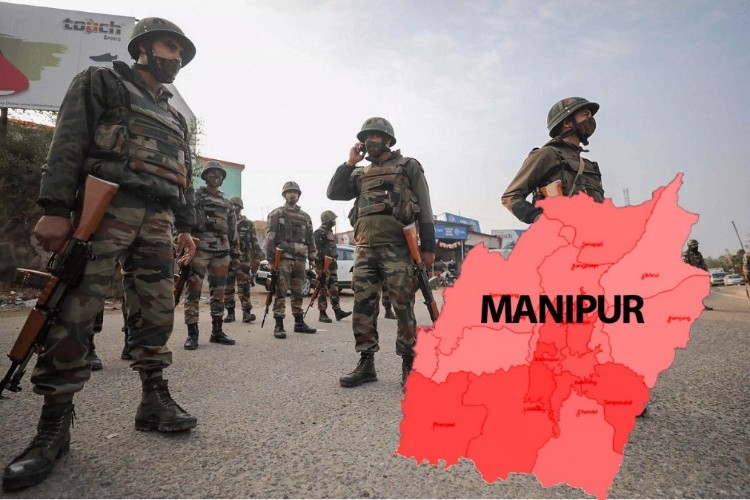
The Armed Forces (Special Powers) Act, 1958 (AFSPA), has long been a contentious law in India’s internal security framework. Originally enacted to empower the armed forces in disturbed areas, it has frequently been criticized for human rights concerns. The recent demand by the Army to reimpose AFSPA in 12 police station limits in Manipur Valley, amid ongoing ethnic unrest, has reignited the debate on balancing operational necessity with democratic rights.
Contextual Background
- Ethnic violence in Manipur erupted on May 3, 2023, between Meitei and Kuki-Zo communities, leading to hundreds of deaths and widespread displacement.
- In response, the AFSPA was reimposed in six police station areas (out of 19) in November 2024.
- President’s Rule was imposed in Manipur on February 13, 2025, due to prolonged instability.
- As of March 20, 2025, the Army has requested AFSPA coverage in 12 more police station areas in valley districts for operational efficiency, to be implemented in phases.
Current Status of AFSPA (March 2025)
|
State |
AFSPA Status |
Notification By |
|
Manipur |
Partial coverage in valley; extended in hills |
State Government |
|
Nagaland |
Continues in certain areas |
Ministry of Home Affairs |
|
Arunachal Pradesh |
Present in select districts |
Ministry of Home Affairs |
|
Assam |
Likely to be withdrawn from 1 district |
State Government |
Why the Army Seeks AFSPA in More Areas
- Operational Efficiency: Legal protection is necessary for operations involving search, seizure, and arrests in volatile areas.
- Intelligence Operations: Movement and presence of insurgents among civilian populations require swift action.
- Deterrence: The Act gives psychological advantage to forces during unstable conditions.
Arguments For AFSPA
- National Security Tool: Helps maintain law and order in insurgency-hit areas.
- Legal Shield for Forces: Necessary to operate in high-risk zones without fear of prosecution.
- Institutional Continuity: Essential during President’s Rule when political vacuum exists.
Arguments Against AFSPA
- Human Rights Violations: Allegations of misuse—extrajudicial killings, rape, arbitrary detention.
- Impunity Clause: No prosecution without Centre’s sanction (Section 6), violates principles of natural justice.
- Alienation of Locals: Deepens mistrust between people and government; affects democratic legitimacy.
Case in Point:
- 2004: Imphal Municipality area was exempted from AFSPA following the custodial killing of Thangjam Manorama, triggering mass protests.
- Supreme Court 2016: Ruled that armed forces cannot use excessive force in the name of AFSPA during peacetime.
Ethnic Dimension and Security Fragility in Manipur
- The ethnic composition of Manipur makes governance and policing complex:
- Meiteis dominate the valley
- Kuki-Zo and Nagas inhabit the hill districts
- The hill-valley divide affects both perception and application of AFSPA, leading to asymmetrical enforcement.
- South Asia Terrorism Portal data (2024): Over 200 violent incidents reported in Manipur post-violence.
The Way Forward
- Phased De-escalation Strategy:
- AFSPA to be used as a temporary measure, with regular review and sunset clauses.
- Enhanced Local Policing:
- Strengthen community policing and civil administration in sensitive areas.
- Human Rights Oversight:
- Independent monitoring of military actions in AFSPA zones.
- Implement recommendations of Justice Jeevan Reddy Committee (2005) and Second ARC to replace AFSPA with a more humane law.
- Political Engagement:
- Peace talks with ethnic groups, rehabilitation of displaced communities, and efforts to restore legislative processes in Manipur.
- Smart Use of Technology:
- Deploy surveillance drones, biometric tracking, and AI for intelligence without over-militarizing regions.
Conclusion
The AFSPA debate in Manipur illustrates the tightrope walk between ensuring national security and upholding democratic rights. While the Army’s concerns over operational efficiency are valid, long-term peace in Manipur and the Northeast can only be achieved through inclusive governance, strong civil institutions, and meaningful reconciliation. The judicious use of AFSPA, subject to checks and balances, is key to a sustainable and democratic resolution of internal conflict.

3rd UN conference on landlocked countries
UPSC CURRENT AFFAIRS – 08th August 2025 Home / 3rd UN conference on landlocked countries Why in News? At the

Issue of soapstone mining in Uttarakhand’s Bageshwar
UPSC CURRENT AFFAIRS – 08th August 2025 Home / Issue of soapstone mining in Uttarakhand’s Bageshwar Why in News? Unregulated
Groundwater Pollution in India – A Silent Public Health Emergency
UPSC CURRENT AFFAIRS – 08th August 2025 Home / Groundwater Pollution in India – A Silent Public Health Emergency Why

Universal banking- need and impact
UPSC CURRENT AFFAIRS – 08th August 2025 Home / Universal banking- need and impact Why in News? The Reserve Bank
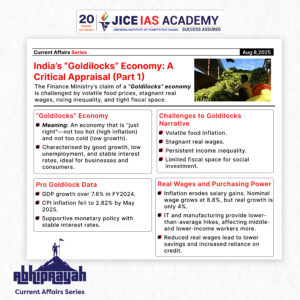
India’s “Goldilocks” Economy: A Critical Appraisal
UPSC CURRENT AFFAIRS – 08th August 2025 Home / India’s “Goldilocks” Economy: A Critical Appraisal Why in News? The Finance

U.S.-India Trade Dispute: Trump’s 50% Tariffs and India’s Oil Imports from Russia
UPSC CURRENT AFFAIRS – 07th August 2025 Home / U.S.-India Trade Dispute: Trump’s 50% Tariffs and India’s Oil Imports from
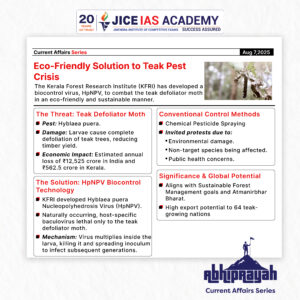
Eco-Friendly Solution to Teak Pest Crisis: KFRI’s HpNPV Technology
UPSC CURRENT AFFAIRS – 07th August 2025 Home / Eco-Friendly Solution to Teak Pest Crisis: KFRI’s HpNPV Technology Why in

New Species of Non-Venomous Rain Snake Discovered in Mizoram
UPSC CURRENT AFFAIRS – 07th August 2025 Home / New Species of Non-Venomous Rain Snake Discovered in Mizoram Why in