
UPSC CURRENT AFFAIRS – 10th July 2025

Home / UPSC / Current Affairs / Towards Redefining the SI Second: The Rise of Optical Atomic Clocks

Towards Redefining the SI Second: The Rise of Optical Atomic Clocks

Why in News?

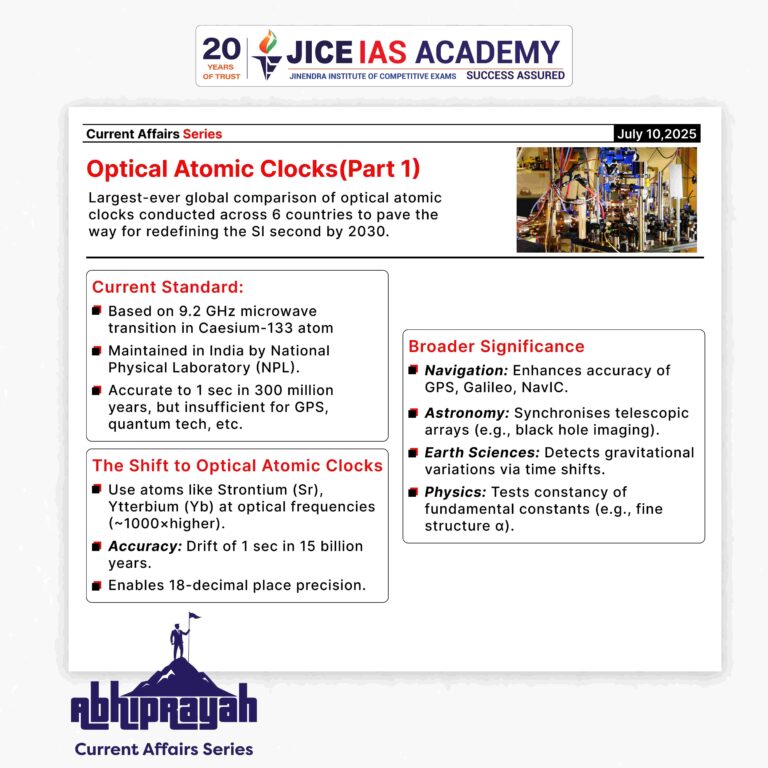
Scientists across six countries conducted the largest international comparison of optical atomic clocks to validate their precision before redefining the SI second.

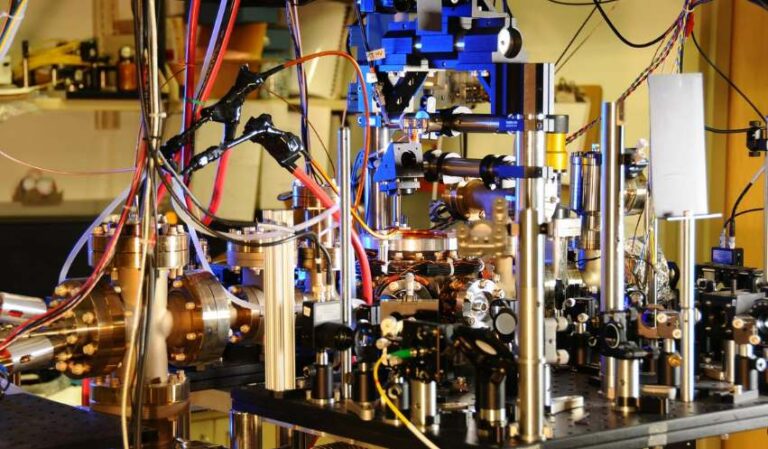
intricate scientific equipment in a lab setting

Introduction

  • Time is a fundamental parameter in both daily life and scientific research. The global standard for time—the SI unit of the second—is currently based on the microwave frequency emitted by caesium-133 atoms. 
  • However, with technological advances demanding more precision, the scientific community is preparing to redefine the second using optical atomic clocks, which are expected to become the new global time standard by 2030.
  • In a landmark development, 65 researchers across six national metrology institutes spanning three continents have completed the largest head-to-head test of atomic clocks in history, validating the extraordinary precision of optical clocks and identifying areas for further improvement.

The Existing Standard: Caesium Atomic Clocks

  • Since 1967, the SI second has been defined as:

“The duration of 9,192,631,770 periods of radiation corresponding to the transition between the two hyperfine levels of the ground state of the caesium-133 atom.”

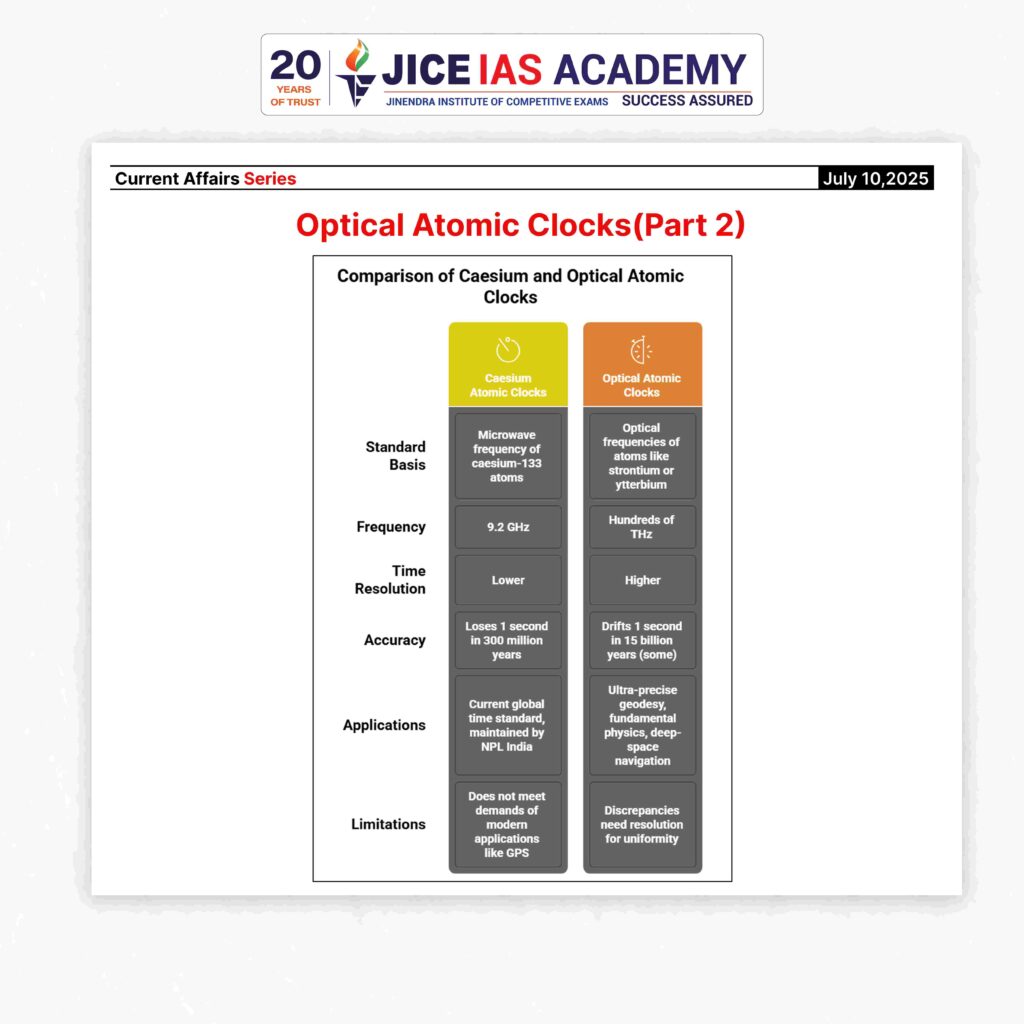
  • These caesium (Cs) atomic clocks generate a microwave signal at 9.2 GHz, and electronics use this to define one second.
  • India’s national time standard is maintained by five Cs atomic clocks at the National Physical Laboratory (NPL), New Delhi. The output is disseminated via INSAT satellites, telecommunication networks, and fibre links.

Limitations:

  • Although highly accurate (losing 1 second in 300 million years), Cs clocks do not meet the demands of modern applications such as GPS, radio astronomy, climate science, and quantum technologies.
comparison of caesium and optical atomic clocks

The Future Standard: Optical Atomic Clocks

  • Optical clocks use atoms like strontium (Sr) or ytterbium (Yb), which emit radiation at optical frequencies (hundreds of THz), i.e., about 10,000 times higher than microwave frequencies.
  • Because frequency is the inverse of time, higher frequencies allow finer time resolution, thus making optical clocks far more stable.

Key Advantages:

  • Measure time to 18 decimal places.
  • Some have been shown to drift only 1 second in 15 billion years.
  • Enable ultra-precise geodesy, fundamental physics tests, and deep-space navigation.

Broader Significance and Applications

  1. Navigation & Space
    • Satellite systems (GPS, Galileo, GLONASS, NavIC) require precise clocks for accurate positioning.
  1. Astronomy
    • Interferometric imaging (e.g., black hole imaging) depends on synchronization of signals over vast distances.
  1. Earth Sciences
    • Time variations help detect subtle gravitational field changes, aiding in water and ice mass monitoring.
  1. Fundamental Physics
    • Clocks test constancy of physical constants like the fine structure constant (α), aiding quantum gravity research.

Conclusion

  • The 2022 multi-national clock comparison project has marked a major step toward redefining the SI second using optical atomic clocks
  • By demonstrating that clocks using different atomic species and spread across three continents can agree to an unprecedented precision (up to 10⁻¹⁸), scientists have not only validated the feasibility of the new time standard but also laid the groundwork for global time synchronisation in the 21st century.
  • As we approach 2030, resolving the minor discrepancies highlighted in this test and building international consensus will be critical to ushering in a new era of timekeeping—one more suited to the needs of science, technology, and society.

Economic Implications

For Indian Exporters

  • These reforms reduce transaction costs and compliance hurdles
  • Encourage a more competitive and efficient export environment
  • Promote value addition in key sectors like leather

For Tamil Nadu

  • The reforms particularly benefit the state’s leather industry, a major contributor to employment and exports
  • Boost the marketability of GI-tagged E.I. leather, enhancing rural and traditional industries

For Trade Policy

  • These decisions indicate a shift from regulatory controls to policy facilitation

Reinforce the goals of Make in India, Atmanirbhar Bharat, and India’s ambition to become a leading export power

Recently, BVR Subrahmanyam, CEO of NITI Aayog, claimed that India has overtaken Japan to become the fourth-largest economy in the world, citing data from the International Monetary Fund (IMF). 

India’s rank as the world’s largest economy varies by measure—nominal GDP or purchasing power parity (PPP)—each with key implications for economic analysis.

Significance and Applications

Leave a Reply

Your email address will not be published. Required fields are marked *

Call Us Now !

Copyright © JICE ACADEMY FOR EXCELLENCE PRIVATE LIMITED