
UPSC CURRENT AFFAIRS – 29th June 2025
Secondary Pollutants: Major Contributor to India’s PM2.5 Pollution
Why in News?
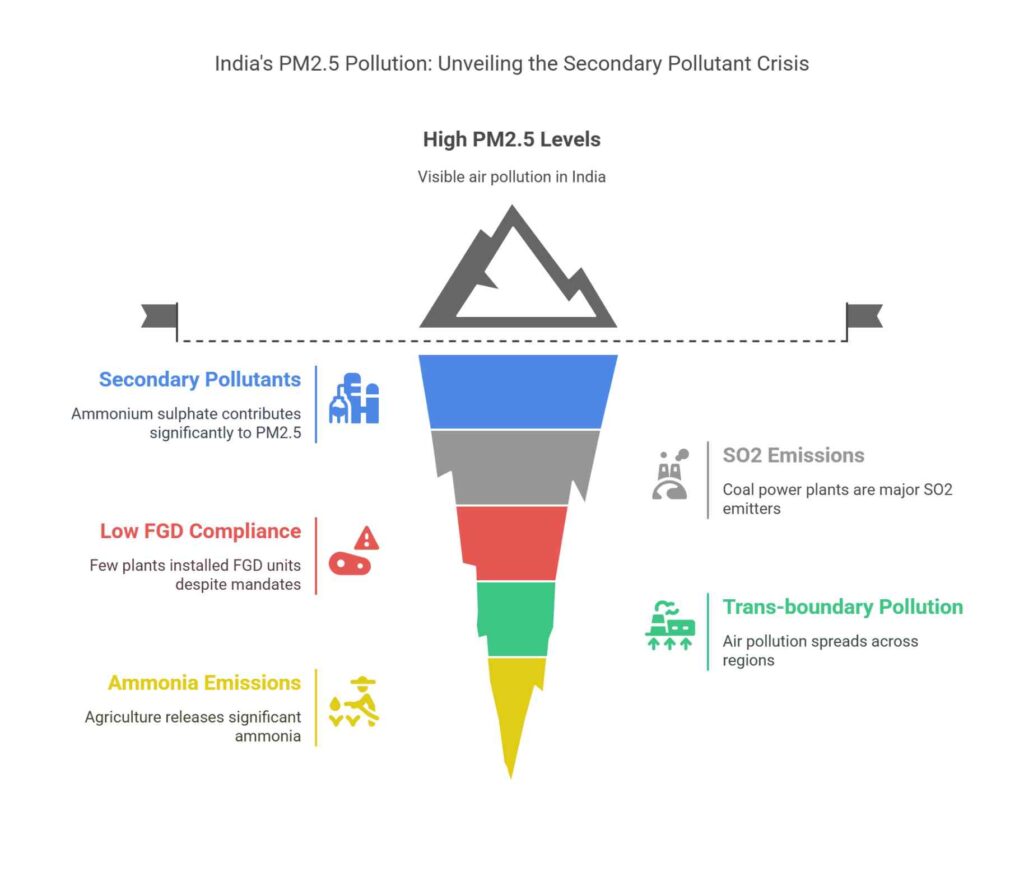
- A new study by the Centre for Research on Energy and Clean Air (CREA) reveals that secondary pollutants, especially ammonium sulphate, account for nearly one-third of India’s fine particulate matter (PM2.5) pollution. This insight comes from combined satellite data analysis and modelling, highlighting the need for targeted emission control beyond primary sources.
Key Highlights of the Study
- Scale of the Problem:
Nationwide average concentration of ammonium sulphate is estimated at 11.9 μg/m³, contributing around 34% of India’s total PM2.5 levels. - Primary Sources:
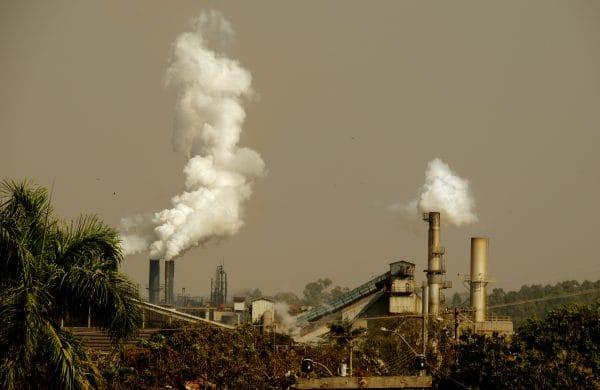
Over 60% of India’s sulphur dioxide (SO₂) emissions — the main precursor of ammonium sulphate — originate from coal-fired thermal power plants. - Regional Spread:
The study found that ammonium sulphate concentrations are highest near coal power plants — 2.5 times higher within 10 km of the plants. However, significant levels are also observed in cities far from major point sources, due to the trans-boundary nature of air pollution. - National Clean Air Programme (NCAP) Cities:
In 114 out of 130 NCAP cities, ammonium sulphate made up more than 30% of total PM2.5 levels, indicating its widespread impact across urban India. - Low Compliance with Pollution Norms:
While India’s coal plants are mandated to install flue-gas desulphurisation (FGD) units to curb SO₂ emissions, only about 8% have done so. Moreover, there are proposals to dilute these mandatory requirements, undermining clean air targets.
Explaining the Concept: Primary vs Secondary Pollutants
- Primary Pollutants:
Directly emitted from sources like vehicle exhaust, industrial emissions, and burning of fossil fuels. Examples: SO₂, NOₓ, carbon monoxide, and particulate matter. - Secondary Pollutants:
Formed when primary pollutants chemically react in the atmosphere with gases, sunlight, or water vapour. In this case, SO₂ reacts with ammonia (NH₃) to form ammonium sulphate — a major component of fine particulate matter (PM2.5).
Organisations, Policies, and Legal Framework
- Centre for Research on Energy and Clean Air (CREA):
An independent research body providing air quality data and policy suggestions. - National Clean Air Programme (NCAP):
Launched in 2019 by the Ministry of Environment, Forest and Climate Change (MoEFCC) to reduce PM2.5 and PM10 concentrations by 20–30% by 2024–25 compared to 2017 levels in 130 non-attainment cities. - Emission Standards:
As per MoEFCC notifications, coal-based thermal power plants are legally required to implement FGD technology to control SO₂ emissions under the Environment (Protection) Act, 1986.
Challenges Identified
- Low Compliance:
Weak enforcement of emission standards for thermal power plants; poor installation of FGD units despite legal mandates. - Sectoral Gaps:
Secondary pollutants like ammonium sulphate are less visible than direct emissions, making them harder to tackle through conventional policies. - Trans-Boundary Nature:
Pollutants travel beyond administrative boundaries, complicating local-level air quality management. - Ammonia Emissions:
Agriculture, especially fertiliser use, releases significant ammonia, but policies to manage this source remain underdeveloped.
India Impact and Relevance
- Health Impact:
High levels of PM2.5 aggravate respiratory illnesses, cardiovascular diseases, and premature deaths. Tackling secondary pollutants is vital for improving public health outcomes in urban and peri-urban regions. - Policy Relevance:
Strengthening NCAP implementation, enforcing sector-specific emission norms, and promoting pollution control technologies (like FGD) are essential for meeting India’s clean air targets. - Agriculture and Industry Link:
Better fertilizer management to reduce ammonia emissions and stricter monitoring of industrial SO₂ emissions are needed to reduce secondary PM burden.
Way Forward
- Implement flue-gas desulphurisation (FGD) in all coal-fired thermal power plants without further delay.
- Enforce compliance with existing emission standards under the Environment (Protection) Act.
- Develop and implement ammonia management strategies in agriculture to tackle ammonia emissions at source.
- Strengthen trans-boundary and inter-state coordination under NCAP for better regional air quality management.
- Invest in continuous air quality monitoring and satellite-based data integration for better tracking of secondary pollutants.

3rd UN conference on landlocked countries
UPSC CURRENT AFFAIRS – 08th August 2025 Home / 3rd UN conference on landlocked countries Why in News? At the

Issue of soapstone mining in Uttarakhand’s Bageshwar
UPSC CURRENT AFFAIRS – 08th August 2025 Home / Issue of soapstone mining in Uttarakhand’s Bageshwar Why in News? Unregulated
Groundwater Pollution in India – A Silent Public Health Emergency
UPSC CURRENT AFFAIRS – 08th August 2025 Home / Groundwater Pollution in India – A Silent Public Health Emergency Why

Universal banking- need and impact
UPSC CURRENT AFFAIRS – 08th August 2025 Home / Universal banking- need and impact Why in News? The Reserve Bank

India’s “Goldilocks” Economy: A Critical Appraisal
UPSC CURRENT AFFAIRS – 08th August 2025 Home / India’s “Goldilocks” Economy: A Critical Appraisal Why in News? The Finance

U.S.-India Trade Dispute: Trump’s 50% Tariffs and India’s Oil Imports from Russia
UPSC CURRENT AFFAIRS – 07th August 2025 Home / U.S.-India Trade Dispute: Trump’s 50% Tariffs and India’s Oil Imports from

Eco-Friendly Solution to Teak Pest Crisis: KFRI’s HpNPV Technology
UPSC CURRENT AFFAIRS – 07th August 2025 Home / Eco-Friendly Solution to Teak Pest Crisis: KFRI’s HpNPV Technology Why in

New Species of Non-Venomous Rain Snake Discovered in Mizoram
UPSC CURRENT AFFAIRS – 07th August 2025 Home / New Species of Non-Venomous Rain Snake Discovered in Mizoram Why in

Economic Implications
For Indian Exporters
- These reforms reduce transaction costs and compliance hurdles
- Encourage a more competitive and efficient export environment
- Promote value addition in key sectors like leather
For Tamil Nadu
- The reforms particularly benefit the state’s leather industry, a major contributor to employment and exports
- Boost the marketability of GI-tagged E.I. leather, enhancing rural and traditional industries
For Trade Policy
- These decisions indicate a shift from regulatory controls to policy facilitation
Reinforce the goals of Make in India, Atmanirbhar Bharat, and India’s ambition to become a leading export power
Recently, BVR Subrahmanyam, CEO of NITI Aayog, claimed that India has overtaken Japan to become the fourth-largest economy in the world, citing data from the International Monetary Fund (IMF).
India’s rank as the world’s largest economy varies by measure—nominal GDP or purchasing power parity (PPP)—each with key implications for economic analysis.