UPSC CURRENT AFFAIRS – 13th July 2025

Home / UPSC / Current Affairs / Sharavathi Valley Hydel Project endangers Lion-Tailed Macaque Sanctuary

Sharavathi Valley Hydel Project endangers Lion-Tailed Macaque Sanctuary

Why in News?

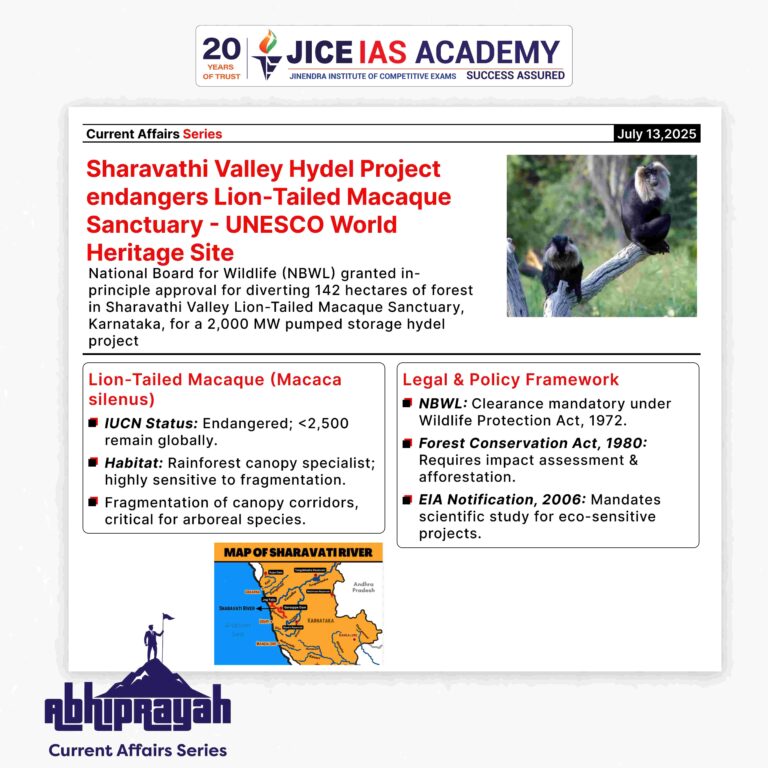
  • The Standing Committee of the National Board for Wildlife (NBWL) has granted in-principle approval for the diversion of 142 hectares of forest land inside Karnataka’s Sharavathi Valley Lion-Tailed Macaque Wildlife Sanctuary for a 2,000 MW pumped storage hydropower project.
  • The sanctuary is a UNESCO World Heritage-tagged site within the Western Ghats, hosting the largest wild population of the endangered lion-tailed macaque — about 700 individuals.
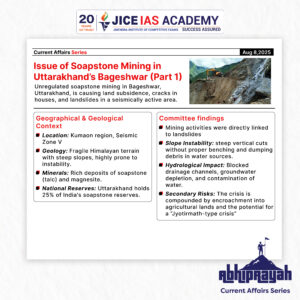
  • The proposal includes felling nearly 15,000 trees, sparking concerns about its ecological and economic viability.
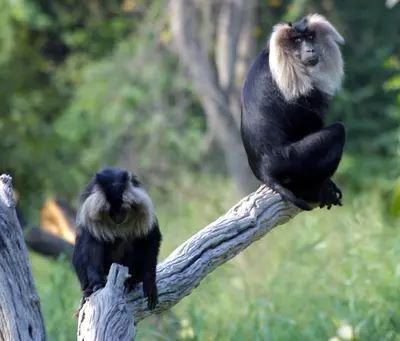
two black macaques

Ecological & Conservation Context

  • Lion-Tailed Macaque (Macaca silenus):
    • IUCN Red List: Endangered; fewer than 2,500 remain in the wild.
    • Restricted to the rainforests of the Western Ghats; extremely habitat-sensitive and canopy-dependent.
  • The Sharavathi Valley Wildlife Sanctuary is part of the Western Ghats Biodiversity Hotspot, designated as a UNESCO World Heritage Site for its exceptional biodiversity and endemic species.
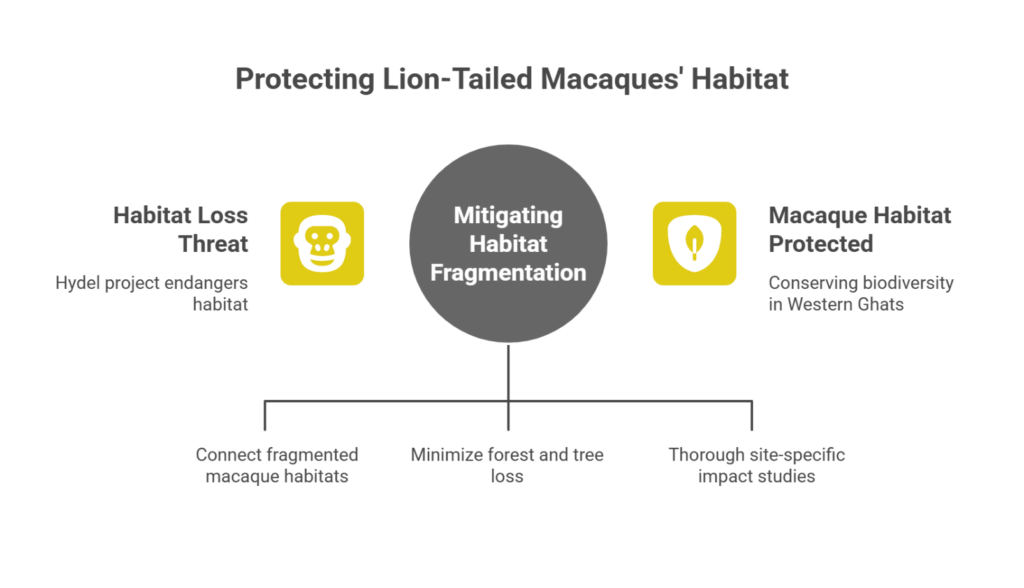
  • The proposed project involves existing reservoirs — Talakalale (upper) and Gerusoppa (lower) — with underground pipes and road construction, but tree felling and road-building could fragment critical canopy corridors for the macaques.

Relevant Concepts & Energy Implications

  • Pumped Storage Hydropower (PSH):
    • Works like a giant battery: excess renewable power (e.g., solar) is used to pump water uphill during off-peak hours; the stored water is released downhill to generate electricity during peak demand.
    • It involves energy losses and raises questions about net economic viability, especially when large forests are impacted.
  • India’s National Energy Storage Policy envisions PSH as a key grid balancing solution, but projects must meet strict environmental and wildlife clearance norms under the Wildlife (Protection) Act, 1972 and Forest (Conservation) Act, 1980.
protecting lion-tailed macaques' habitat

Legal & Policy Framework

  • National Board for Wildlife (NBWL): Statutory body under the Wildlife (Protection) Act, 1972. Its Standing Committee reviews diversion proposals affecting protected areas and eco-sensitive zones.
  • Forest (Conservation) Act, 1980 (Van Adhiniyam): Governs diversion of forest land for non-forest use; requires site inspection, impact assessment, and compensatory afforestation plans.
  • Environment Impact Assessment (EIA): Mandated under the Environment (Protection) Act, 1986, for large infrastructure projects.
  • Mitigation Measures Proposed:
    • Underground pipes instead of open canals.
    • Canopy bridges to reduce habitat fragmentation for arboreal species like lion-tailed macaques.
    • Concurrent wildlife, forest, and environmental clearances must be obtained before final approval.

Concerns Raised

  • NBWL Members & Experts:
    • Ecological risks include canopy loss, disturbance of sensitive species, and cumulative impacts in a biodiversity hotspot.
    • Economic concerns about the viability of pumped storage with inherent energy losses.
  • Wildlife Institute of India: Highlighted the UNESCO heritage status and called for thorough site-specific impact studies.
  • Local Stakeholders & Conservationists: Stress the risk to the largest contiguous habitat of lion-tailed macaques — a flagship species for Western Ghats conservation.

Significance

  • The Sharavathi Valley hydel project highlights the conflict between renewable energy expansion and biodiversity conservation, especially within protected areas.
  • It reinforces the need for rigorous, science-based Environmental Impact Assessments (EIAs), cumulative impact studies, and genuine local stakeholder consultation before final clearance.
  • The case demonstrates how India’s constitutional duty (Article 48A) and international obligations (Convention on Biological Diversity, UNESCO WHC) demand balancing development and ecological sustainability, particularly in fragile ecosystems like the Western Ghats.

Economic Implications

For Indian Exporters

  • These reforms reduce transaction costs and compliance hurdles
  • Encourage a more competitive and efficient export environment
  • Promote value addition in key sectors like leather

For Tamil Nadu

  • The reforms particularly benefit the state’s leather industry, a major contributor to employment and exports
  • Boost the marketability of GI-tagged E.I. leather, enhancing rural and traditional industries

For Trade Policy

  • These decisions indicate a shift from regulatory controls to policy facilitation

Reinforce the goals of Make in India, Atmanirbhar Bharat, and India’s ambition to become a leading export power

Recently, BVR Subrahmanyam, CEO of NITI Aayog, claimed that India has overtaken Japan to become the fourth-largest economy in the world, citing data from the International Monetary Fund (IMF). 

India’s rank as the world’s largest economy varies by measure—nominal GDP or purchasing power parity (PPP)—each with key implications for economic analysis.

Significance and Applications

Leave a Reply

Your email address will not be published. Required fields are marked *

Call Us Now !

Copyright © JICE ACADEMY FOR EXCELLENCE PRIVATE LIMITED