UPSC CURRENT AFFAIRS – 17th May 2025
State Legislatures Meet for Fewer than 30 Days a Year – PRS Report 2024
Why in News?
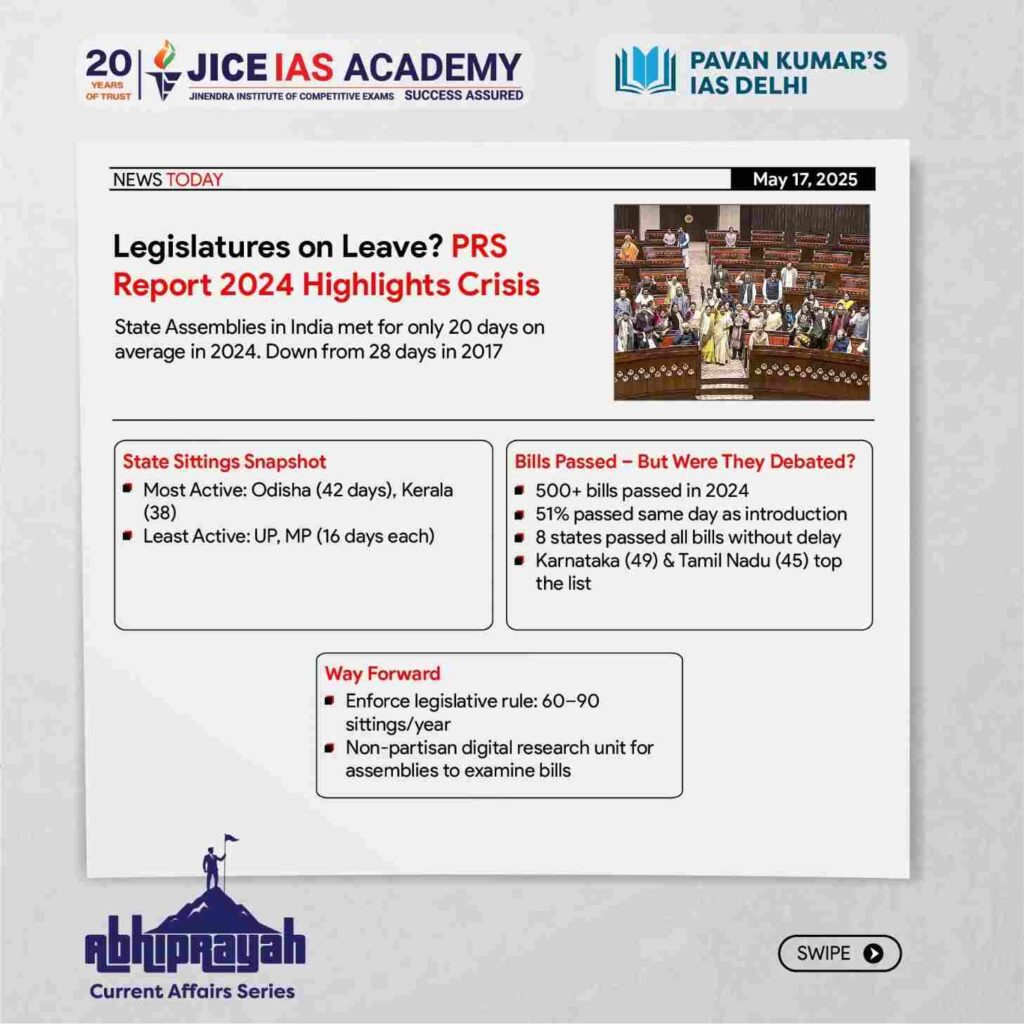
The PRS Annual Review of State Laws 2024 reveals that State Legislative Assemblies in India met for only 20 days on average in 2024, far below recommended norms. The report also flags vacancies in Deputy Speaker posts, low scrutiny of legislation, and a growing trend of passing bills without debate—highlighting critical issues in legislative accountability and functioning at the state level.
Key Findings from the PRS Report (2024):
- Average sittings per year:
- 2024: 20 days
- Pre-pandemic (2017): 28 days
- 2020 (COVID impact): 16 days
- States with highest sittings in 2024:
- Odisha (42 days), Kerala (38 days)
- Uttar Pradesh, Madhya Pradesh: Only 16 days each
- Deputy Speaker Vacancies:
- 8 state assemblies, including Jharkhand, have no Deputy Speaker
- Jharkhand has not elected one for over 20 years
- Bills Passed in 2024:
- Over 500 bills were passed
- 51% were passed on the same day as introduction
- 8 states passed all bills without any deliberation delay
- Karnataka (49 bills) and Tamil Nadu (45 bills) passed the most
- Nature of Legislation:
- Majority relate to education, finance, and local governance
- Significant laws include:
- Uttarakhand UCC, West Bengal Aparajita Act, Haryana’s Coaching Regulation Act, Assam’s Magical Healing Ban
Constitutional and Legislative Framework:
🔹 Article 178 – Speaker and Deputy Speaker of the State Assembly:
The Legislative Assembly shall, as soon as may be, choose two members to be Speaker and Deputy Speaker respectively.
🔹 Legislative Accountability Mechanisms:
- Rules of Procedure in several states set minimum sitting days (usually ~50–60), but these are routinely violated.
- Bills passed without committee scrutiny or public consultation hinder deliberative democracy.
Challenges:
- State legislatures are failing to meet even minimum standards of deliberation, as most assemblies function for less than 30 days a year.
- The rising trend of passing bills on the same day of introduction undermines legislative scrutiny and democratic debate.
- Prolonged vacancies in key constitutional positions like the Deputy Speaker violate Article 178 and weaken institutional checks within assemblies.
- There is limited capacity for research, legislative drafting, and legal vetting at the state level, reducing the quality of enacted laws.
- Public participation in lawmaking remains negligible due to the absence of mandatory pre-legislative consultation processes at the state level.
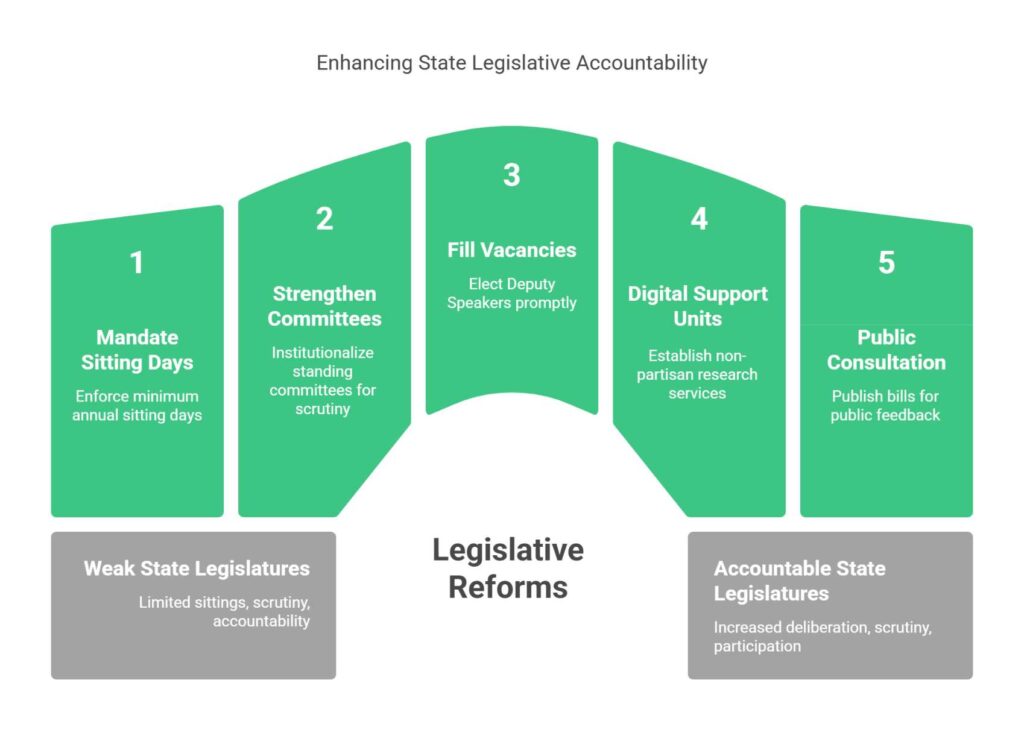
Way Forward:
- Mandate Minimum Sitting Days
- Enforce norms similar to the National Commission to Review the Working of the Constitution (NCRWC) recommendation: 60 days/year for small states, 90 days/year for larger ones.
- Strengthen Legislative Committees
- Institutionalize Department-Related Standing Committees (DRSCs) in all states for effective bill scrutiny.
- Fill Key Constitutional Vacancies
- Ensure mandatory election of Deputy Speakers within 6 months as per convention and judicial interpretation.
- Digital Legislative Support Units
- Set up non-partisan research services (like PRS) in every assembly to assist MLAs in examining bills and budgets.
- Pre-legislative Consultation Mechanism
- Make it compulsory for bills to be published in the public domain with a feedback period before tabling in the House.
Conclusion:
State legislatures form the bedrock of India’s federal democratic structure, yet their declining deliberative role and procedural lapses point to a growing democratic deficit. To restore public trust and uphold constitutional norms, it is imperative to revitalize state legislative processes through institutional reforms, transparency, and regular functioning. Without it, India’s legislative federalism risks becoming increasingly symbolic.

3rd UN conference on landlocked countries
UPSC CURRENT AFFAIRS – 08th August 2025 Home / 3rd UN conference on landlocked countries Why in News? At the
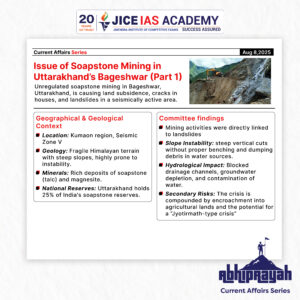
Issue of soapstone mining in Uttarakhand’s Bageshwar
UPSC CURRENT AFFAIRS – 08th August 2025 Home / Issue of soapstone mining in Uttarakhand’s Bageshwar Why in News? Unregulated
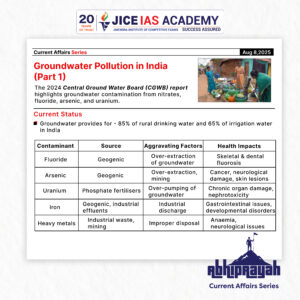
Groundwater Pollution in India – A Silent Public Health Emergency
UPSC CURRENT AFFAIRS – 08th August 2025 Home / Groundwater Pollution in India – A Silent Public Health Emergency Why
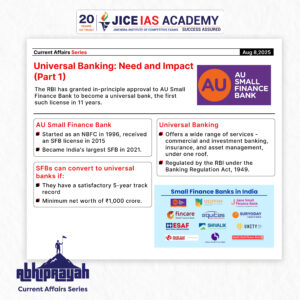
Universal banking- need and impact
UPSC CURRENT AFFAIRS – 08th August 2025 Home / Universal banking- need and impact Why in News? The Reserve Bank

India’s “Goldilocks” Economy: A Critical Appraisal
UPSC CURRENT AFFAIRS – 08th August 2025 Home / India’s “Goldilocks” Economy: A Critical Appraisal Why in News? The Finance

U.S.-India Trade Dispute: Trump’s 50% Tariffs and India’s Oil Imports from Russia
UPSC CURRENT AFFAIRS – 07th August 2025 Home / U.S.-India Trade Dispute: Trump’s 50% Tariffs and India’s Oil Imports from
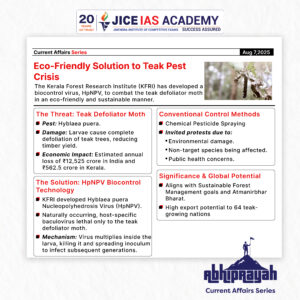
Eco-Friendly Solution to Teak Pest Crisis: KFRI’s HpNPV Technology
UPSC CURRENT AFFAIRS – 07th August 2025 Home / Eco-Friendly Solution to Teak Pest Crisis: KFRI’s HpNPV Technology Why in

New Species of Non-Venomous Rain Snake Discovered in Mizoram
UPSC CURRENT AFFAIRS – 07th August 2025 Home / New Species of Non-Venomous Rain Snake Discovered in Mizoram Why in