UPSC CURRENT AFFAIRS – 01st August 2025
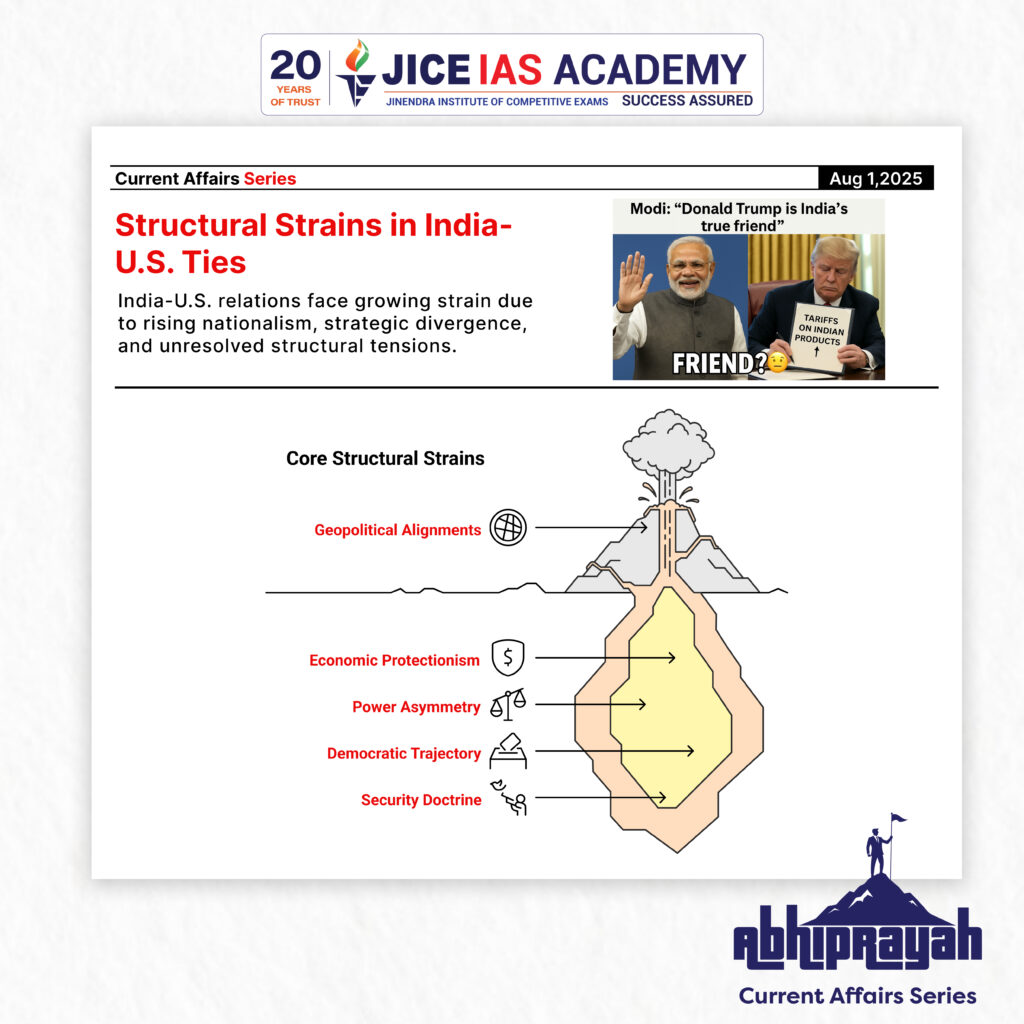
Structural Strains in India-U.S. Ties Amid Rising Nationalism
Why in News?
- India-U.S. relations are now facing strain due to rising nationalism, strategic divergence, and unresolved structural tensions.
Introduction
- India-U.S. relations have long been projected as a “definitive partnership of the 21st century”.
- The partnership has been marked by growing convergence on strategic, economic, and democratic values.
- However, recent tensions suggest that beneath the celebratory rhetoric, deeper structural fissures are becoming visible.
- These strains have been exacerbated by the rise of nationalist leadership in both countries.
- They also stem from enduring differences in strategic culture, geopolitical priorities, and economic expectations.
Historical Context
- The relationship between India and the United States has evolved significantly since the Cold War era.
- During the bipolar world order, the two countries viewed each other with mutual suspicion.
- The ties shifted toward strategic partnership after the 1998 nuclear tests and especially after the 2005 civil nuclear agreement.
- Cooperation expanded across several domains such as defence, trade, energy, science and technology, and people-to-people linkages.
- Successive U.S. administrations viewed India as a potential counterbalance to China.
- India was also seen as a responsible democratic partner in the Indo-Pacific region.
Present Challenges:
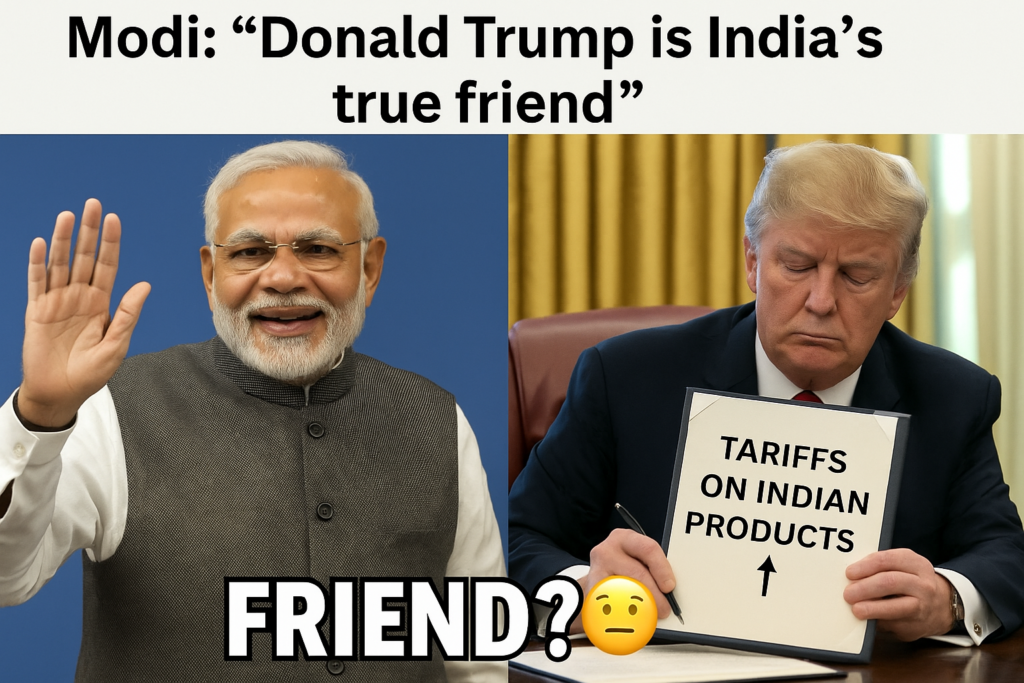
- President Trump’s volatile and transactional style aggravated certain bilateral tensions.
- However, the emerging rift is rooted in broader structural divergences.
- These divergences include conflicting national priorities, differing approaches to strategic partnerships, and mutual economic protectionism.
Rise of Nationalism and Policy Assertiveness
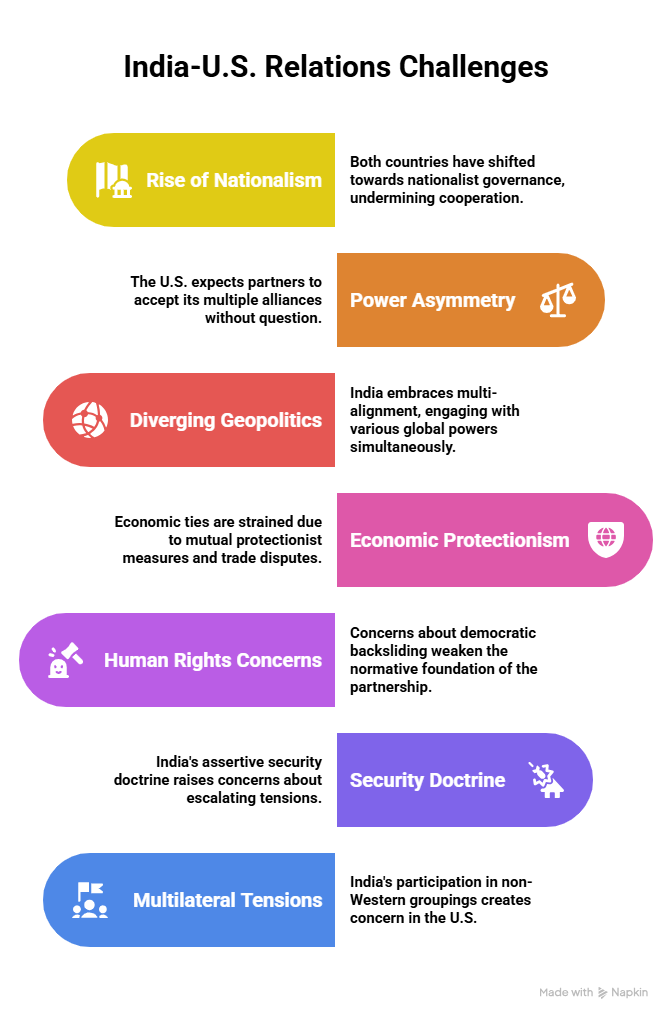
- Both India and the U.S. have shifted towards nationalist and populist governance.
- Prime Minister Narendra Modi’s foreign policy is often termed “India First”.
- President Donald Trump followed the “America First” doctrine.
- Trump emphasized transactionalism, economic protectionism, and strategic unilateralism.
- Modi’s approach promotes strategic autonomy and muscular diplomacy, including military retaliation against terrorism.
- This parallel rise in nationalism has undermined earlier notions of strategic altruism.
- When both countries adopt self-serving postures, it becomes difficult to sustain long-term cooperation.
Power Asymmetry and the Expectation Gap
- The United States, as a global superpower, maintains multiple and sometimes contradictory alliances.
- For example, it engages both India and Pakistan, or Qatar and Saudi Arabia.
- The U.S. expects partners to accept this duality without question.
- However, it is less tolerant when countries like India follow similar multi-vector diplomacy.
- India continues strategic ties with Iran for energy and connectivity through Chabahar Port.
- India also relies on Russia for defence cooperation and energy.
- Washington views these relationships with suspicion.
- Conversely, U.S. outreach to Pakistan and efforts to reset ties with China worry Indian policymakers.
- This mutual unease reflects a core asymmetry in how both countries define national interest and partnership obligations.
Diverging Geopolitical Alignments
- India’s foreign policy increasingly embraces a multi-alignment strategy.
- External Affairs Minister S. Jaishankar has articulated India’s ability to engage with all sides.
- India engages simultaneously with Russia and Ukraine, Israel and Iran, BRICS and QUAD, the West and the Global South.
- India views this flexibility as a strength in foreign policy.
- However, in Washington, such flexibility is often seen as ambiguity or unreliability.
- The U.S. wants clearer alignment from its partners in the context of renewed great-power rivalries.
- In particular, it expects alignment against China and Russia.
- India’s participation in BRICS and its neutral stance on the Ukraine war have raised concerns about its global intentions.
Economic Protectionism and Trade Disputes
- Economic ties between India and the U.S. have become strained due to mutual protectionist measures.
- India has resisted full-scale market liberalisation in sensitive sectors like agriculture, dairy, and e-commerce.
- These protectionist policies are intended to safeguard small producers and promote domestic manufacturing.
- Initiatives like Atmanirbhar Bharat reflect India’s push for economic self-reliance.
- Meanwhile, the Trump administration pursued a confrontational and reciprocal trade policy.
- The U.S. withdrew India’s Generalized System of Preferences (GSP) benefits in 2019.
- Trade negotiations failed repeatedly due to issues like tariffs, data localization, and intellectual property protection.
- Despite being a large and fast-growing economy, India remains a difficult market for U.S. exporters.
- This has led to growing frustration in Washington.
Human Rights Concerns and Democratic Backsliding
- A growing section of the American strategic community is critical of India’s democratic trajectory.
- Concerns have been raised about the Citizenship Amendment Act (CAA) and the abrogation of Article 370.
- Restrictions on civil liberties and rising majoritarian politics have also drawn criticism.
- These issues have been highlighted by U.S. media, think tanks, and members of Congress.
- While the U.S. administration tries to balance values and interests, concerns persist.
- Perceived democratic backsliding in India weakens the normative foundation of the partnership.
- Earlier, both countries celebrated their shared democratic values as a unifying factor.
Security Doctrine and Strategic Restraint
- India’s security doctrine has shifted toward assertiveness in recent years.
- India has demonstrated a willingness to carry out cross-border strikes in response to terrorism.
- This marks a departure from India’s earlier posture of strategic restraint.
- While this enhances deterrence in Indian thinking, it raises concerns in Washington.
- The U.S. fears such assertiveness could escalate tensions in a nuclearised South Asia.
- Washington prefers India to act as a stabilising regional force.
- India’s new approach complicates this expectation.
Tensions in Multilateral Forums and Strategic Autonomy
- India’s active participation in non-Western groupings like BRICS creates concern in the U.S.
- Continued defence and energy cooperation with Russia and Iran adds to this unease.
- These alignments prompt doubts about India’s long-term strategic direction.
- Even former advocates of U.S.-India ties, like Ashley Tellis, have voiced skepticism.
- He referred to India’s global ambitions as “great-power delusions”.
- President Trump, at times, linked India’s tariff policies to its role in BRICS.
- This indicates that multilateral affiliations are now being interpreted through a transactional lens.
Conclusion
- The current strain in India-U.S. relations is not merely the result of President Trump’s erratic foreign policy, but a reflection of deep structural tensions that are likely to persist unless both sides recalibrate their expectations.
- As India seeks to project itself as an independent global power, its divergence from the American worldview becomes more pronounced.
- At the same time, strategic convergence still exists in areas such as the Indo-Pacific, countering China’s assertiveness, and cooperation in defence and technology.

3rd UN conference on landlocked countries
UPSC CURRENT AFFAIRS – 08th August 2025 Home / 3rd UN conference on landlocked countries Why in News? At the

Issue of soapstone mining in Uttarakhand’s Bageshwar
UPSC CURRENT AFFAIRS – 08th August 2025 Home / Issue of soapstone mining in Uttarakhand’s Bageshwar Why in News? Unregulated

Groundwater Pollution in India – A Silent Public Health Emergency
UPSC CURRENT AFFAIRS – 08th August 2025 Home / Groundwater Pollution in India – A Silent Public Health Emergency Why
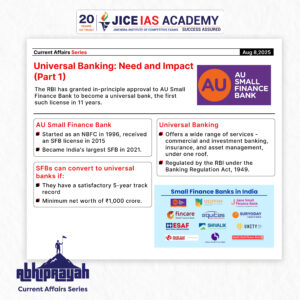
Universal banking- need and impact
UPSC CURRENT AFFAIRS – 08th August 2025 Home / Universal banking- need and impact Why in News? The Reserve Bank

India’s “Goldilocks” Economy: A Critical Appraisal
UPSC CURRENT AFFAIRS – 08th August 2025 Home / India’s “Goldilocks” Economy: A Critical Appraisal Why in News? The Finance
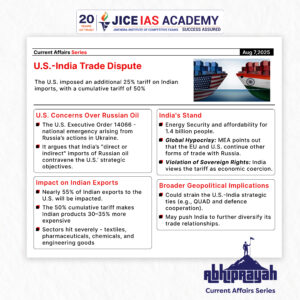
U.S.-India Trade Dispute: Trump’s 50% Tariffs and India’s Oil Imports from Russia
UPSC CURRENT AFFAIRS – 07th August 2025 Home / U.S.-India Trade Dispute: Trump’s 50% Tariffs and India’s Oil Imports from
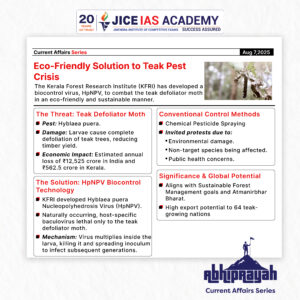
Eco-Friendly Solution to Teak Pest Crisis: KFRI’s HpNPV Technology
UPSC CURRENT AFFAIRS – 07th August 2025 Home / Eco-Friendly Solution to Teak Pest Crisis: KFRI’s HpNPV Technology Why in

New Species of Non-Venomous Rain Snake Discovered in Mizoram
UPSC CURRENT AFFAIRS – 07th August 2025 Home / New Species of Non-Venomous Rain Snake Discovered in Mizoram Why in

Introduction
Economic Implications
For Indian Exporters
- These reforms reduce transaction costs and compliance hurdles
- Encourage a more competitive and efficient export environment
- Promote value addition in key sectors like leather
For Tamil Nadu
- The reforms particularly benefit the state’s leather industry, a major contributor to employment and exports
- Boost the marketability of GI-tagged E.I. leather, enhancing rural and traditional industries
For Trade Policy
- These decisions indicate a shift from regulatory controls to policy facilitation
Reinforce the goals of Make in India, Atmanirbhar Bharat, and India’s ambition to become a leading export power
Recently, BVR Subrahmanyam, CEO of NITI Aayog, claimed that India has overtaken Japan to become the fourth-largest economy in the world, citing data from the International Monetary Fund (IMF).
India’s rank as the world’s largest economy varies by measure—nominal GDP or purchasing power parity (PPP)—each with key implications for economic analysis.