
UPSC CURRENT AFFAIRS – 01st August 2025

Home / UPSC / Current Affairs / Supreme Court Reserves Verdict on Challenge to Age Limits in Surrogacy Law

Supreme Court Reserves Verdict on Challenge to Age Limits in Surrogacy Law

Why in News?

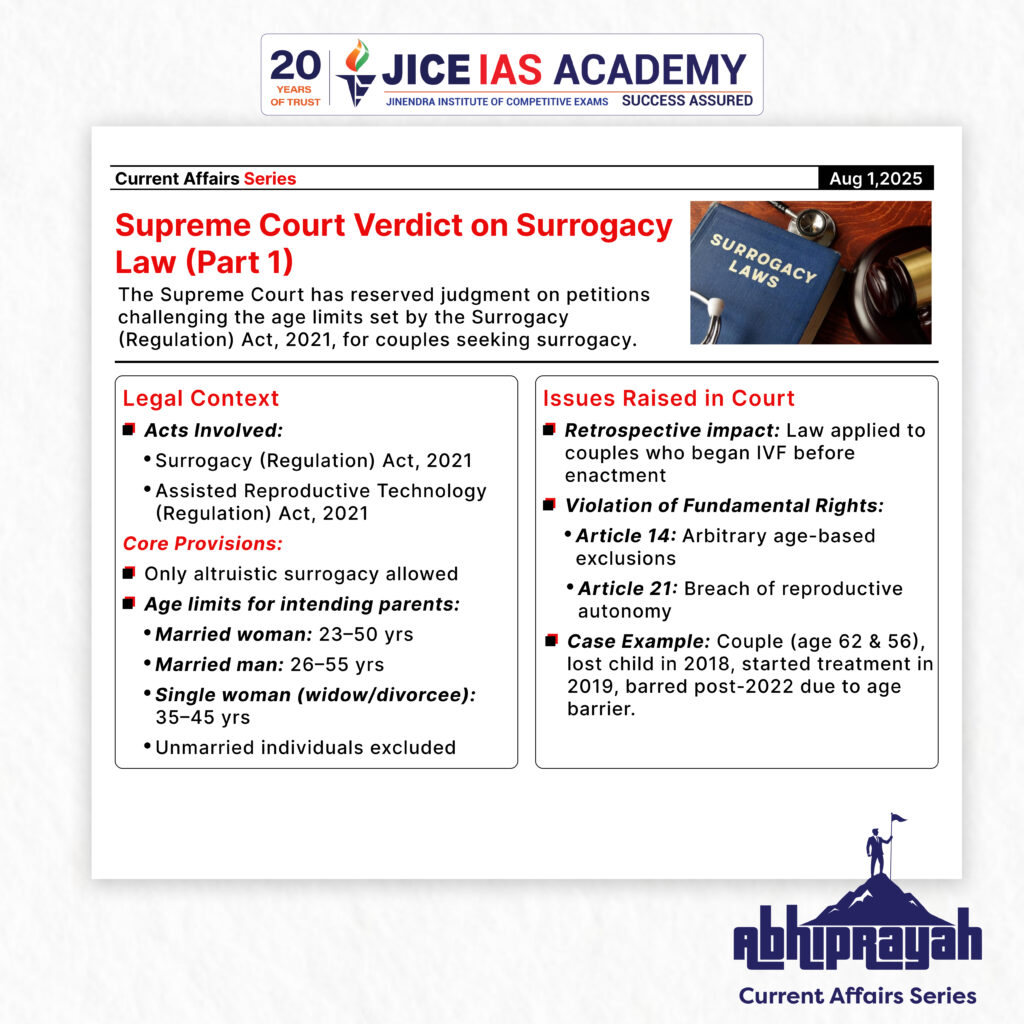
  • The Supreme Court has reserved its verdict on petitions challenging the age limits for couples seeking surrogacy under the Surrogacy (Regulation) Act, 2021.

Legal Framework Governing Surrogacy in India:

Two key legislations regulate assisted reproduction and surrogacy:

  1. Assisted Reproductive Technology (Regulation) Act, 2021
  2. Surrogacy (Regulation) Act, 2021

Together, these Acts:

  • Ban commercial surrogacy
  • Permit only altruistic surrogacy
  • Set strict eligibility criteria, including age limits, for intending parents

Age Criteria under the Surrogacy (Regulation) Act:

Category

Age Limit

Married Woman

23 to 50 years

Married Man

26 to 55 years

Single Woman (Widow/Divorcee only)

35 to 45 years

Note: Single unmarried women and single men are excluded from surrogacy under this law.

The Supreme Court Case:

Background:

Several couples approached the Supreme Court after being denied eligibility certificates under the new surrogacy law due to age limits. Their argument was that:

  • They had begun medical procedures before the Act was enacted (2022),
  • And that denial of surrogacy now violates their reproductive rights and personal liberty.

Example Case:

One petition involved a couple:

  • Husband aged 62, wife aged 56
  • Lost their only child in 2018
  • Started fertility treatment in 2019
  • Embryo transfer attempted in 2022, which failed
  • Age restrictions now prevent them from proceeding further

Key Legal Issues Raised:

  1. Retrospective Application:
    • The petitioners argue that applying the age criteria retrospectively is unjust, as they had already begun the process under the earlier legal vacuum.
    • The law lacks a transitional provision (also known as a “grandfather clause”) to protect ongoing cases.
  2. Violation of Fundamental Rights:
    • Article 14 (Right to Equality): The age restriction is said to create arbitrary classifications, discriminating against older couples and unmarried single women.
    • Article 21 (Right to Life & Personal Liberty): Petitioners argue that reproductive autonomy is an essential part of the right to life.
  3. Exclusion of Unmarried Women:
    • The law allows only widowed/divorced single women between 35 and 45 years to avail surrogacy.
    • The exclusion of unmarried single women is challenged as unconstitutional, though this point is not being adjudicated in the current batch of cases.

Court’s Observations and Concerns:

  • Justice B.V. Nagarathna raised critical concerns:
    • “Why outlaw surrogacy for older couples when natural geriatric pregnancies are allowed?”
    • “The Act aims to curb commercial surrogacy, not to punish genuine intending parents.”
    • The court noted the absence of any relief or exemption for those who were already in the process when the law came into effect.
    • Justice Nagarathna remarked that the law effectively says: “Stop, no children! Look how harsh it is.”

Legal and Ethical Dilemmas:

Issue

Argument

Medical Safety vs Reproductive Autonomy

Should the State impose age-based restrictions even when couples are medically fit?

Retrospective Effect

Should ongoing procedures be stopped midway due to a new law?

Inclusivity in Parenthood Rights

Should unmarried women and older couples be given equal rights to parenthood?

Welfare of Child

Can concerns of the child’s future be balanced with reproductive rights?

Conclusion & Way Forward:

The Supreme Court’s impending verdict will have far-reaching implications for:

  • Reproductive rights jurisprudence in India
  • Policy formulation in assisted reproductive technologies
  • The scope of individual autonomy under Article 21

If the court rules in favour of the petitioners, it may direct the government to:

  • Include transitional safeguards (grandfather clauses)
  • Re-evaluate age restrictions to allow medical discretion
  • Broaden the definition of eligible single women

At stake is not just the legal recognition of surrogacy procedures but the deeper constitutional question of balancing public health policy with fundamental rights.

Introduction

Economic Implications

For Indian Exporters

  • These reforms reduce transaction costs and compliance hurdles
  • Encourage a more competitive and efficient export environment
  • Promote value addition in key sectors like leather

For Tamil Nadu

  • The reforms particularly benefit the state’s leather industry, a major contributor to employment and exports
  • Boost the marketability of GI-tagged E.I. leather, enhancing rural and traditional industries

For Trade Policy

  • These decisions indicate a shift from regulatory controls to policy facilitation

Reinforce the goals of Make in India, Atmanirbhar Bharat, and India’s ambition to become a leading export power

Recently, BVR Subrahmanyam, CEO of NITI Aayog, claimed that India has overtaken Japan to become the fourth-largest economy in the world, citing data from the International Monetary Fund (IMF). 

India’s rank as the world’s largest economy varies by measure—nominal GDP or purchasing power parity (PPP)—each with key implications for economic analysis.

Significance and Applications

Leave a Reply

Your email address will not be published. Required fields are marked *

Call Us Now !

Copyright © JICE ACADEMY FOR EXCELLENCE PRIVATE LIMITED