UPSC CURRENT AFFAIRS – 12th June 2025
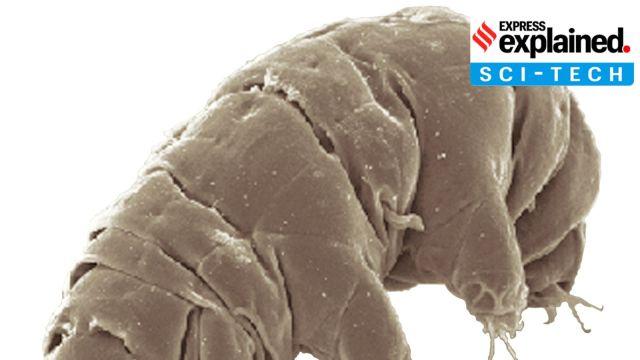
Tardigrades, tiny eight-legged ‘water bears’
Why in News?
The Voyager Tardigrades experiment aboard the ISS aims to study how microscopic water bears survive and reproduce in space, helping scientists identify genes linked to extreme resilience.
Introduction
- The upcoming scientific experiment aboard the International Space Station (ISS) involving astronaut Shubhanshu Shukla is set to explore the survival mechanisms of one of Earth’s most resilient lifeforms — the tardigrades, also known as water bears.
- The Voyager Tardigrades experiment will investigate the effects of space conditions on these microscopic organisms, potentially paving the way for advancements in space exploration and biotechnology.
What are Tardigrades?
Tardigrades are microscopic aquatic invertebrates, typically measuring about 0.5 mm in length. Known for their stubby appearance and bear-like gait, they are often referred to as “moss piglets” due to their frequent presence on moss and lichen.
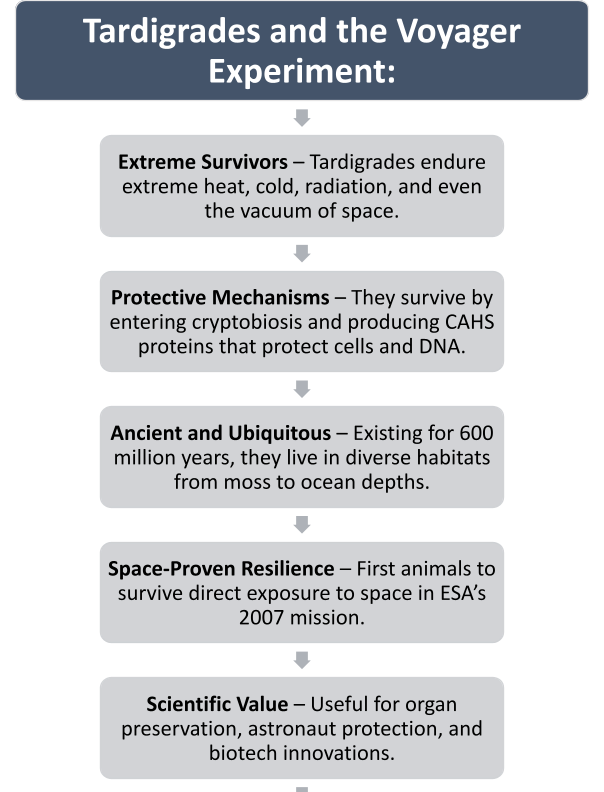
- Evolutionary survivors: Tardigrades have existed for nearly 600 million years, predating the dinosaurs by over 400 million years.
- Physical structure: They have four pairs of legs, each with tiny claws, and a specialised feeding organ used to extract nutrients from plant cells and smaller organisms.
- Habitat: They are found in extreme environments — from deep ocean trenches to Himalayan peaks — but most commonly reside in the thin films of water on mosses.
Why Are Scientists Interested in Tardigrades?
Although discovered in 1773 by German zoologist Johann August Ephraim Goeze, tardigrades have become a major subject of research in recent decades due to their astonishing resistance to extreme conditions.
Resilience Factors:
- Temperature extremes: Can endure from –272.95°C to 150°C.
- Radiation & pressure: Survive UV radiation and pressures up to 40,000 kilopascals (like being 4 km under the ocean).
- Longevity: Some have revived after 30 years of freezing.
Scientific Applications:
Understanding tardigrades can lead to:
- Improved preservation of biological tissues and organs.
- Development of radiation-shielding strategies for astronauts.
- Biotechnological innovations like advanced sunscreens and stress-resistant crops.
What Makes Tardigrades So Resilient?
Their resilience is mainly due to two biological states:
- Cryptobiosis:
- A survival state where metabolic activity nearly stops (to less than 0.01% of normal).
- This allows the organism to endure environmental extremes.
- Anhydrobiosis:
- A form of cryptobiosis where water content drops by over 95%, causing the organism to shrink into a durable tun state — a hardened, lifeless-looking form.
Molecular Protection:
- CAHS Proteins (Cytoplasmic-Abundant Heat Soluble Proteins): These create a gel-like protective matrix inside cells, preserving DNA and proteins during dehydration or radiation exposure.
- DNA repair mechanisms: Tardigrades possess unique genes for rapid and efficient DNA repair, making them ideal for space studies.
The Voyager Tardigrades Experiment
The Voyager Tardigrades experiment aims to explore how space radiation and microgravity affect these animals’ biological processes.
Objectives:
- Revival in space: Tardigrades will be sent in their tun state, rehydrated, and observed for survival and reproduction.
- Genetic analysis: Scientists will study which genes are activated for survival and DNA repair in space.
- Biotechnological insights: The results could inform ways to:
- Protect astronauts from space radiation.
- Counter muscle and bone loss during prolonged space stays.
- Develop long-term biological storage solutions for space missions.
Have Tardigrades Been to Space Before?
Yes. Tardigrades were first sent into space in 2007 aboard the European Space Agency’s Foton-M3 mission.
Key Outcomes:
- Survival in vacuum: Many tardigrades survived the vacuum and cosmic radiation.
- Successful reproduction: Some even reproduced after rehydration upon return.
- Pioneers in space biology: They became the first animals known to survive direct exposure to outer space, without the protection of a spacecraft or suit.
Significance of the Experiment
Conclusion
- Tardigrades, Earth’s tiny titans of survival, may hold the key to solving some of the greatest challenges in space science and biotechnology.
- The Voyager Tardigrades experiment led by astronaut Shubhanshu Shukla represents a step forward in understanding how life can persist — not just on Earth, but possibly, far beyond.

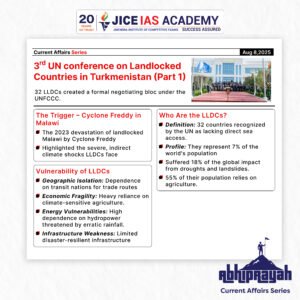
3rd UN conference on landlocked countries
UPSC CURRENT AFFAIRS – 08th August 2025 Home / 3rd UN conference on landlocked countries Why in News? At the
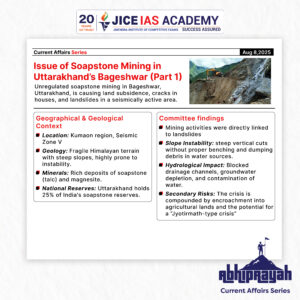
Issue of soapstone mining in Uttarakhand’s Bageshwar
UPSC CURRENT AFFAIRS – 08th August 2025 Home / Issue of soapstone mining in Uttarakhand’s Bageshwar Why in News? Unregulated

Groundwater Pollution in India – A Silent Public Health Emergency
UPSC CURRENT AFFAIRS – 08th August 2025 Home / Groundwater Pollution in India – A Silent Public Health Emergency Why

Universal banking- need and impact
UPSC CURRENT AFFAIRS – 08th August 2025 Home / Universal banking- need and impact Why in News? The Reserve Bank

India’s “Goldilocks” Economy: A Critical Appraisal
UPSC CURRENT AFFAIRS – 08th August 2025 Home / India’s “Goldilocks” Economy: A Critical Appraisal Why in News? The Finance
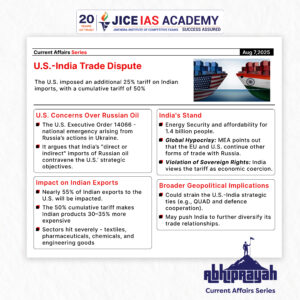
U.S.-India Trade Dispute: Trump’s 50% Tariffs and India’s Oil Imports from Russia
UPSC CURRENT AFFAIRS – 07th August 2025 Home / U.S.-India Trade Dispute: Trump’s 50% Tariffs and India’s Oil Imports from
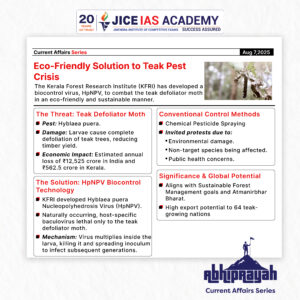
Eco-Friendly Solution to Teak Pest Crisis: KFRI’s HpNPV Technology
UPSC CURRENT AFFAIRS – 07th August 2025 Home / Eco-Friendly Solution to Teak Pest Crisis: KFRI’s HpNPV Technology Why in

New Species of Non-Venomous Rain Snake Discovered in Mizoram
UPSC CURRENT AFFAIRS – 07th August 2025 Home / New Species of Non-Venomous Rain Snake Discovered in Mizoram Why in

Economic Implications
For Indian Exporters
- These reforms reduce transaction costs and compliance hurdles
- Encourage a more competitive and efficient export environment
- Promote value addition in key sectors like leather
For Tamil Nadu
- The reforms particularly benefit the state’s leather industry, a major contributor to employment and exports
- Boost the marketability of GI-tagged E.I. leather, enhancing rural and traditional industries
For Trade Policy
- These decisions indicate a shift from regulatory controls to policy facilitation
Reinforce the goals of Make in India, Atmanirbhar Bharat, and India’s ambition to become a leading export power
Recently, BVR Subrahmanyam, CEO of NITI Aayog, claimed that India has overtaken Japan to become the fourth-largest economy in the world, citing data from the International Monetary Fund (IMF).
India’s rank as the world’s largest economy varies by measure—nominal GDP or purchasing power parity (PPP)—each with key implications for economic analysis.