


UPSC CURRENT AFFAIRS – 04th August 2025

Home / UPSC / Current Affairs / Timely Justice and the Crisis of Judicial Delays in India

Timely Justice and the Crisis of Judicial Delays in India

Why in News?

  • India’s judiciary is facing a critical crisis of pendency, with over 5 crore cases stuck across courts.

Introduction

  • The adage “Justice delayed is justice denied” captures the essence of a fair legal system.
  • Timely justice builds public trust, ensures social stability, and upholds the rule of law.
  • Yet, in India, the enormity of pending cases has reached alarming levels, making judicial delay a chronic crisis.
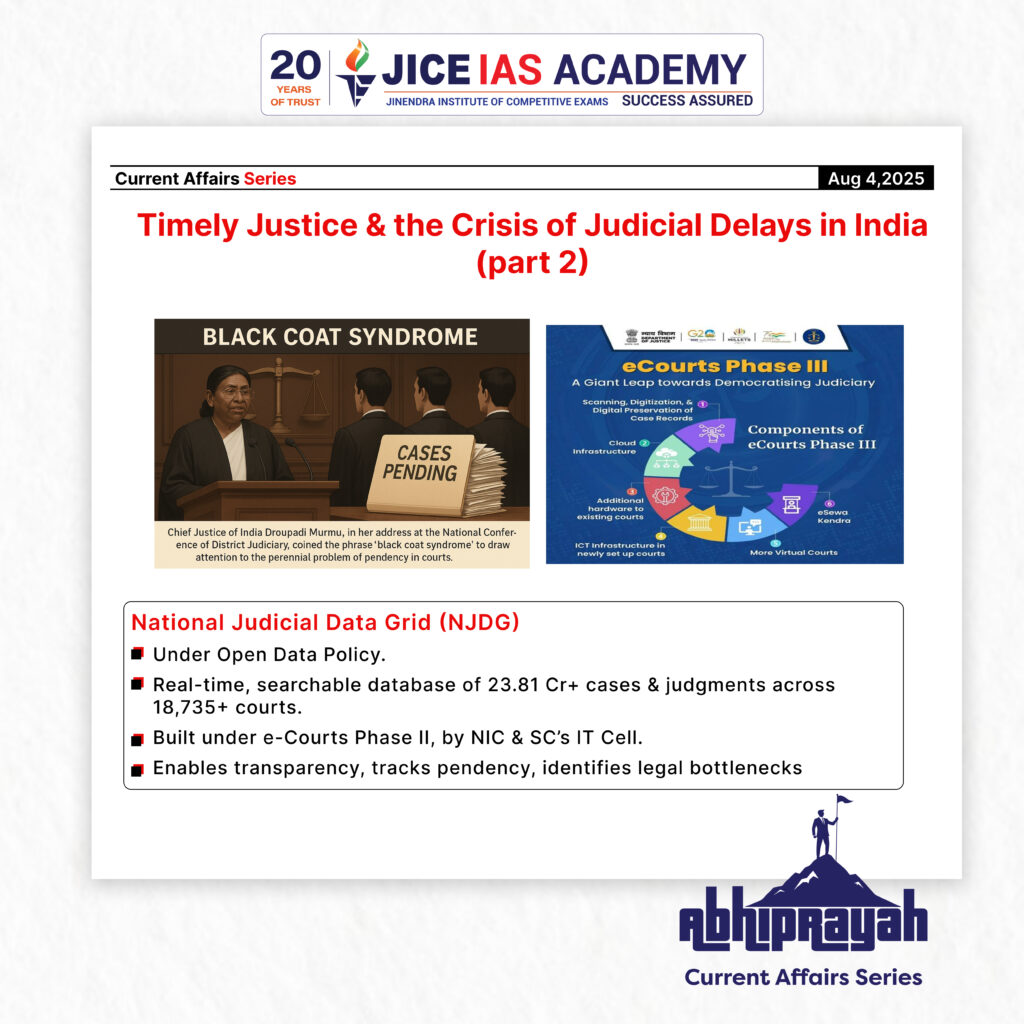
  • President Droupadi Murmu’s remark on the public’s hesitation to approach courts — termed the “black coat syndrome” — reflects this widespread lack of confidence in the system.

Extent of Pendency: A Crisis in Numbers

As per the latest data:

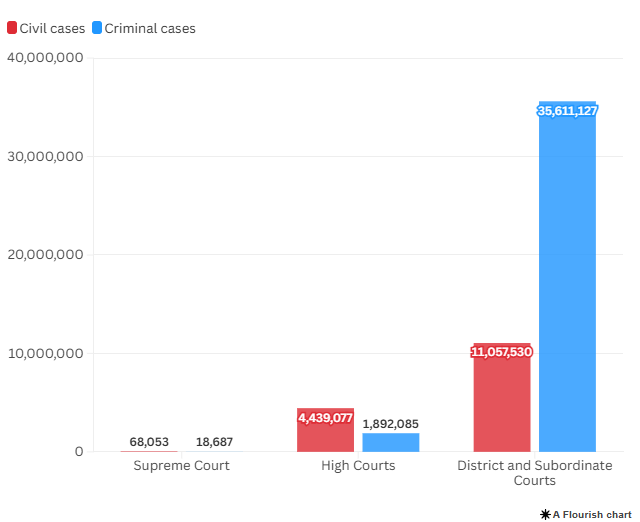
  • Supreme Court: Over 86,700 cases
  • High Courts: Over 3 lakh cases pending.
  • District & Subordinate Courts: Over 6 crore cases pending.
  • Total: More than 5 crore cases across all levels.
  • These figures highlight an unsustainable backlog, straining India’s justice delivery system and affecting millions of litigants.

Structural and Systemic Causes of Delay

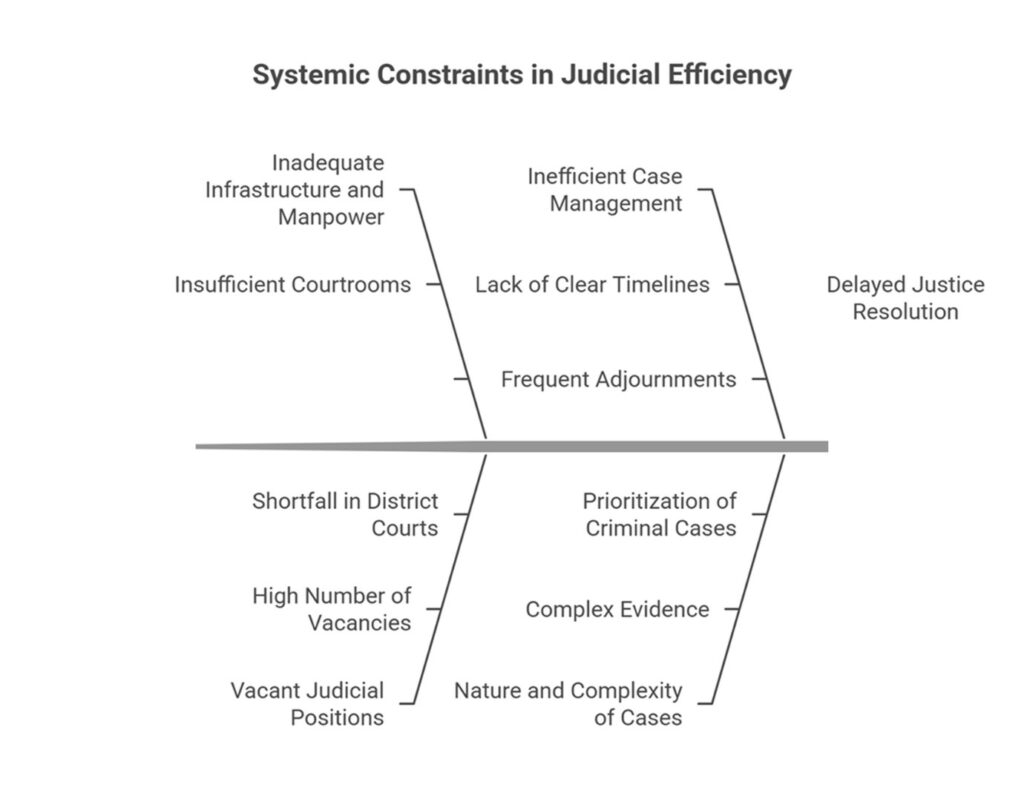
Despite good faith among judges, lawyers, and litigants, multiple systemic constraints hinder timely resolution:

Inadequate Infrastructure and Manpower:

  • Courts lack sufficient courtrooms, support staff, and digital facilities.
  • India has only 15 judges per 10 lakh population, far below the Law Commission’s 1987 recommendation of 50.

Vacant Judicial Positions:

  • Of the 26,927 sanctioned judges, 5,665 posts remain vacant.
  • District courts — the backbone of the judiciary — function with a 19% shortfall in judge strength.

Inefficient Case Management:

  • Absence of clear timelines for stages like filing, evidence, and hearings.
  • Frequent adjournments, procedural delays, and weak monitoring mechanisms slow down justice.

Nature and Complexity of Cases:

  • Civil cases (like property or contractual disputes) often involve complex evidence and documentation.
  • Criminal cases, which receive priority, tend to move faster than civil matters.

Disparity in Case Disposal Rates

The pace of justice varies significantly across courts and case types:

  • Criminal Cases Resolved Within a Year:
  • High Courts: 3%
  • Supreme Court: 5%
  • District Courts: 6%
  • Civil Cases Resolved Within a Year (District Courts): Only 7%
  • Civil Cases Pending Over 5 Years: Nearly 20%

This disparity reveals that district courts, which handle the majority of civil disputes, are the least equipped to ensure timely disposal.

Steps Taken for Judicial Reform

The judiciary and the executive have been working on several fronts:

  • Filling Vacancies:
  • The Supreme Court and the Union Government are actively working to expedite appointments, especially in High Courts.
  • Process Simplification & Digitalisation:
  • Use of e-Courts, virtual hearings, and National Judicial Data Grid (NJDG) for tracking cases.
  • Fast Track Courts and Special Benches:
  • To expedite sensitive cases like rape, POCSO, and cheque bounce cases.

Alternative Dispute Resolution (ADR): A Promising Solution

  • ADR mechanisms provide cost-effective, quick, and citizen-centric justice alternatives:
  • Mediation and Arbitration: Encourage out-of-court settlements.


Lok Adalats:

  • Organised across taluks, districts, and High Courts on fixed dates.
  • From 2021 to March 2025, resolved:
  • 5 crore cases in total.
  • 21 crore pre-litigation cases
  • 34 crore pending court cases
  • Lok Adalats’ success reflects their ability to unburden courts and improve access to justice, especially in rural areas.

Way Forward

To restore public faith and uphold constitutional ideals, the following steps are vital:

Judicial Capacity Expansion:

  • Increase sanctioned judge strength to meet population-based norms.
  • Invest in court infrastructure, including digital systems.

Strict Timelines and Case Management Rules:

  • Mandate stage-wise deadlines for each case type.
  • Empower registrars and judicial clerks to handle procedural tasks.

Promote ADR & Pre-Litigation Resolution:

  • Institutionalise mediation centers in all districts.
  • Mandate pre-litigation mediation in select civil cases.

Judicial Accountability and Monitoring:

  • Create a performance audit system for tracking case progress.
  • Encourage court-wise pendency dashboards.

Introduction

Economic Implications

For Indian Exporters

  • These reforms reduce transaction costs and compliance hurdles
  • Encourage a more competitive and efficient export environment
  • Promote value addition in key sectors like leather

For Tamil Nadu

  • The reforms particularly benefit the state’s leather industry, a major contributor to employment and exports
  • Boost the marketability of GI-tagged E.I. leather, enhancing rural and traditional industries

For Trade Policy

  • These decisions indicate a shift from regulatory controls to policy facilitation

Reinforce the goals of Make in India, Atmanirbhar Bharat, and India’s ambition to become a leading export power

Recently, BVR Subrahmanyam, CEO of NITI Aayog, claimed that India has overtaken Japan to become the fourth-largest economy in the world, citing data from the International Monetary Fund (IMF). 

India’s rank as the world’s largest economy varies by measure—nominal GDP or purchasing power parity (PPP)—each with key implications for economic analysis.

Significance and Applications

Leave a Reply

Your email address will not be published. Required fields are marked *

Call Us Now !

Copyright © JICE ACADEMY FOR EXCELLENCE PRIVATE LIMITED