
UPSC CURRENT AFFAIRS – 28th June 2025

Home / UPSC / Current Affairs / Centre Issues Model Rules for Felling of Trees on Agricultural Land

Centre Issues Model Rules for Felling of Trees on Agricultural Land

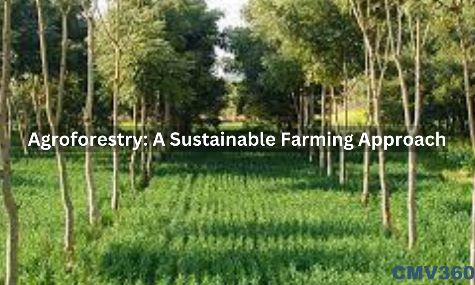
trees on agricultural land

Why in News?

The Environment Ministry has issued Model Rules for Felling of Trees on Agricultural Lands to promote agroforestry, ease regulations, and support India’s climate and income goals.

Introduction

  • In a significant policy move aimed at promoting agroforestry and facilitating climate-resilient agriculture, the Ministry of Environment, Forest and Climate Change (MoEFCC) issued Model Rules for Felling of Trees on Agricultural Land on June 19, 2025
  • The rules have been formulated to simplify procedures, provide regulatory clarity, and boost the economic potential of tree cultivation on farmlands. 
  • This initiative is aligned with India’s National Agroforestry Policy (2014) and its broader commitments under the Paris Climate Agreement
  • The ultimate goal is to double farmers’ income, reduce import dependency on timber, and increase tree cover outside forest areas (TOF).

Context and Rationale

  • India has been advocating agroforestry as a means to enhance rural incomes, promote sustainable land use, increase carbon sequestration to combat climate change, and meet the rising domestic demand for timber
  • Despite its benefits, agroforestry has remained underutilized, largely due to complex and inconsistent regulations across different states regarding the felling of trees grown on agricultural lands.

Major Challenges Previously Faced:

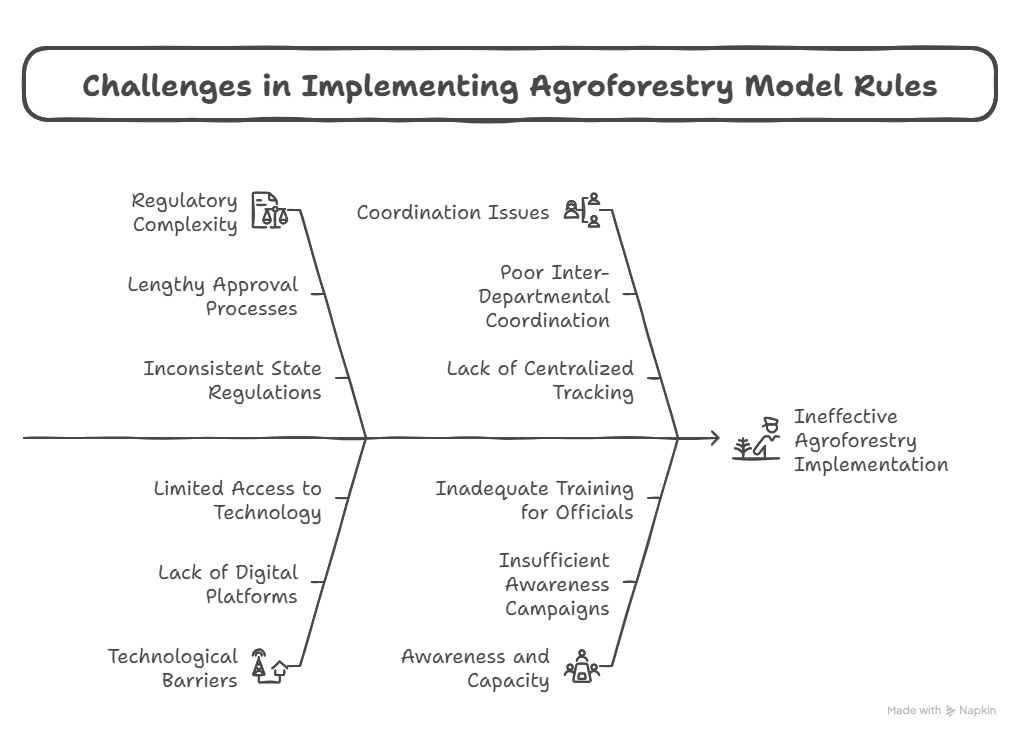
  • Lengthy and unclear approval processes for felling.
  • No centralized or digital platform for registration and tracking.
  • Lack of coordination between forest, revenue, and agriculture departments.
  • Fear of legal consequences among farmers for tree felling.

Objectives of the Model Rules

The newly issued model rules aim to:

  • Simplify and harmonize felling and transit procedures across states.
  • Ensure that farmers can cut and transport trees grown on their land without unnecessary hurdles.
  • Promote tree plantation on farmland by incentivizing agroforestry.
  • Strengthen India’s efforts towards climate change mitigation.
  • Increase India’s timber self-sufficiency.
challenges in implementing agroforestry model rules

Key Provisions of the Model Rules

1. Expanded Role of State Level Committee (SLC)

The rules designate the State Level Committee, already functioning under the Wood-Based Industries (Establishment and Regulation) Guidelines, 2016, as the nodal body for agroforestry felling regulation.

Committee Composition:

  • Forest department officials.
  • New additions: Revenue and agriculture department officials.

Committee Functions:

  • Advising the state government on promoting agroforestry.
  • Simplifying rules related to tree felling and transit.
  • Empanelling agencies for field verification and permit facilitation.

2. Mandatory Plantation Land Registration on NTMS Portal

All applicants must register their plantation details on the National Timber Management System (NTMS) portal.

Information Required:

  • Land ownership documents.
  • Plantation site geolocation.
  • Number of saplings planted (by species).
  • Month and year of planting.
  • Average height of saplings.

This ensures that data is digitally available and monitored transparently.

3. Geotagged Monitoring and Verification

  • Each tree must be photographed with a geotagged image in KML format.
  • Field monitoring is to be done by officials from forest, agriculture, and panchayati raj departments.

4. Differential Procedure Based on Tree Count

A. For up to 10 Trees:

  • Simple online application via NTMS with photos and species details.
  • The system will automatically estimate tree girth, height, yield, and species.
  • Applicants must upload post-felling stump photos.
  • A No Objection Certificate (NOC) is auto-generated unless verification is required.

B. For More Than 10 Trees:

  • A field inspection is mandatory.
  • The verifying agency will:
    • Visit the land.
    • Prepare a detailed report on tree number, species, and expected timber quantity.
  • A felling permit is then issued based on this verification.

5. Monitoring of Verifying Agencies

  • Divisional Forest Officers (DFOs) will monitor the working of verifying agencies.
  • DFOs must submit quarterly reports to the SLC regarding performance and compliance.
  • This ensures accountability and transparency.

Judicial Backing and Environmental Ethics

The Supreme Court of India has emphasized that indiscriminate felling of trees has grave consequences. In a recent observation, the Court stated that the mass destruction of trees can be worse than the killing of human beings, considering their crucial ecological role. The Court has:

  • Mandated a tree census.
  • Ordered restrictions on felling more than 50 trees without explicit permission.

Hence, these model rules seek to create a balance between development needs and ecological protection.

Significance of the Initiative

A. For Farmers:

  • Reduced procedural delays in tree felling.
  • Legal and digital protection of agroforestry practices.
  • Encouragement to plant more commercial species for income diversification.

B. For Environment:

  • Enhanced tree cover on non-forest land.
  • Improved climate resilience of agriculture.
  • Increased biodiversity and ecosystem services.

C. For Economy:

  • Lowered timber import dependency.
  • Boost to wood-based industries and local entrepreneurship.
  • Better land productivity.

Challenges in Implementation

  • State-level adoption of model rules is not mandatory; states must notify their own rules.
  • Potential technological barriers in rural areas for portal use.
  • Need for awareness campaigns and capacity-building of officials.
  • Effective monitoring of verifying agencies is critical to avoid misuse.

Conclusion

The Model Rules for Felling of Trees in Agricultural Lands are a progressive reform, combining the interests of farmers, environment, and economy. They reflect India’s commitment to climate action, ease of doing business, and sustainable agriculture. Their success will depend on the timely adoption by states, the active involvement of stakeholders, and the efficient operation of digital systems like NTMS. If implemented properly, they can be a game-changer in transforming India’s rural landscape.

Economic Implications

For Indian Exporters

  • These reforms reduce transaction costs and compliance hurdles
  • Encourage a more competitive and efficient export environment
  • Promote value addition in key sectors like leather

For Tamil Nadu

  • The reforms particularly benefit the state’s leather industry, a major contributor to employment and exports
  • Boost the marketability of GI-tagged E.I. leather, enhancing rural and traditional industries

For Trade Policy

  • These decisions indicate a shift from regulatory controls to policy facilitation

Reinforce the goals of Make in India, Atmanirbhar Bharat, and India’s ambition to become a leading export power

Recently, BVR Subrahmanyam, CEO of NITI Aayog, claimed that India has overtaken Japan to become the fourth-largest economy in the world, citing data from the International Monetary Fund (IMF). 

India’s rank as the world’s largest economy varies by measure—nominal GDP or purchasing power parity (PPP)—each with key implications for economic analysis.

Significance and Applications

One Response

Leave a Reply

Your email address will not be published. Required fields are marked *

Call Us Now !

Copyright © JICE ACADEMY FOR EXCELLENCE PRIVATE LIMITED