
UPSC CURRENT AFFAIRS – 03rd August 2025

Home / UPSC / Current Affairs / U.K. Set to Recognise Palestine: Historical Significance, Geopolitical Shift, and India’s Strategic Lens

U.K. Set to Recognise Palestine: Historical Significance, Geopolitical Shift, and India’s Strategic Lens

Why in News?

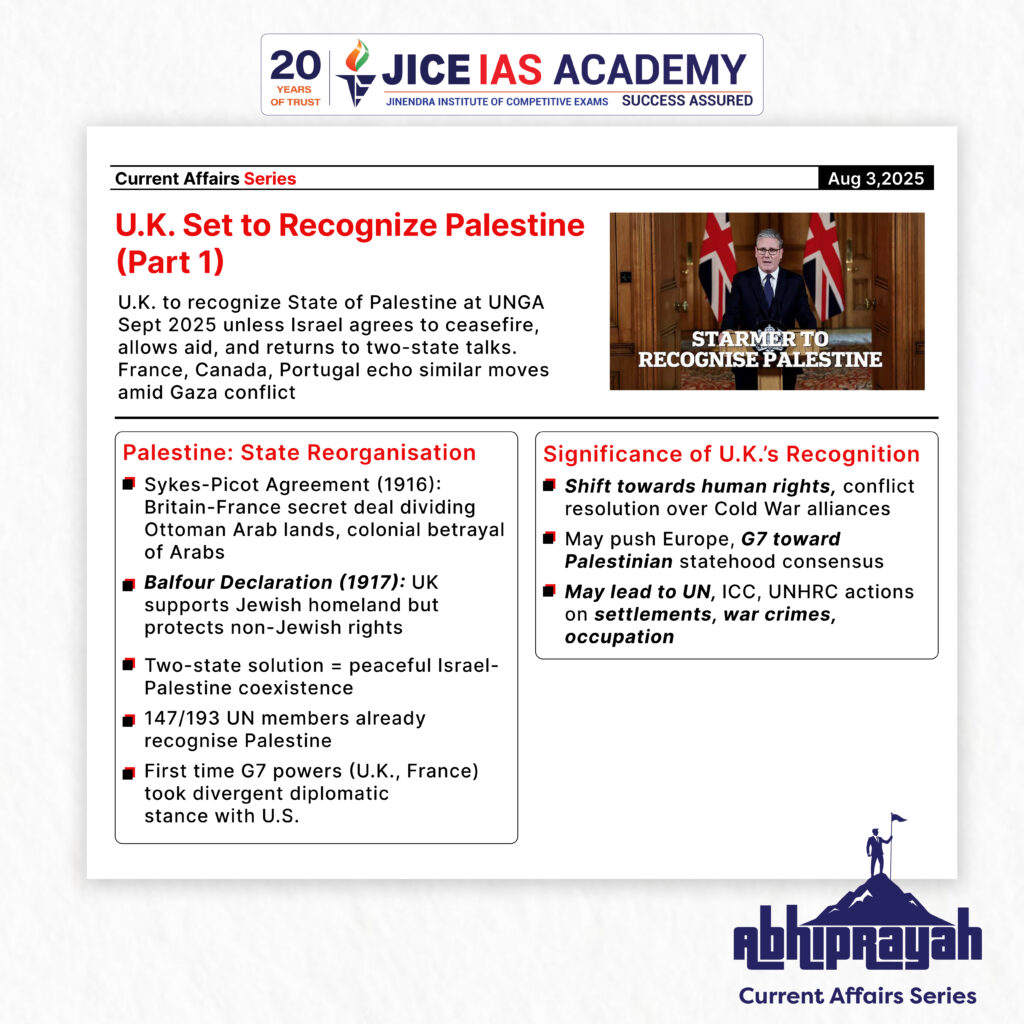
  • The Prime Minister of the United Kingdom has announced that Britain will recognize the State of Palestine at the upcoming UN General Assembly in September 2025, unless Israel agrees to a ceasefire, allows humanitarian aid into Gaza, and recommits to the two-state solution.
  • This declaration marks a major shift in Western diplomatic stance, with France, Canada, and Portugal also expressing similar intentions in the backdrop of Israel’s prolonged military campaign in Gaza.

Key Highlights

  • Of the 193 member states of the United Nations, 147 already recognize Palestine. However, most Western powers had resisted such recognition, arguing it should only follow a final negotiated peace settlement.
  • The move by the U.K. and France, both permanent members of the UN Security Council and members of the G7, represents a potential turning point, likely increasing pressure on Israel and isolating the United States diplomatically.
  • The U.K.’s recognition of Palestine carries deep historical symbolism, as it was the first major power to support the Zionist movement for a Jewish homeland in Palestine through the Balfour Declaration of 1917.

Concepts

  • Recognition of statehood in international law refers to a formal acknowledgment of a political entity’s sovereignty, enabling it to enter into diplomatic relations and join international organizations, though not necessarily the UN itself without Security Council approval.
  • The two-state solution envisions an independent Palestine coexisting peacefully alongside Israel and has long been supported by the international community as a resolution to the Israeli–Palestinian conflict.

Treaties

The Balfour Declaration (1917)

  • The Balfour Declaration was a formal statement issued by British Foreign Secretary Arthur Balfour on November 2, 1917, during World War I.
  • It was addressed to Lord Rothschild, a prominent British Zionist, and stated that “His Majesty’s Government view with favour the establishment in Palestine of a national home for the Jewish people.”
  • The declaration marked the first official endorsement by a major world power of Zionist aspirations for a Jewish homeland in Palestine.
  • At the time, Palestine was part of the Ottoman Empire, but Britain sought to win the support of global Jewry, especially in the U.S. and Russia, for the Allied war effort.
  • While the declaration supported the Jewish cause, it also stated that “nothing shall be done which may prejudice the civil and religious rights of existing non-Jewish communities in Palestine.”
  • The declaration is considered a turning point in Middle Eastern geopolitics, as it laid the foundation for increased Jewish migration to Palestine, tensions with the Arab population, and the eventual establishment of Israel in 1948.

The Sykes–Picot Agreement (1916)

  • The Sykes–Picot Agreement was a secret treaty negotiated in 1916 between Britain and France, with assent from Russia, during World War I.
  • The agreement was named after British diplomat Sir Mark Sykes and French diplomat François Georges-Picot.
  • It proposed the division of Ottoman-controlled Arab territories in the Middle East into British and French spheres of influence, after the defeat of the Ottoman Empire.
  • Under the agreement:
    • France would control modern-day Syria and Lebanon.
    • Britain would control Iraq, Jordan, and parts of Palestine.
    • Palestine was to be placed under international administration due to its religious significance.
  • The agreement contradicted Britain’s earlier promise to support Arab independence if the Arabs revolted against the Ottomans, as seen in the Hussein–McMahon Correspondence.
  • When the agreement was made public by the Bolsheviks after the Russian Revolution, it generated Arab outrage and is widely viewed as a symbol of colonial betrayal and the start of Western manipulation of the Middle East.

U.K.’s recognition of Palestine and Strategic Significance

  • The U.K.’s recognition reflects a shift in Western policy that prioritizes human rights, humanitarian law, and conflict resolution over historical alliances and Cold War-era realpolitik.
  • This move may influence other European and G7 countries to adopt similar positions, creating momentum for broader international consensus on Palestinian statehood.
  • Britain’s change in stance also increases pressure on multilateral institutions such as the UN, the International Criminal Court, and the Human Rights Council to act on issues of occupation, settlement activity, and alleged war crimes.

India’s Impact and Policy Relevance

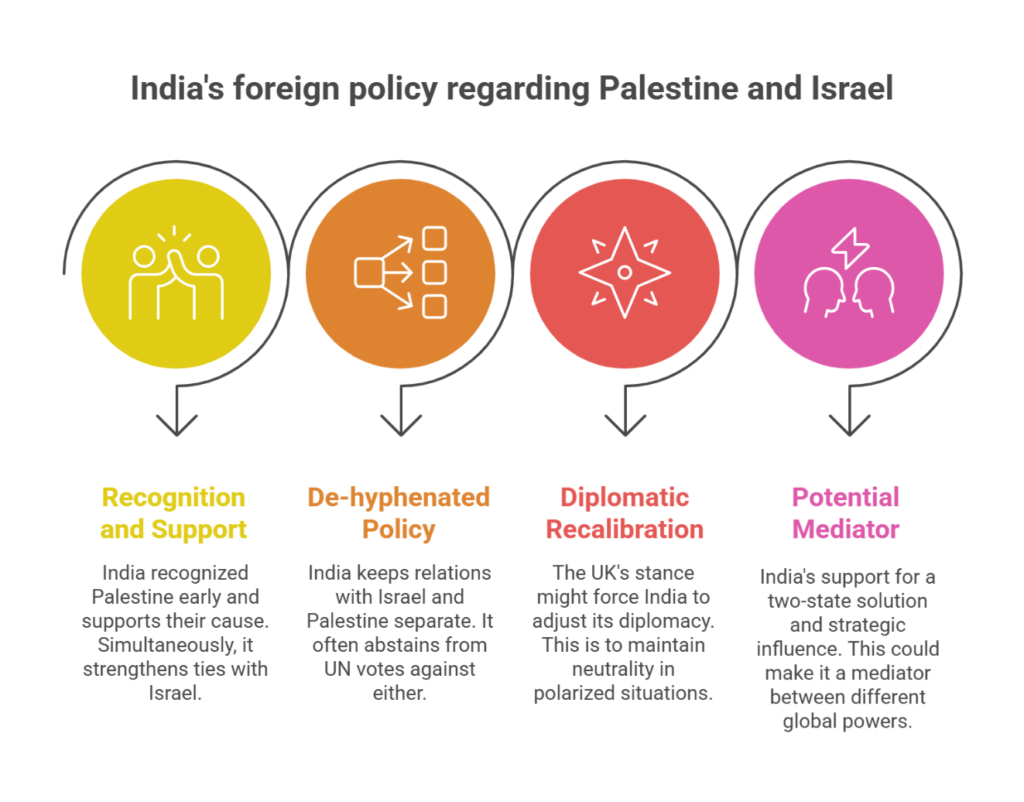
  • India recognized Palestine in 1974 and has consistently supported the Palestinian cause while simultaneously deepening its strategic ties with Israel through defense, agriculture, and technology partnerships.
  • India follows a de-hyphenated policy, treating relations with Israel and Palestine independently, and has often abstained from UN votes that single out either party.
  • The U.K.’s stance may prompt recalibration of India’s diplomatic approach, particularly in multilateral forums, to maintain its image as a neutral, rule-based actor amid increasing polarization.
  • India’s longstanding support for the two-state solution, combined with its growing strategic clout, may place it in a unique position to act as a potential mediator or bridge-builder between Global South solidarity and Global North institutions.

Introduction

Economic Implications

For Indian Exporters

  • These reforms reduce transaction costs and compliance hurdles
  • Encourage a more competitive and efficient export environment
  • Promote value addition in key sectors like leather

For Tamil Nadu

  • The reforms particularly benefit the state’s leather industry, a major contributor to employment and exports
  • Boost the marketability of GI-tagged E.I. leather, enhancing rural and traditional industries

For Trade Policy

  • These decisions indicate a shift from regulatory controls to policy facilitation

Reinforce the goals of Make in India, Atmanirbhar Bharat, and India’s ambition to become a leading export power

Recently, BVR Subrahmanyam, CEO of NITI Aayog, claimed that India has overtaken Japan to become the fourth-largest economy in the world, citing data from the International Monetary Fund (IMF). 

India’s rank as the world’s largest economy varies by measure—nominal GDP or purchasing power parity (PPP)—each with key implications for economic analysis.

Significance and Applications

Leave a Reply

Your email address will not be published. Required fields are marked *

Call Us Now !

Copyright © JICE ACADEMY FOR EXCELLENCE PRIVATE LIMITED