
UPSC CURRENT AFFAIRS – 07th July 2025

Home / UPSC / Current Affairs / UN Rapporteur: Global Firms Aiding Israel ‘Profiting from Genocide’ in Gaza

UN Rapporteur: Global Firms Aiding Israel ‘Profiting from Genocide’ in Gaza

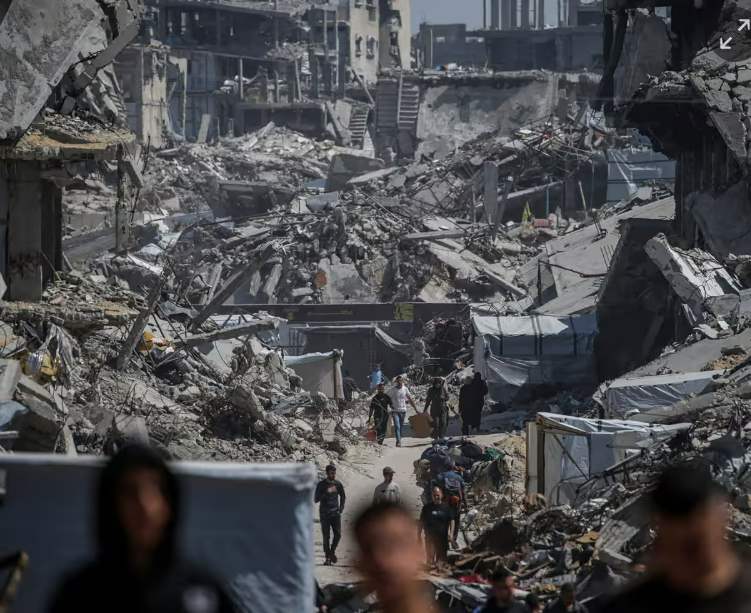
depicting widespread destruction

Why in News?

  • UN Special Rapporteur Francesca Albanese’s 2025 report to the UN Human Rights Council aaccuses Israel of genocide in Gaza.

Introduction

In a landmark development, Francesca Albanese, the UN Special Rapporteur on the human rights situation in the Occupied Palestinian Territories, has released a detailed report to the UN Human Rights Council calling for:

  • Sanctions and an arms embargo on Israel, and
  • Legal accountability of corporate entities involved in supporting what she terms a “genocide” in Gaza.

The report titled “From Economy of Occupation to Economy of Genocide” highlights the economic and corporate structures enabling Israel’s military campaign in Gaza since October 2023.

Key Highlights of the Report

1. Genocide Allegations

  • Albanese reiterates her earlier stance from January 2024, asserting that Israel’s actions in Gaza amount to genocide.
  • Over 56,000 Palestinians have been killed (as per Gaza’s health ministry), with estimates possibly higher due to unrecovered bodies under rubble.
  • Destruction includes:
    • 80% of homes,
    • Widespread lack of food and water,
    • Systematic displacement.
  • These actions align with genocidal acts as defined by international law, including:
    • Killing members of the group,
    • Creating conditions intended to destroy the group.

2. Corporate Involvement and Profiteering

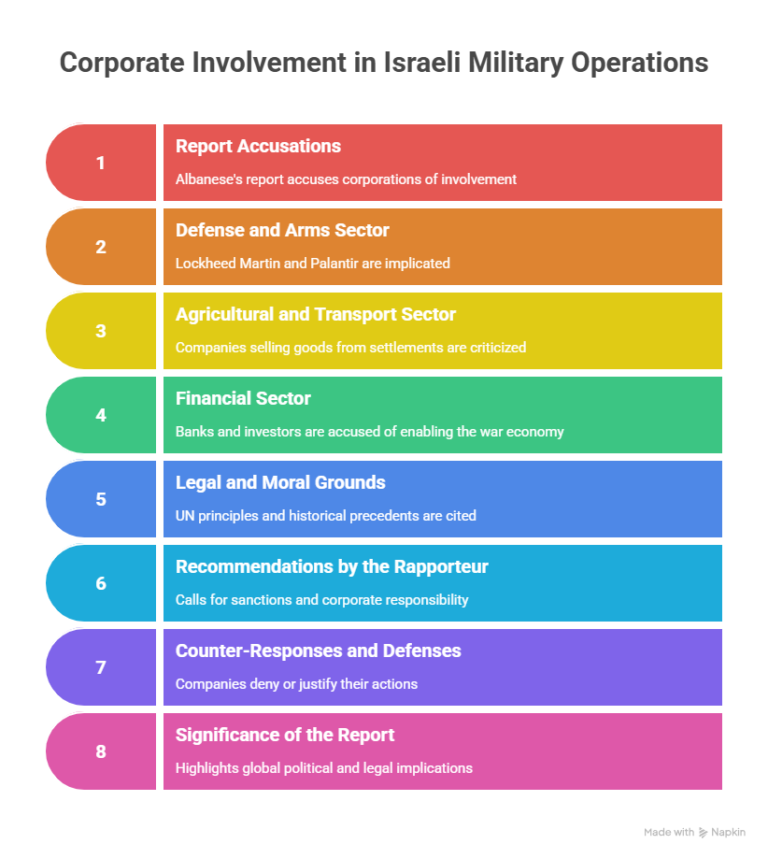
Albanese’s report accuses multinational corporations of enabling and profiting from Israeli military operations.

a) Defence and Arms Sector

  • Lockheed Martin: Supplier of F-35 fighter jets to Israel, used in “beast mode” (carrying 18,000 lbs of bombs).
    • Over 1,600 manufacturers across 8 countries involved.
  • Palantir: US-based tech firm, accused of aiding Israeli military decision-making through AI platforms.
  • Caterpillar & Volvo: Accused of supplying heavy machinery used to demolish Palestinian homes and infrastructure.
    • Volvo claimed many units were second-hand and outside its control.

b) Agricultural and Transport Sector

  • Companies selling agricultural goods from illegal Israeli settlements are enabling the occupation economy.
  • Merkavim, an Israeli bus assembler working with Volvo, is listed in the UN database of companies operating in occupied territory.

c) Financial Sector

  • Global financial institutions and investors are allegedly enabling the war economy:
    • BNP Paribas, Barclays: Underwrote Israeli treasury bonds.
    • PIMCO, Vanguard: Large-scale bondholders.
    • Norwegian Government Pension Fund Global (GPFG): Increased investment in Israeli firms by 32% post-October 2023.
corporate involvement in israeli military operations

Legal and Moral Grounds for Corporate Accountability

1. UN Principles on Business & Human Rights (2011)

  • Emphasize corporate due diligence to avoid infringing on human rights.
  • Corporates must remediate harm caused by their operations.

2. Historical Precedents

  • Nuremberg Trials: IG Farben executives prosecuted for aiding Nazi war crimes.
  • South African Truth and Reconciliation Commission: Held companies accountable for sustaining apartheid.

3. International Court of Justice (ICJ)

  • ICJ has acknowledged the plausibility of genocide in Gaza and issued provisional measures (January 2024).
  • Israel has largely ignored these calls.
  • Albanese argues that legal delay at ICJ should not deter immediate international action.

Recommendations by the Rapporteur

  1. International Actions
  • Sanctions and arms embargo on Israel.
  • Investigations and prosecutions of complicit companies by:
    • International Criminal Court (ICC)
    • National judiciaries
  1. Corporate Responsibility
  • Corporations must:
    • Withdraw from business that supports illegal occupation or genocide,
    • Be held accountable for aiding international crimes and laundering war profits.

Counter-Responses and Defences by Companies

  • Lockheed Martin: Referred questions to the US government as part of foreign military sales.
  • Palantir: Denied involvement in specific controversial programs (e.g., Lavender).
  • Volvo: Claimed second-hand sales and cited adherence to legal and ethical standards.
  • Vanguard: Emphasized compliance with sanctions and human rights due diligence.
  • ThyssenKrupp and Oshkosh: Cited compliance with respective national laws.

Significance of the Report

a) Global Political Implications

  • Puts pressure on Western governments to re-evaluate military and economic ties with Israel.
  • Challenges neutrality of corporate involvement in armed conflicts.

b) Legal Precedent for Corporate Accountability

  • May trigger criminal investigations into corporate complicity in war crimes.
  • Adds to growing advocacy around “business and human rights” accountability.

c) Humanitarian Advocacy

  • Reframes Gaza’s crisis from a conflict to an international criminal issue, placing moral responsibility on global actors.

Economic Implications

For Indian Exporters

  • These reforms reduce transaction costs and compliance hurdles
  • Encourage a more competitive and efficient export environment
  • Promote value addition in key sectors like leather

For Tamil Nadu

  • The reforms particularly benefit the state’s leather industry, a major contributor to employment and exports
  • Boost the marketability of GI-tagged E.I. leather, enhancing rural and traditional industries

For Trade Policy

  • These decisions indicate a shift from regulatory controls to policy facilitation

Reinforce the goals of Make in India, Atmanirbhar Bharat, and India’s ambition to become a leading export power

Recently, BVR Subrahmanyam, CEO of NITI Aayog, claimed that India has overtaken Japan to become the fourth-largest economy in the world, citing data from the International Monetary Fund (IMF). 

India’s rank as the world’s largest economy varies by measure—nominal GDP or purchasing power parity (PPP)—each with key implications for economic analysis.

Significance and Applications

Leave a Reply

Your email address will not be published. Required fields are marked *

Call Us Now !

Copyright © JICE ACADEMY FOR EXCELLENCE PRIVATE LIMITED