UPSC CURRENT AFFAIRS – 11th July 2025

Home / UPSC / Current Affairs / Social Issues: United Nations for World Population Day

Social Issues: United Nations for World Population Day

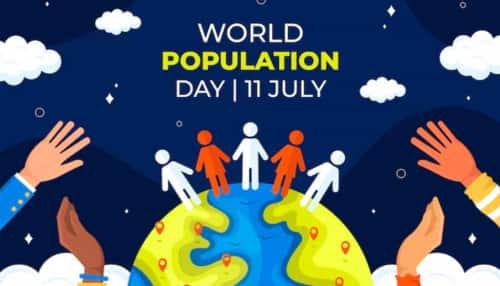
world population day 11 july

Why in News?

  • World Population Day 2025 highlights the need to empower youth—especially young women—by ensuring access to education, health, and reproductive rights, aligning with the 1994 ICPD promise. 

Introduction

  • As the world crosses the 8 billion population mark, the focus on macro-level planning is essential. However, to create inclusive and sustainable societies, attention must equally be paid to micro-level vulnerabilities—particularly young people, women, and marginalised groups
  • The 2025 theme of the United Nations for World Population Day“Empowering young people to create the families they want in a fair and hopeful world” — aligns with the 1994 International Conference on Population and Development (ICPD) agenda, emphasizing sexual and reproductive rights, freedom of choice, and gender equality.
  • India, with the largest youth population globally, stands at a critical demographic juncture. 
  • Leveraging this demographic dividend through rights-based policies and investments in education, health, and employment is not only a moral imperative but also an economic necessity.

India’s Youth Bulge: Opportunity and Challenge

Demographic Profile

  • According to UNICEF, India has 371 million youth (15–29 years) — the largest in the world.
  • This presents both a challenge (resource strain) and an opportunity (economic growth potential).

Economic Potential

  • With the right investments, India’s youth can add $1 trillion to GDP by 2030 (World Bank & NITI Aayog).
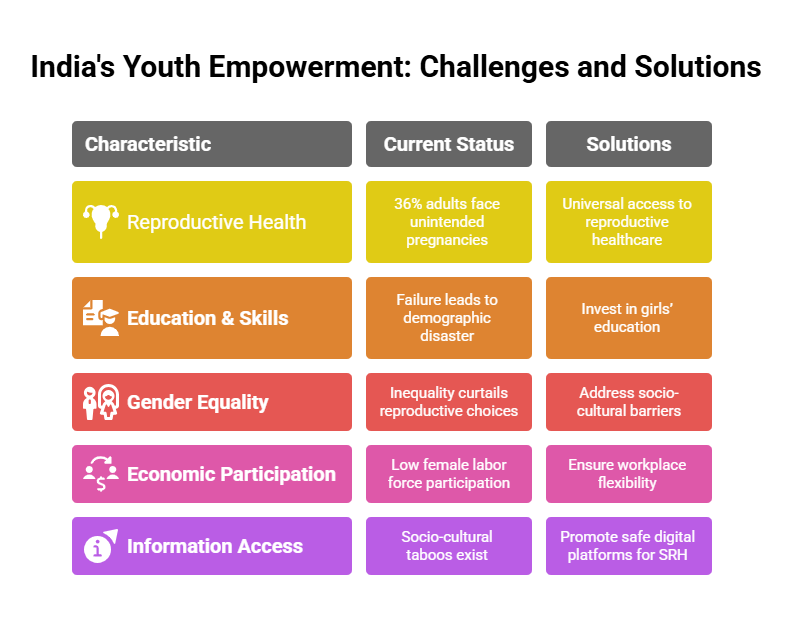
  • However, failure to provide education, skills, and reproductive autonomy may result in a demographic disaster rather than a dividend.
india youth empowerment challenges and solutions

Current Status: Progress and Persistent Gaps

Progress Made

  • Schemes like ‘Beti Bachao, Beti Padhao’ and the National Adolescent Health Programme have reduced child marriage and adolescent fertility.
  • Child marriage has dropped from 47% in 2006 to 23.3% in 2019-21 (NFHS-5).

Persisting Issues

  • Teenage pregnancies still affect 7% of girls aged 15–19, with regional disparities.
  • 36% of Indian adults face unintended pregnancies; 30% have unmet reproductive goals (UNFPA, 2025).
  • Gender inequality and socio-cultural norms continue to curtail reproductive choices, especially among young women.

Case Studies:

1. Project Udaan (Rajasthan, 2017–2022)

  • Objectives: Prevent child marriage and teenage pregnancy.
  • Strategies:
    • Keeping girls in secondary school through government scholarships.
    • Awareness generation on reproductive health.
    • Access to modern contraceptives.
  • Outcomes:
    • 30,000 child marriages were prevented.
    • 15,000 teenage pregnancies averted.

2. Advika Programme (Odisha, 2019–present)

  • Partnership: Government of Odisha with UNICEF & UNFPA.
  • Key Features:
    • Community mobilisation and leadership training.
    • Skill development and child protection awareness.
  • Impact:
    • 11,000 villages declared child marriage-free.
    • 950 child marriages stopped in 2022 alone.

3. Project Manzil (Rajasthan, 2019–2025)

  • Aim: Economic empowerment of young women.
  • Approach:
    • Human-centred design to align skill training with aspirations.
    • Gender-friendly employment creation.
  • Results:
    • 28,000 young women trained; 16,000 employed.
    • Enhanced bargaining power and delayed marriage decisions.

Key Structural Barriers

  1. Lack of access to contraception and safe abortion.
  2. Gender-based violence and child marriage.
  3. Low female labour force participation (hovering around 25%).
  4. Inadequate mental health and life skills education.
  5. Socio-cultural taboos around reproductive autonomy.

The Way Forward:

  • Universal access to reproductive healthcare including safe abortion and infertility care.
  • Invest in girls’ education, conditional cash transfers, and community mobilisation.
  • Ensure housing, childcare, and workplace flexibility to enhance participation.
  • Promote life-skills training to develop autonomy and confidence.

Policy Suggestions for India

  • Integrate Comprehensive Sexuality Education (CSE) in school curricula.
  • Expand schemes like Mission Shakti and Skill India with a youth-gender lens.
  • Promote safe digital platforms for youth to access SRH (Sexual and Reproductive Health) information.
  • Increase budgetary allocation for adolescent health programmes under National Health Mission (NHM).

Conclusion

  • As India celebrates World Population Day 2025, it must reflect on the promise of the ICPD — that every individual has the right to make informed choices about their body and future
  • By investing in the empowerment of youth, especially girls, India can unlock immense economic and social potential.
  • Projects like Udaan, Advika, and Manzil illustrate that rights-based, holistic, and community-engaged strategies can produce transformative results. 
  • But to scale up these successes, India must ensure cross-sectoral convergence, address socio-cultural barriers, and promote an ecosystem of dignity, choice, and opportunity.
  • Empowering youth today is not just about population control — it is about nation-building and ensuring a fair, inclusive, and hopeful future for the largest generation of young people in history.

Economic Implications

For Indian Exporters

  • These reforms reduce transaction costs and compliance hurdles
  • Encourage a more competitive and efficient export environment
  • Promote value addition in key sectors like leather

For Tamil Nadu

  • The reforms particularly benefit the state’s leather industry, a major contributor to employment and exports
  • Boost the marketability of GI-tagged E.I. leather, enhancing rural and traditional industries

For Trade Policy

  • These decisions indicate a shift from regulatory controls to policy facilitation

Reinforce the goals of Make in India, Atmanirbhar Bharat, and India’s ambition to become a leading export power

Recently, BVR Subrahmanyam, CEO of NITI Aayog, claimed that India has overtaken Japan to become the fourth-largest economy in the world, citing data from the International Monetary Fund (IMF). 

India’s rank as the world’s largest economy varies by measure—nominal GDP or purchasing power parity (PPP)—each with key implications for economic analysis.

Significance and Applications

Leave a Reply

Your email address will not be published. Required fields are marked *

Call Us Now !

Copyright © JICE ACADEMY FOR EXCELLENCE PRIVATE LIMITED