
UPSC CURRENT AFFAIRS – 18th July 2025

Home / UPSC / Current Affairs / Universe and Matter-Antimatter Asymmetry

Universe and Matter-Antimatter Asymmetry

universe and matter-antimatter asymmetry

Why in News?

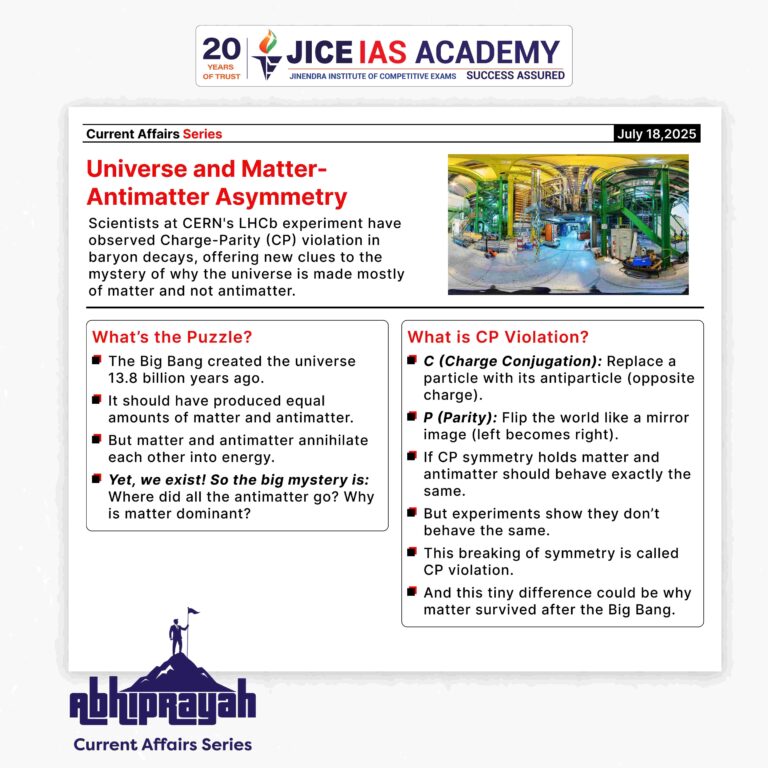
  • Scientists at CERN’s LHCb experiment have observed CP violation in baryon decays, offering insights into the matter-antimatter imbalance in the universe.

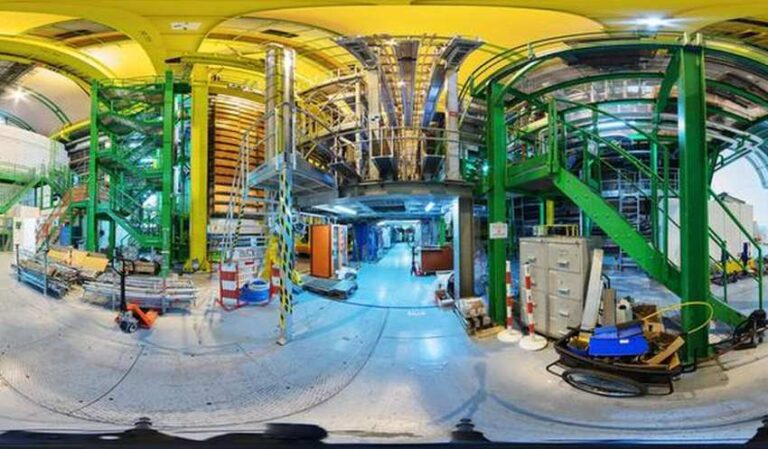
large-scale industrial or scientific facility

Introduction

  • An international team of scientists working at the Large Hadron Collider (LHC) in Europe reported a historic discovery in particle physics — the first-ever observation of CP violation in baryon decays. 
  • This finding could be a crucial step toward understanding why the universe is composed predominantly of matter, even though the Big Bang should have created equal amounts of matter and antimatter.

The Matter-Antimatter Asymmetry Puzzle

  • According to current cosmological models, the Big Bang, which occurred around 13.8 billion years ago, should have generated equal amounts of matter and antimatter
  • In theory, these should have annihilated each other, leaving behind a universe filled with radiation and no substantial matter. 
  • However, the observable universe today is overwhelmingly composed of matter — stars, galaxies, and living beings — with very little antimatter
  • This discrepancy is one of the biggest unsolved mysteries in physics.
  • Physicists suspect that the answer lies in subtle differences in how matter and antimatter behave, a phenomenon known as CP violation.

Understanding CP Violation

  • CP stands for Charge Conjugation (C) and Parity (P):
    • Charge Conjugation (C): Swapping a particle with its antiparticle, which has opposite electric charge.
    • Parity (P): A mirror inversion of spatial coordinates — flipping left and right.
  • If the universe treated matter and antimatter identically, CP symmetry would hold. However, several experiments have revealed that CP symmetry is violated, meaning matter and antimatter can behave differently under certain conditions.
  • Importantly, CP violation is one of the Sakharov conditions, proposed by physicist Andrei Sakharov, necessary to explain the matter-dominated universe.

Previous Observations of CP Violation

  • Before this latest result, CP violation had only been observed in mesons — particles made of a quark and an antiquark. These included neutral K mesons (kaons) and B mesons. 
  • However, the dominant constituents of visible matter — protons and neutrons — are baryons, made of three quarks. Detecting CP violation in baryons was therefore a long-sought milestone.
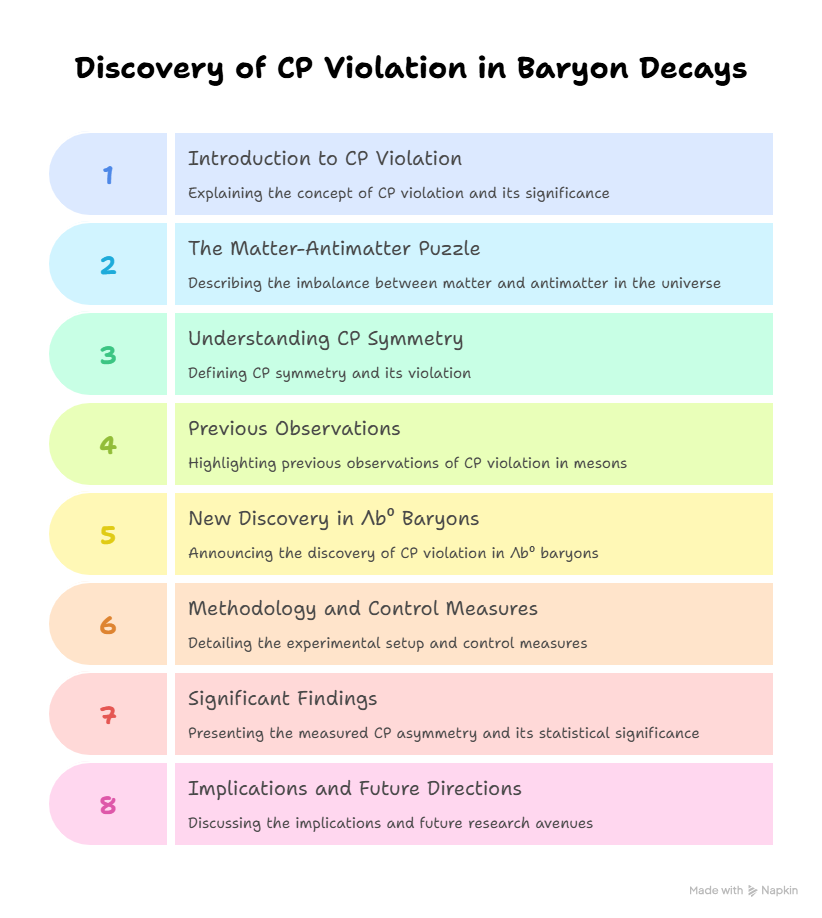
discovery of cp violation in baryon decays

New Discovery in Λb⁰ Baryons

The LHCb experiment at CERN studied the decay of a particular heavy baryon, the Λb⁰ (lambda-b-zero) particle. This particle is composed of three quarks: up, down, and bottom. Its antimatter counterpart, Λb⁰-bar, is made of the corresponding antiquarks.

Researchers analyzed how these particles decayed into specific final products:

  • Λb⁰ → proton + negative kaon + positive pion + negative pion
  • Λb⁰-bar → antiproton + positive kaon + negative pion + positive pion

If CP symmetry were conserved, the decay rates of Λb⁰ and Λb⁰-bar into their respective products would be identical. But any statistically significant difference in decay rates indicates CP violation.

Methodology and Control Measures

  • The experiment relied on data collected from billions of proton-proton collisions at the LHC, where Λb⁰ and Λb⁰-bar baryons were occasionally produced. 
  • Researchers used advanced machine learning techniques and statistical algorithms to identify rare decay events of interest.
  • To ensure accuracy, scientists used a control channel — a similar decay process not expected to exhibit CP violation — to account for experimental biases such as:
    • Slight differences in Λb⁰ and Λb⁰-bar production rates
    • Detector sensitivity variations
  • By subtracting any asymmetry observed in the control channel, they isolated the true CP asymmetry.

Significant Findings

  • The measured CP asymmetry in Λb⁰ decays was found to be approximately 2.45%, with a statistical significance of 5.2 sigma — exceeding the 5-sigma threshold required in particle physics to claim a discovery.
  • This result constitutes the first confirmed observation of CP violation in baryons, offering a new perspective on the matter-antimatter imbalance in the universe.

Implications and Future Directions

While the observed CP violation is not yet large enough to fully account for the vast dominance of matter over antimatter, it is a crucial breakthrough. It opens the door to:

    • Exploring CP violation in other baryon types
    • Refining theoretical models of particle interactions
    • Searching for new particles or forces beyond the Standard Model
    • Providing constraints or guidance for cosmological theories on baryogenesis
  • This discovery deepens our understanding of why the universe exists in its current form
  • Every atom, star, and living organism owes its existence to an imbalance that likely arose in the earliest moments of the cosmos. 
  • Understanding the mechanisms behind CP violation may eventually unravel the origin of this cosmic preference for matter.

Conclusion

  • The detection of CP violation in the decays of Λb⁰ baryons is a landmark achievement in the quest to solve the mystery of the matter-antimatter asymmetry
  • It adds an important piece to the puzzle of our universe’s origin and evolution, taking us one step closer to answering a fundamental question: Why is there something rather than nothing?

Economic Implications

For Indian Exporters

  • These reforms reduce transaction costs and compliance hurdles
  • Encourage a more competitive and efficient export environment
  • Promote value addition in key sectors like leather

For Tamil Nadu

  • The reforms particularly benefit the state’s leather industry, a major contributor to employment and exports
  • Boost the marketability of GI-tagged E.I. leather, enhancing rural and traditional industries

For Trade Policy

  • These decisions indicate a shift from regulatory controls to policy facilitation

Reinforce the goals of Make in India, Atmanirbhar Bharat, and India’s ambition to become a leading export power

Recently, BVR Subrahmanyam, CEO of NITI Aayog, claimed that India has overtaken Japan to become the fourth-largest economy in the world, citing data from the International Monetary Fund (IMF). 

India’s rank as the world’s largest economy varies by measure—nominal GDP or purchasing power parity (PPP)—each with key implications for economic analysis.

Significance and Applications

Leave a Reply

Your email address will not be published. Required fields are marked *

Call Us Now !

Copyright © JICE ACADEMY FOR EXCELLENCE PRIVATE LIMITED