
UPSC CURRENT AFFAIRS – 04th August 2025
Urbanisation, Air Pollution, and the Rise of Electric Vehicles
Why in News?
Rapid urbanisation in developing countries is worsening air pollution, prompting a global shift towards electric and hydrogen vehicles.
Introduction
- The pace of urbanisation in developing countries is accelerating, with nearly 70% of their population expected to live in cities by 2050.
- While this urban shift provides better access to employment, healthcare, and education, it also generates complex challenges—especially urban air pollution and congestion—which severely impact public health and the environment.
- One of the most significant contributors to urban air pollution is vehicular emissions, particularly Particulate Matter (PM2.5). Amid these concerns, there is a global push towards clean mobility solutions, with Electric Vehicles (EVs) and Hydrogen Fuel Cell Vehicles (FCEVs) emerging as alternatives to fossil fuel-based transportation.
Impact of Air Pollution on Urban Health: The Indian Scenario
Key Findings from the Lancet Study (2008–2019):
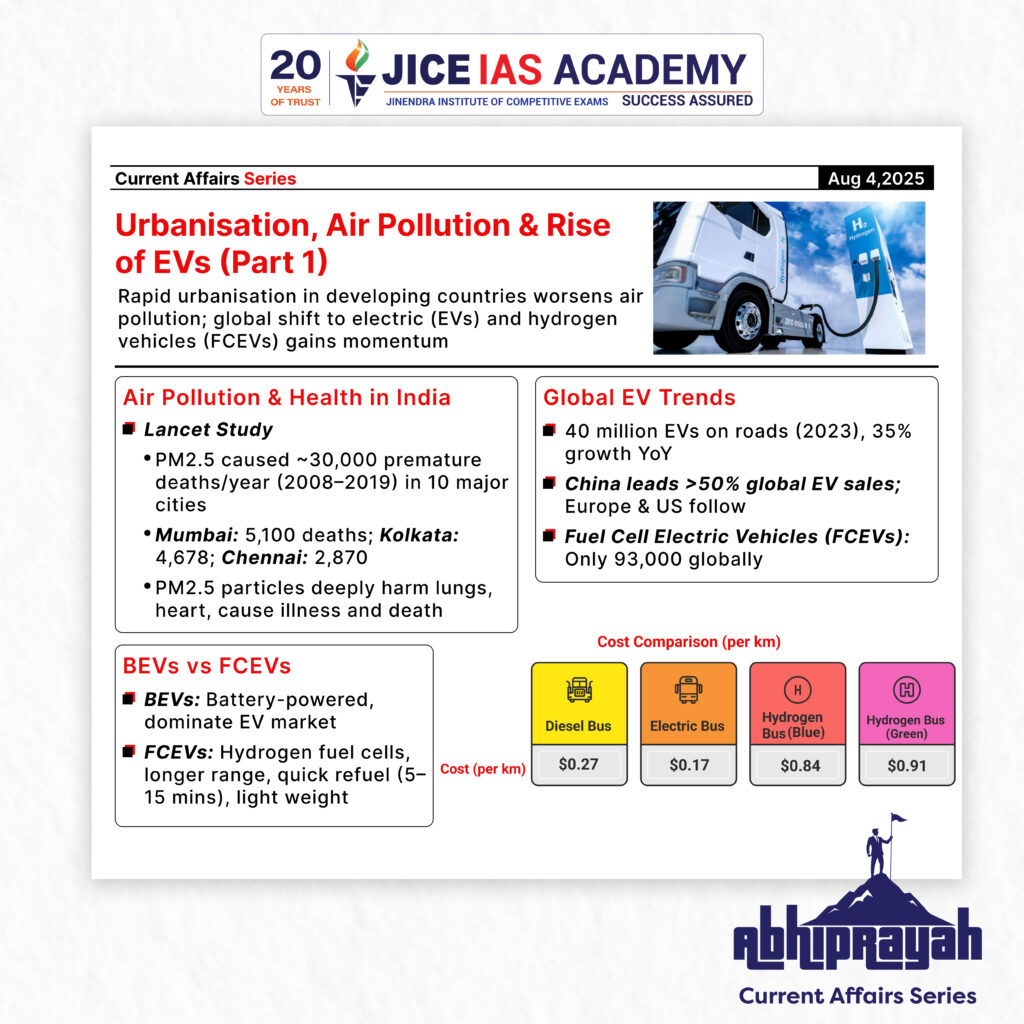
- In India, short-term exposure to PM2.5 led to 30,000 premature deaths annually across 10 major cities.
- These deaths constituted approximately 7.2% of all deaths in those cities.
City-wise breakdown:
- Mumbai: 5,100 deaths/year
- Kolkata: 4,678 deaths/year
- Chennai: 2,870 deaths/year
Why PM2.5 is Dangerous:
- PM2.5 refers to fine inhalable particles with diameters that are 2.5 micrometres or smaller.
- These particles penetrate deep into the lungs and bloodstream, causing respiratory and cardiovascular illnesses, and even premature death.
Global Response:
Cities around the world—Cairo, Dakar, Santiago, Bogotá, among others—are taking proactive steps to reduce pollution by adopting cleaner public transport, primarily through electrification.
Global Electric Vehicle (EV) Trends:
- By 2023, there were 40 million EVs on the road globally—a 35% increase from the previous year.
- China leads the global market with over 50% of EV sales, followed by Europe and the United States.
- Despite the growth, EVs still form a small share of total vehicles globally.
Alternatives: BEVs vs. FCEVs
Battery Electric Vehicles (BEVs):
- Powered by rechargeable batteries.
- Dominate the current EV market.
Fuel Cell Electric Vehicles (FCEVs):
- Powered by hydrogen fuel cells.
- Advantages:
- Longer driving range.
- Refuelling time of only 5–15 minutes.
- Lighter than BEVs.
- Suitable for long-distance travel, rugged terrain, and cold climates.
Current Limitation:
- Only 93,000 FCEVs exist globally—a ratio of 1 hydrogen vehicle to 330 battery-powered vehicles.
- High initial and operational costs are key deterrents.
Cost Comparison: Initial & Operational
Initial Costs:
- Hydrogen fuel cell buses/trucks are 20–30% more expensive than battery-electric ones.
- Prices are expected to converge by 2030 due to technological advancements.
Operational Costs per Km:
Vehicle Type | Cost per km (USD) |
Diesel Bus | $0.27 |
Electric Bus | $0.17 |
Hydrogen (Blue) Bus | $0.84 |
Hydrogen (Green) Bus | $0.91 |
- Electric buses are the most cost-effective currently.
- Hydrogen vehicles are expensive to operate, especially green hydrogen, which is derived from renewables.
India’s EV Adoption Landscape
Current Penetration (2023):
- EVs = 5% of total vehicle sales.
- Electric car registrations rose by 70% YoY (80,000 units).
- Overall car sales rose only by 10%, showing a shift in consumer preference.
Segment-wise Growth:
- a) Three-Wheelers:
- India accounted for 60% of global electric three-wheeler sales.
- 0.58 million units sold in 2023.
- India surpassed China to become the largest e-three-wheeler market globally.
- b) Two-Wheelers:
- 0.88 million electric two-wheelers sold in India (2023).
- Second to China, which sold 6 million units.
China, India, and ASEAN nations dominate the global electric 2 & 3-wheeler markets, contributing >95% of total sales.
Challenges to EV and FCEV Adoption in India
Infrastructure Gaps:
- Limited public charging stations.
- Underdeveloped hydrogen refuelling infrastructure.
High Initial Costs:
- Battery cost still makes electric vehicles expensive for the average consumer.
Energy Source Dependence:
- India’s grid still largely dependent on coal. EV sustainability hinges on clean energy.
Policy and Incentive Issues:
- Inconsistent state-level policies.
- Need for stronger financial incentives and manufacturing support.
Government Interventions & Way Forward
Key Initiatives:
- FAME India Scheme (I & II) – Financial incentives for EV buyers and infrastructure development.
- PLI Scheme for ACC batteries – Boosting local battery manufacturing.
- National Hydrogen Mission – Support for green hydrogen development and FCEVs.
Recommendations:
- Prioritise EV adoption in public transport (buses, rickshaws).
- Invest in battery R&D and recycling ecosystems.
- Create urban low-emission zones.
- Strengthen last-mile connectivity using electric 2 & 3-wheelers.
Conclusion
- As India and other developing countries continue to urbanise, the need for sustainable and clean transport solutions is more urgent than ever.
- The twin goals of reducing pollution-related deaths and achieving energy efficiency can be addressed through a strategic push towards electric and hydrogen-powered mobility.
- India’s rapid rise in electric three-wheeler and two-wheeler markets is promising.
- However, long-term sustainability requires a balanced approach combining technological innovation, policy support, and green energy transition.

3rd UN conference on landlocked countries
UPSC CURRENT AFFAIRS – 08th August 2025 Home / 3rd UN conference on landlocked countries Why in News? At the

Issue of soapstone mining in Uttarakhand’s Bageshwar
UPSC CURRENT AFFAIRS – 08th August 2025 Home / Issue of soapstone mining in Uttarakhand’s Bageshwar Why in News? Unregulated
Groundwater Pollution in India – A Silent Public Health Emergency
UPSC CURRENT AFFAIRS – 08th August 2025 Home / Groundwater Pollution in India – A Silent Public Health Emergency Why
Universal banking- need and impact
UPSC CURRENT AFFAIRS – 08th August 2025 Home / Universal banking- need and impact Why in News? The Reserve Bank

India’s “Goldilocks” Economy: A Critical Appraisal
UPSC CURRENT AFFAIRS – 08th August 2025 Home / India’s “Goldilocks” Economy: A Critical Appraisal Why in News? The Finance

U.S.-India Trade Dispute: Trump’s 50% Tariffs and India’s Oil Imports from Russia
UPSC CURRENT AFFAIRS – 07th August 2025 Home / U.S.-India Trade Dispute: Trump’s 50% Tariffs and India’s Oil Imports from

Eco-Friendly Solution to Teak Pest Crisis: KFRI’s HpNPV Technology
UPSC CURRENT AFFAIRS – 07th August 2025 Home / Eco-Friendly Solution to Teak Pest Crisis: KFRI’s HpNPV Technology Why in

New Species of Non-Venomous Rain Snake Discovered in Mizoram
UPSC CURRENT AFFAIRS – 07th August 2025 Home / New Species of Non-Venomous Rain Snake Discovered in Mizoram Why in

Introduction
Economic Implications
For Indian Exporters
- These reforms reduce transaction costs and compliance hurdles
- Encourage a more competitive and efficient export environment
- Promote value addition in key sectors like leather
For Tamil Nadu
- The reforms particularly benefit the state’s leather industry, a major contributor to employment and exports
- Boost the marketability of GI-tagged E.I. leather, enhancing rural and traditional industries
For Trade Policy
- These decisions indicate a shift from regulatory controls to policy facilitation
Reinforce the goals of Make in India, Atmanirbhar Bharat, and India’s ambition to become a leading export power
Recently, BVR Subrahmanyam, CEO of NITI Aayog, claimed that India has overtaken Japan to become the fourth-largest economy in the world, citing data from the International Monetary Fund (IMF).
India’s rank as the world’s largest economy varies by measure—nominal GDP or purchasing power parity (PPP)—each with key implications for economic analysis.
The clarity here is outstanding.