UPSC CURRENT AFFAIRS – 29th July 2025

Home / UPSC / Current Affairs / U.S.–E.U. Tariff Deal and Global Trade Crisis

U.S.–E.U. Tariff Deal and Global Trade Crisis

Why in News?

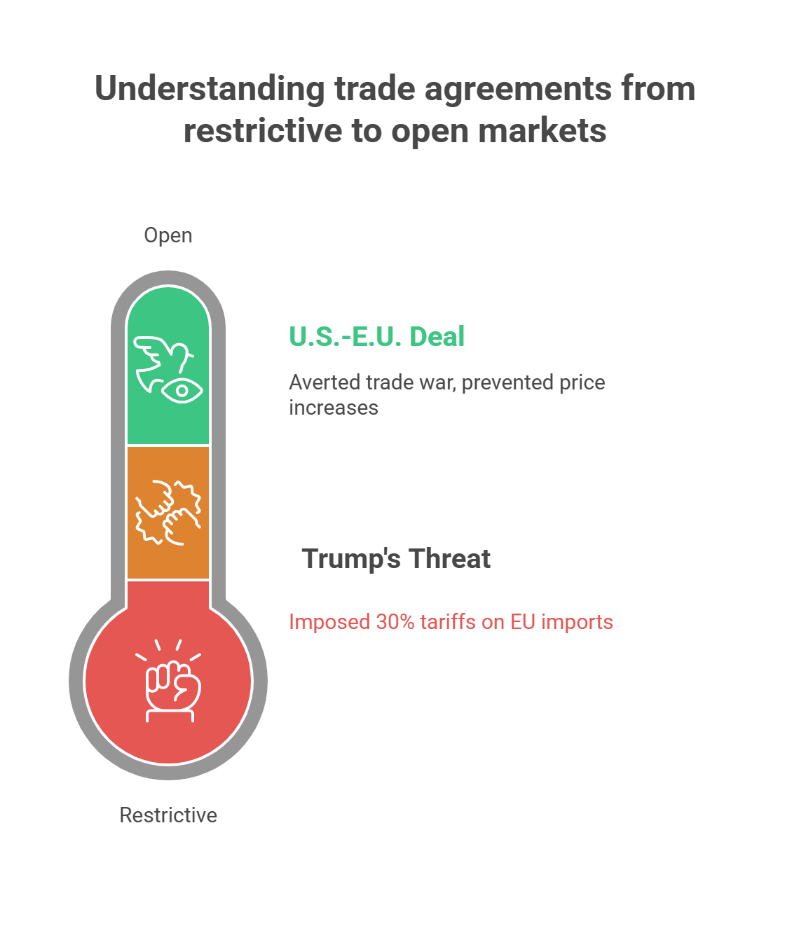
  • The United States and European Union reached a last-minute tariff agreement, averting a potential transatlantic trade war.

Introduction

  • The United States and the European Union reached a landmark tariff agreement just days before a White House-imposed deadline for sweeping import taxes on EU goods.
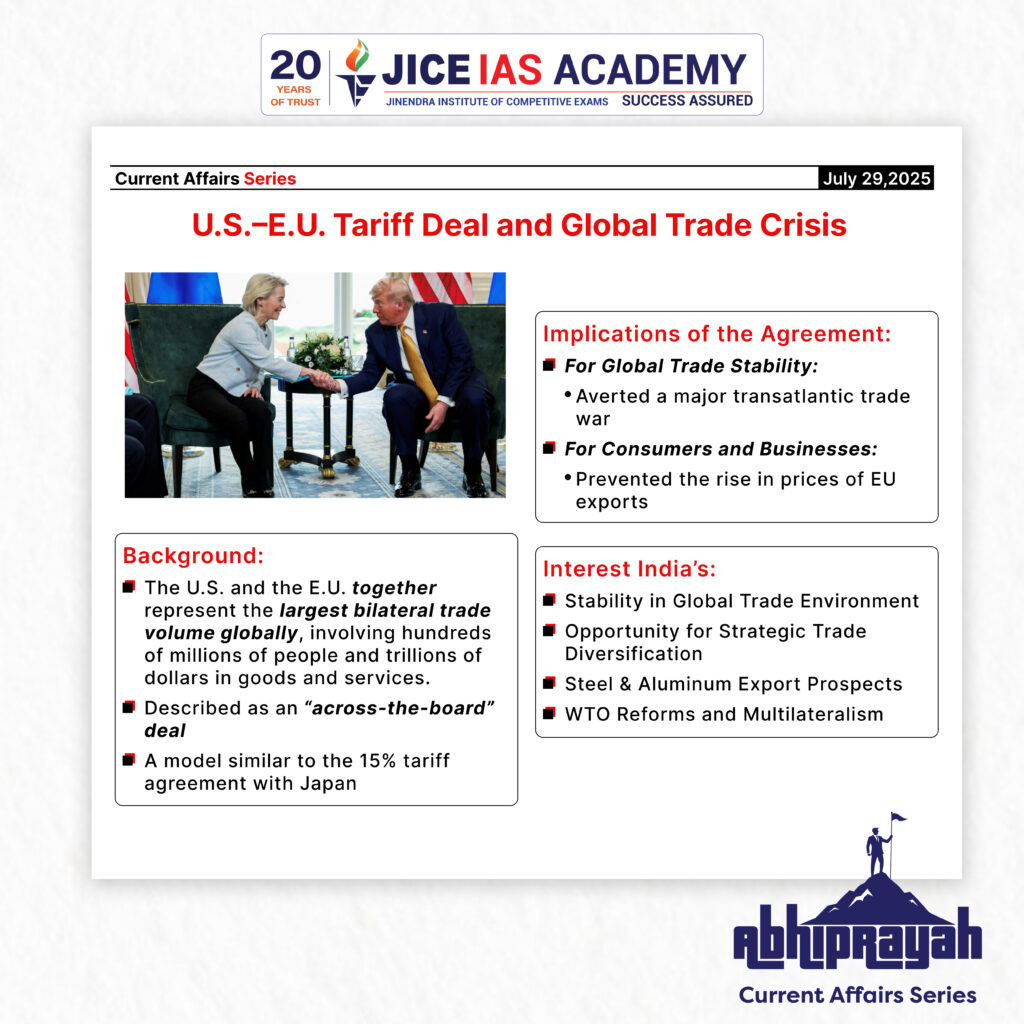
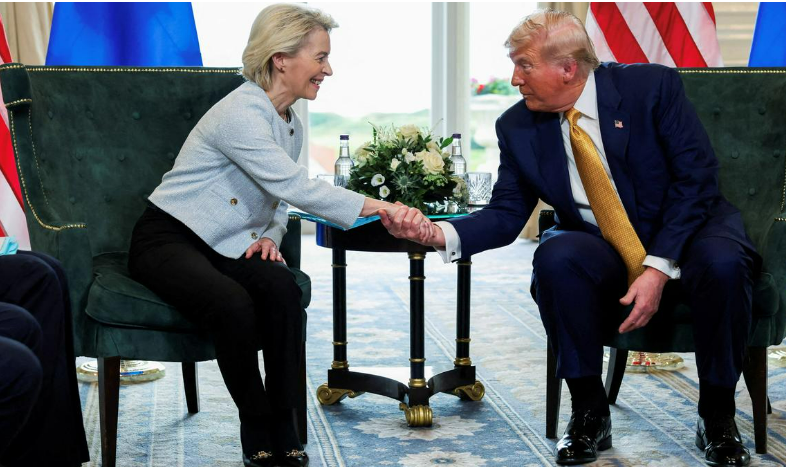
  • The announcement came after a high-stakes meeting between S. President Donald Trump and European Commission President Ursula von der Leyen at Trump’s golf course in Scotland.

Background:

  • The U.S. and the E.U. together represent the largest bilateral trade volume globally, involving hundreds of millions of people and trillions of dollars in goods and services.
  • The Trump administration had threatened to impose 30% tariffs on EU imports by August 1, 2025, unless a new agreement was reached.

Key Highlights of the Agreement:

  • Described as an “across-the-board” deal, though specific tariff terms remain undisclosed.
  • Trump emphasized a model similar to the 15% tariff agreement with Japan, indicating his unwillingness to accept lower rates.
  • Von der Leyen acknowledged the magnitude of the deal, calling it possibly the biggest ever for both parties.

Negotiation Dynamics:

  • Talks were held privately in Scotland and lasted briefly before both leaders announced an agreement.

Implications of the Agreement:

For Global Trade Stability:

  • Averted a major transatlantic trade war, which could have triggered retaliatory tariffs on hundreds of U.S. products, including: Beef, Beer, Auto parts and Boeing aircraft

For Consumers and Businesses:

  • Prevented the rise in prices of EU exports such as: French cheese, Italian leather, German electronics and Spanish pharmaceuticals
  • Provided market clarity and stability for transatlantic companies and investors.

Implications for India:

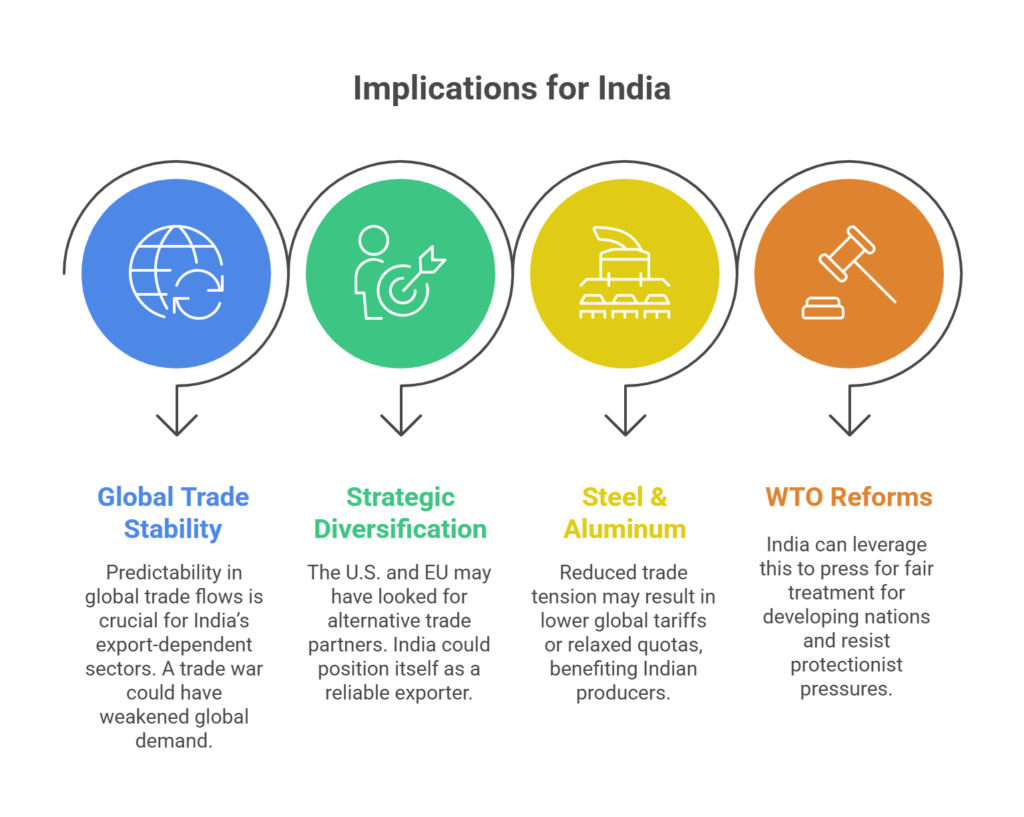
  1. Stability in Global Trade Environment
  • Avoiding a U.S.–EU tariff escalation brings predictability to global trade flows, which is crucial for India’s export-dependent sectors like engineering goods, auto components, and IT services.
  • A trade war could have weakened global demand and disrupted supply chains.
  1. Opportunity for Strategic Trade Diversification
  • Had tariffs been reimposed, the U.S. and EU may have looked for alternative trade partners to fill market gaps. India could position itself as a reliable exporter of steel, aluminum, pharmaceuticals, and textiles.
  • India can explore new bilateral trade agreements in this atmosphere of relative calm.
  1. Steel & Aluminum Export Prospects
  • India exports both steel and aluminum to the U.S. and EU.
  • While the deal focuses on internal tariff adjustments, reduced trade tension among developed countries may result in lower global tariffs or relaxed quotas, benefiting Indian producers.
  1. WTO Reforms and Multilateralism
  • The U.S.–EU deal emphasized rules-based trade. India, a strong advocate for WTO reforms, can leverage this to press for fair treatment for developing nations and resist protectionist pressures.

Challenges and Cautions:

  • Preferential treatment between U.S.–EU may exclude India and lead to trade diversion.
  • India must closely monitor evolving trade alliances and ensure it is not sidelined by plurilateral agreements like the Indo-Pacific Economic Framework (IPEF) or TTC (Trade and Tech Council).

Conclusion:

  • The tariff agreement between the U.S. and the E.U. underscores the delicate balance of economic diplomacy and domestic politics in shaping global trade.

Introduction

Economic Implications

For Indian Exporters

  • These reforms reduce transaction costs and compliance hurdles
  • Encourage a more competitive and efficient export environment
  • Promote value addition in key sectors like leather

For Tamil Nadu

  • The reforms particularly benefit the state’s leather industry, a major contributor to employment and exports
  • Boost the marketability of GI-tagged E.I. leather, enhancing rural and traditional industries

For Trade Policy

  • These decisions indicate a shift from regulatory controls to policy facilitation

Reinforce the goals of Make in India, Atmanirbhar Bharat, and India’s ambition to become a leading export power

Recently, BVR Subrahmanyam, CEO of NITI Aayog, claimed that India has overtaken Japan to become the fourth-largest economy in the world, citing data from the International Monetary Fund (IMF). 

India’s rank as the world’s largest economy varies by measure—nominal GDP or purchasing power parity (PPP)—each with key implications for economic analysis.

Significance and Applications

One Response

Leave a Reply

Your email address will not be published. Required fields are marked *

Call Us Now !

Copyright © JICE ACADEMY FOR EXCELLENCE PRIVATE LIMITED