UPSC CURRENT AFFAIRS – 12th July 2025

Home / UPSC / Current Affairs / Varsha Deshpande Wins 2025 United Nations Population Award

Varsha Deshpande Wins 2025 United Nations Population Award

current affairs document varsha deshpande wins 2025 united nations population award

Why in News?

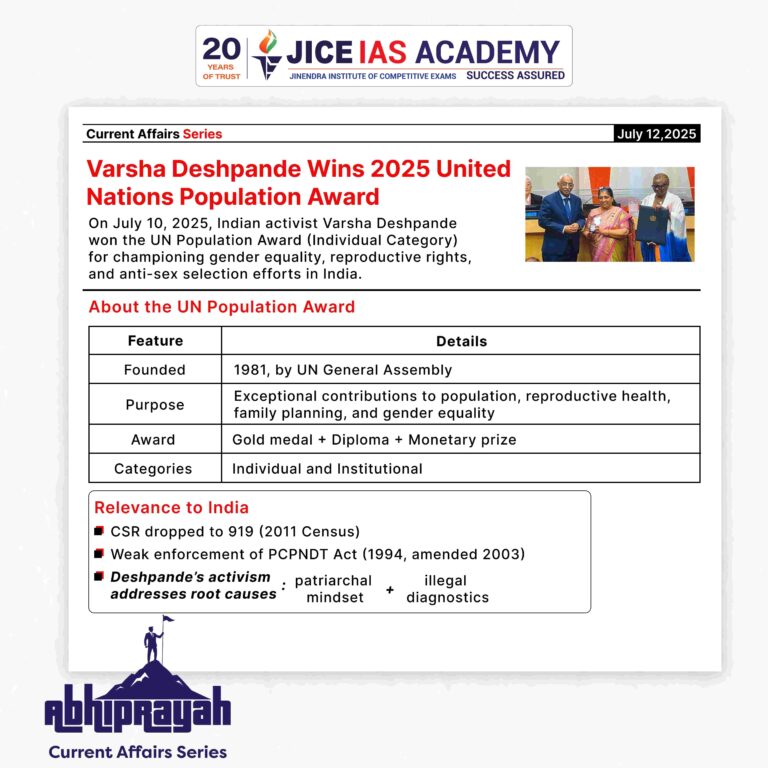
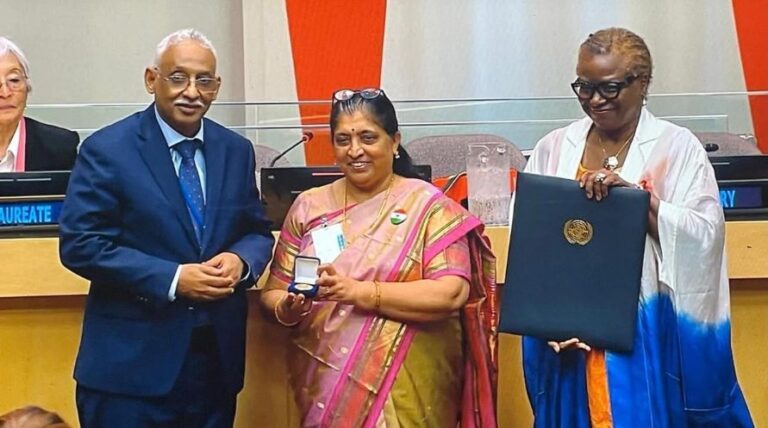
  • Indian women’s rights activist Varsha Deshpande received the 2025 United Nations Population Award for her pioneering work in promoting gender equality and combating gender-biased sex selection in India.
varsha deshpande wins 2025 united nations population award

Background

  • Indian women’s rights activist Varsha Deshpande has been awarded the 2025 United Nations Population Award in the individual category for her outstanding contributions to gender equality and reproductive rights. 
  • Deshpande was recognised for her decades-long legal and social activism, particularly her pioneering efforts to combat gender-biased sex selection and to promote the rights of marginalised women in India. 
  • She has been at the forefront of community-led initiatives aimed at ending discriminatory practices and strengthening the implementation of relevant legal frameworks.

About the United Nations Population Award

  • Establishment: The award was instituted in 1981 by the United Nations General Assembly.
  • Objective: It honours individuals and institutions for exceptional contributions in the fields of population and reproductive health, family planning, gender equality, and related developmental concerns.
  • Components of the Award: The award includes a gold medal, a diploma, and a monetary prize.
  • Awardees: The award is presented annually and includes both individual and institutional categories.

Key Areas of Work and Impact

  1. Legal Reform and Gender Justice
    • Deshpande has utilised the legal system as a strategic tool to advance gender equality. 
    • She has worked extensively to ensure joint property ownership for women, advocated for gender-sensitive implementation of personal laws, and provided legal aid to vulnerable groups.
  1. Combating Gender-Biased Sex Selection
    • A central focus of her activism has been the campaign against gender-biased sex selection. She has played a vital role in strengthening the implementation of the Pre-Conception and Pre-Natal Diagnostic Techniques (PCPNDT) Act of 1994. 
  1. Prevention of Child Marriage
    • Deshpande has been actively involved in community-level efforts to prevent child marriage. Her initiatives have empowered girls to continue their education and resist social pressure to marry early.
  1. Support for Women in the Informal Sector
    • Through her organisation, she has worked to promote the rights and welfare of women in the informal economy. 
    • This includes advocating for maternity benefits, fair wages, and safe working conditions for domestic workers, agricultural labourers, and other unorganised sector workers.
  1. Grassroots Mobilisation and Legal Awareness
    • Deshpande has led numerous campaigns to educate rural communities about women’s rights, legal remedies, and the value of girl children. 
    • Her work has involved organising workshops, legal literacy camps, and community meetings, especially in remote regions of Maharashtra.

Note: The keywords can be referred for measures to address gender-bias problem in the society

Role of Civil Society in Governance

    • The recognition of Varsha Deshpande underscores the vital role of civil society organisations in supplementing governmental efforts. 
    • Her work with the Dalit Mahila Vikas Mandal demonstrates how grassroots activism can influence policy enforcement and catalyse social change.

Economic Implications

For Indian Exporters

  • These reforms reduce transaction costs and compliance hurdles
  • Encourage a more competitive and efficient export environment
  • Promote value addition in key sectors like leather

For Tamil Nadu

  • The reforms particularly benefit the state’s leather industry, a major contributor to employment and exports
  • Boost the marketability of GI-tagged E.I. leather, enhancing rural and traditional industries

For Trade Policy

  • These decisions indicate a shift from regulatory controls to policy facilitation

Reinforce the goals of Make in India, Atmanirbhar Bharat, and India’s ambition to become a leading export power

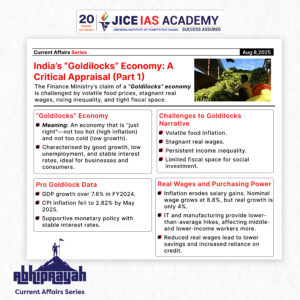
Recently, BVR Subrahmanyam, CEO of NITI Aayog, claimed that India has overtaken Japan to become the fourth-largest economy in the world, citing data from the International Monetary Fund (IMF). 

India’s rank as the world’s largest economy varies by measure—nominal GDP or purchasing power parity (PPP)—each with key implications for economic analysis.

Significance and Applications

Leave a Reply

Your email address will not be published. Required fields are marked *

Call Us Now !

Copyright © JICE ACADEMY FOR EXCELLENCE PRIVATE LIMITED