UPSC CURRENT AFFAIRS – 22nd July 2025

Home / UPSC / Current Affairs / Vice-President’s Mid-Term Resignation

Vice-President’s Mid-Term Resignation

Why in News?

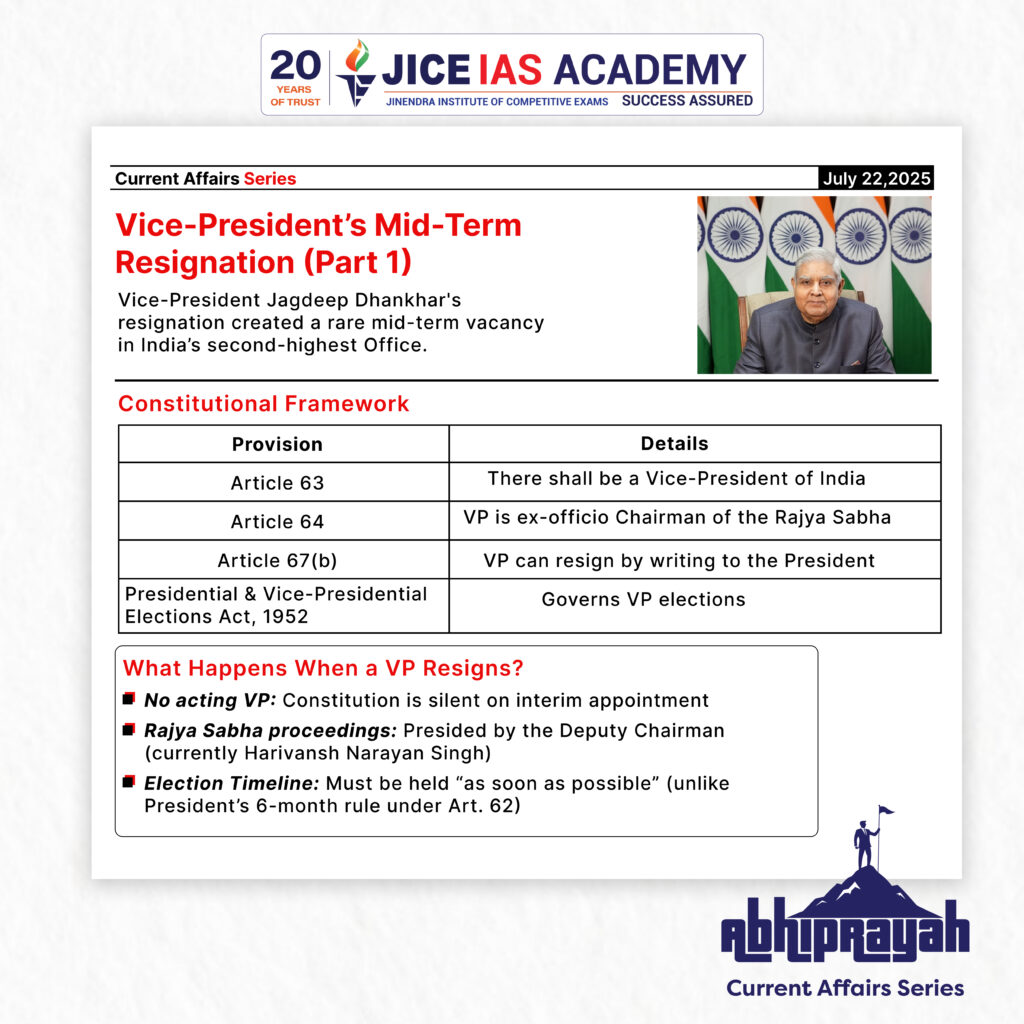
  • Vice-President Jagdeep Dhankhar’s resignation mid-term has created a rare vacancy in India’s second-highest constitutional office.

Introduction

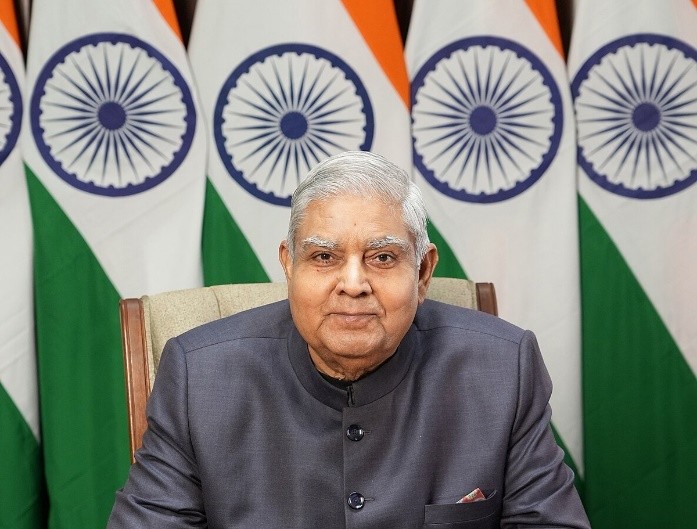
  • Vice-President Jagdeep Dhankhar’s resignation before the completion of his five-year term in July 2025 has created a rare mid-term vacancy in India’s second-highest constitutional office.
  • He is only the third Vice-President in India’s history to resign mid-term, after V. Giri (1969) and R. Venkataraman (1984) — both of whom resigned to contest presidential elections.
  • This situation brings into focus the constitutional provisions, electoral process, and interim arrangements following such a vacancy.

Constitutional Position and Duties

  • The Vice-President of India holds office for a term of five years [Article 67].
  • He is also the ex-officio Chairman of the Rajya Sabha [Article 64].
  • The Constitution does not provide for an acting Vice-President.

Abstentions as a Tool for Middle Powers

  • Abstention is not necessarily a sign of indecisiveness. Rather, it is increasingly seen as a deliberate strategy by emerging powers like India to avoid entanglement in great-power rivalries.
  • It also provides flexibility in multilateral negotiations and preserves future diplomatic space.

Examples of Recent Abstentions

  • Ukraine conflict – India abstained from U.N. resolutions condemning Russia, citing the need for dialogue and de-escalation.
  • Israel-Palestine – India abstained from resolutions seen as one-sided, advocating “building bridges” instead.

Timeline for Election

  • Unlike the office of the President, for which the Constitution mandates that the vacancy be filled within six months [Article 62(1)], no such deadline exists for filling a Vice-Presidential vacancy.
  • The only constitutional requirement is that the election be held “as soon as possible”.
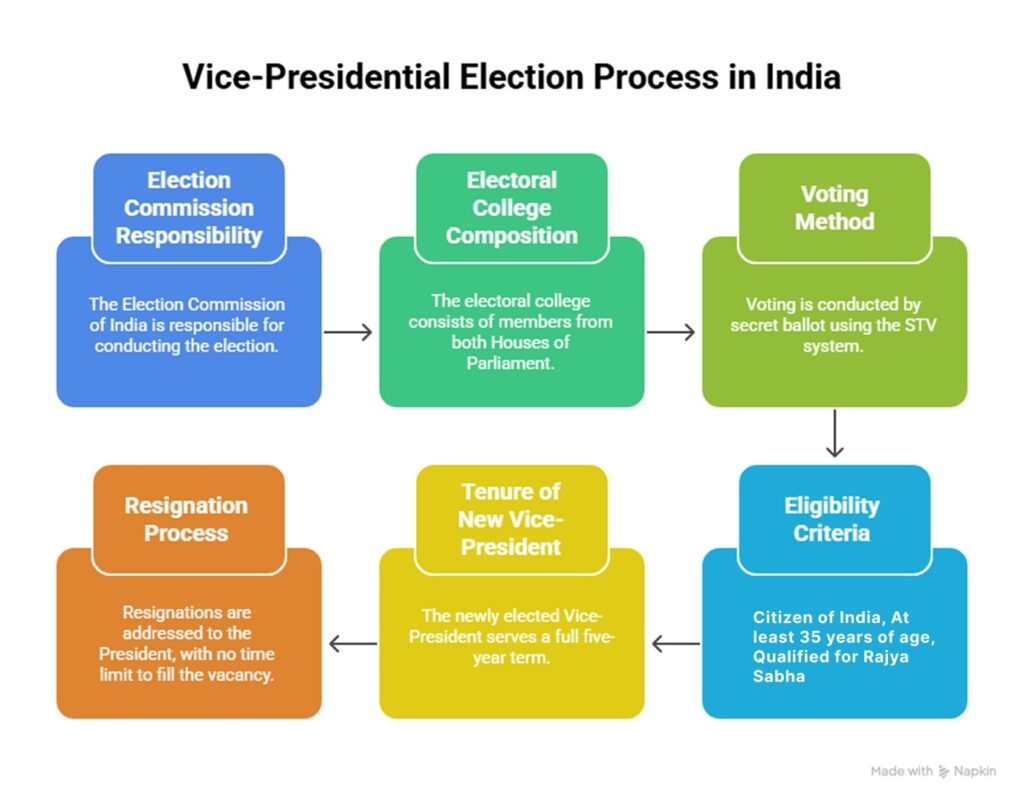
  • The Election Commission of India (ECI) is responsible for conducting the election, under the Presidential and Vice-Presidential Elections Act, 1952.

Tenure of the New Vice-President

  • The newly elected Vice-President will hold office for a full five-year term from the date of assumption of office, and not just the remainder of the previous term.

Electoral Process for Vice-President

  • The Vice-President is elected by an electoral college consisting of members of both Houses of ParliamentLok Sabha and Rajya Sabha, including nominated members.
  • State legislatures do not participate in this election.
  • Voting is held by secret ballot using the system of proportional representation by means of a single transferable vote (STV).

Eligibility Criteria for Vice-Presidential Candidates

A candidate must:

  • Be a citizen of India
  • Be at least 35 years of age
  • Be qualified for election as a member of the Rajya Sabha
  • Be a registered elector in any parliamentary constituency
  • Not hold any office of profit under the Government of India or any state government, except that of:
    • President
    • Vice-President
    • Governor
    • Minister at Union or State level

Tenure and Vacancy

  • Tenure: 5 years, but eligible for re-election.
  • In case of resignation, Article 67(b) applies — the resignation is addressed to the President.
  • Unlike the President, there is no constitutional time limit to fill the Vice-President’s post; the election must be held “as soon as possible”.

Who Performs the Duties in the Interim?

  • While the Vice-President’s office is vacant, no acting Vice-President is appointed.
  • However, the Deputy Chairman of the Rajya Sabha (currently Harivansh Narayan Singh) performs the function of presiding over the Rajya Sabha in his absence.

Economic Implications

For Indian Exporters

  • These reforms reduce transaction costs and compliance hurdles
  • Encourage a more competitive and efficient export environment
  • Promote value addition in key sectors like leather

For Tamil Nadu

  • The reforms particularly benefit the state’s leather industry, a major contributor to employment and exports
  • Boost the marketability of GI-tagged E.I. leather, enhancing rural and traditional industries

For Trade Policy

  • These decisions indicate a shift from regulatory controls to policy facilitation

Reinforce the goals of Make in India, Atmanirbhar Bharat, and India’s ambition to become a leading export power

Recently, BVR Subrahmanyam, CEO of NITI Aayog, claimed that India has overtaken Japan to become the fourth-largest economy in the world, citing data from the International Monetary Fund (IMF). 

India’s rank as the world’s largest economy varies by measure—nominal GDP or purchasing power parity (PPP)—each with key implications for economic analysis.

Significance and Applications

One Response

Leave a Reply

Your email address will not be published. Required fields are marked *

Call Us Now !

Copyright © JICE ACADEMY FOR EXCELLENCE PRIVATE LIMITED