
UPSC CURRENT AFFAIRS – 21st July 2025

Home / UPSC / Current Affairs / Visual ‘Sugar and Oil Boards’ to Promote Healthy Eating

Visual ‘Sugar and Oil Boards’ to Promote Healthy Eating

Why in News?

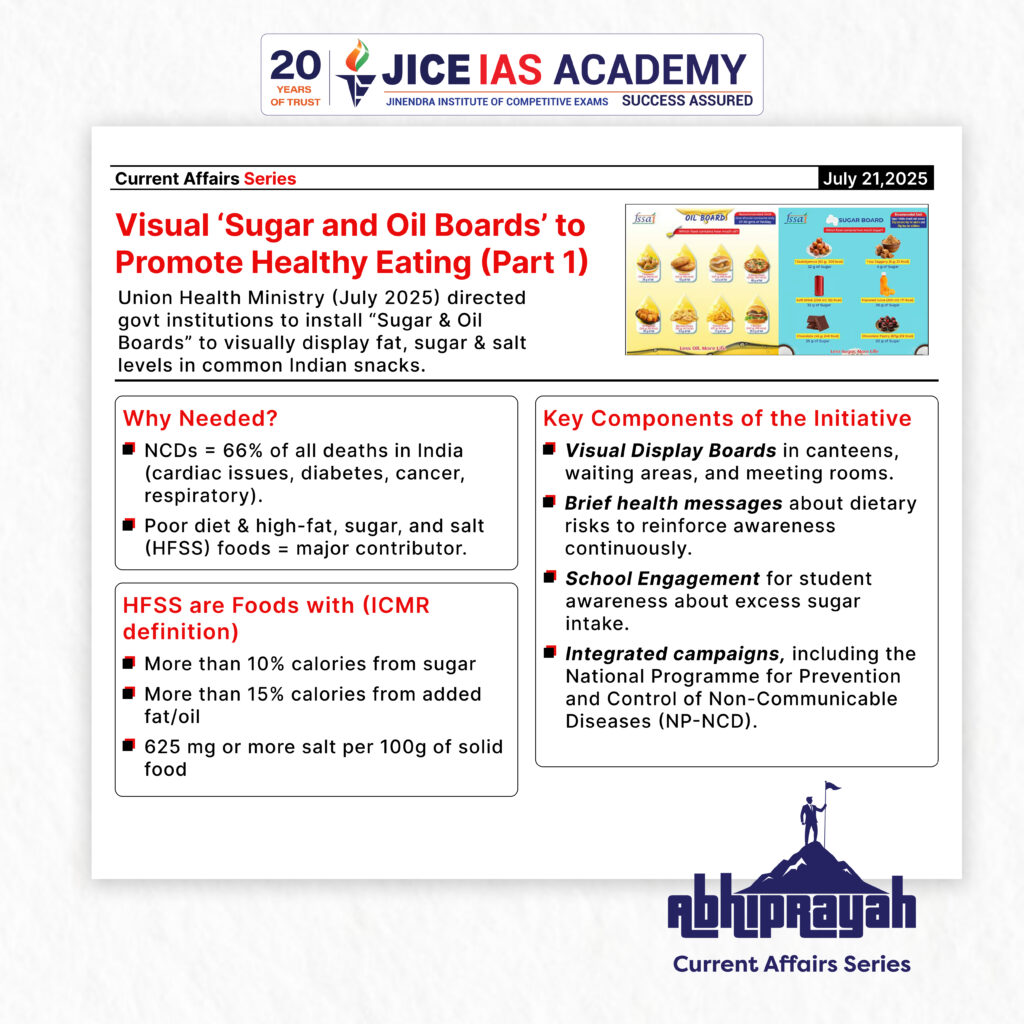
  • The Union Health Ministry has introduced ‘Sugar and Oil Boards’ in schools, offices, and public institutions to raise awareness about unhealthy dietary components in common foods.

Introduction

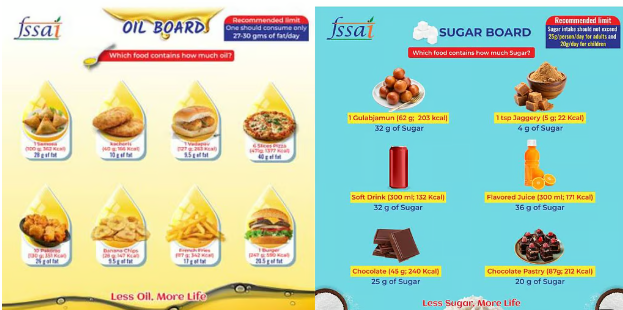
  • In July 2025, the Union Health Ministry issued a directive to all ministries, departments, and autonomous bodies under the central government to display visual information boards—referred to as “Sugar and Oil Boards”—highlighting the levels of hidden fats, sugar, and salt in commonly consumed Indian snacks such as samosas, vada pavs, kachoris, pizzas, and burgers.
  • The aim is to provide behavioural nudges that influence people’s eating habits in everyday settings like schools, government offices, cafeterias, and lobbies.
  • This effort is part of a broader, awareness-oriented campaign to encourage moderation in food consumption rather than enforcing restriction.

Key Components of the Initiative

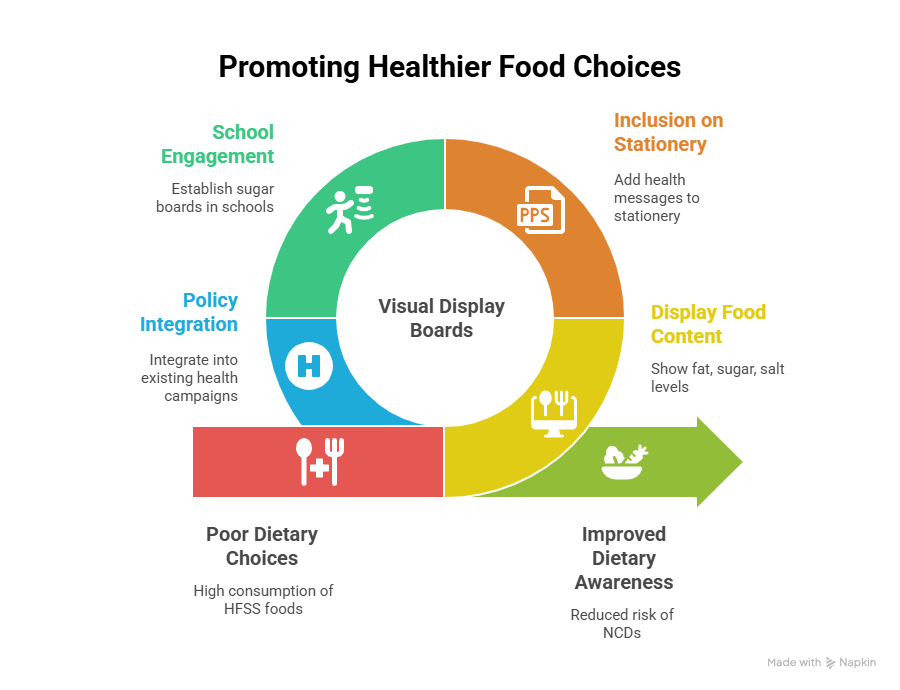
  1. Visual Display Boards: These boards will be placed in canteens, waiting areas, and meeting rooms. They will present the fat, sugar, and salt content of popular food items to nudge individuals toward healthier food choices.
  2. Inclusion on Stationery: All official government stationery, including letterheads, notepads, envelopes, and folders, must carry brief health messages about dietary risks to reinforce awareness continuously.
  3. School Engagement: The CBSE has already directed over 24,000 affiliated schools to establish ‘sugar boards’ for student awareness about the impact of excess sugar intake.
  4. Policy Integration: This initiative will be part of the Union government’s existing health campaigns, including the National Programme for Prevention and Control of Non-Communicable Diseases (NP-NCD).

Rationale Behind the Initiative

India is witnessing a sharp rise in non-communicable diseases (NCDs), which now account for more than 66% of all deaths in the country. These diseases include:

  • Cardiovascular conditions
  • Type 2 diabetes
  • Cancers
  • Chronic respiratory diseases

The rise is particularly evident among adults above the age of 30. According to the Health Ministry, one of the significant contributors to this trend is poor dietary choices, especially the frequent consumption of processed and high-fat, sugar, and salt (HFSS) foods.

Understanding HFSS Foods

The Indian Council of Medical Research – National Institute of Nutrition (ICMR-NIN) has provided a definition for HFSS (High Fat, Sugar, and Salt) foods in its Dietary Guidelines for Indians (2024). These are:

  • Foods in which more than 10% of total energy comes from sugar
  • More than 15% of total energy comes from added fat/oil
  • Salt content exceeds 625 mg per 100 grams of solid food

HFSS foods are usually low in essential nutrients and contribute directly to the development of obesity, hypertension, and metabolic disorders.

Calculation of Nutritional Values

Nutrient profiling is performed in two main ways:

  • Laboratory analysis of food samples, calculated per 100 grams
  • Ingredient-based calculation using the Indian Food Composition Tables (IFCT) by ICMR-NIN, when lab data is unavailable

This provides an accessible format for food evaluation based on key nutrient thresholds.

Recommended Daily Intake Levels for Adults

  • Total fat: Less than 65 grams
  • Added sugar: Less than 25 grams
  • Salt: Less than 5 grams

Children’s intake levels vary based on developmental stages. However, studies show that many Indians consume well beyond these limits, especially in terms of salt and added sugar.

Implications for Public Health and Governance

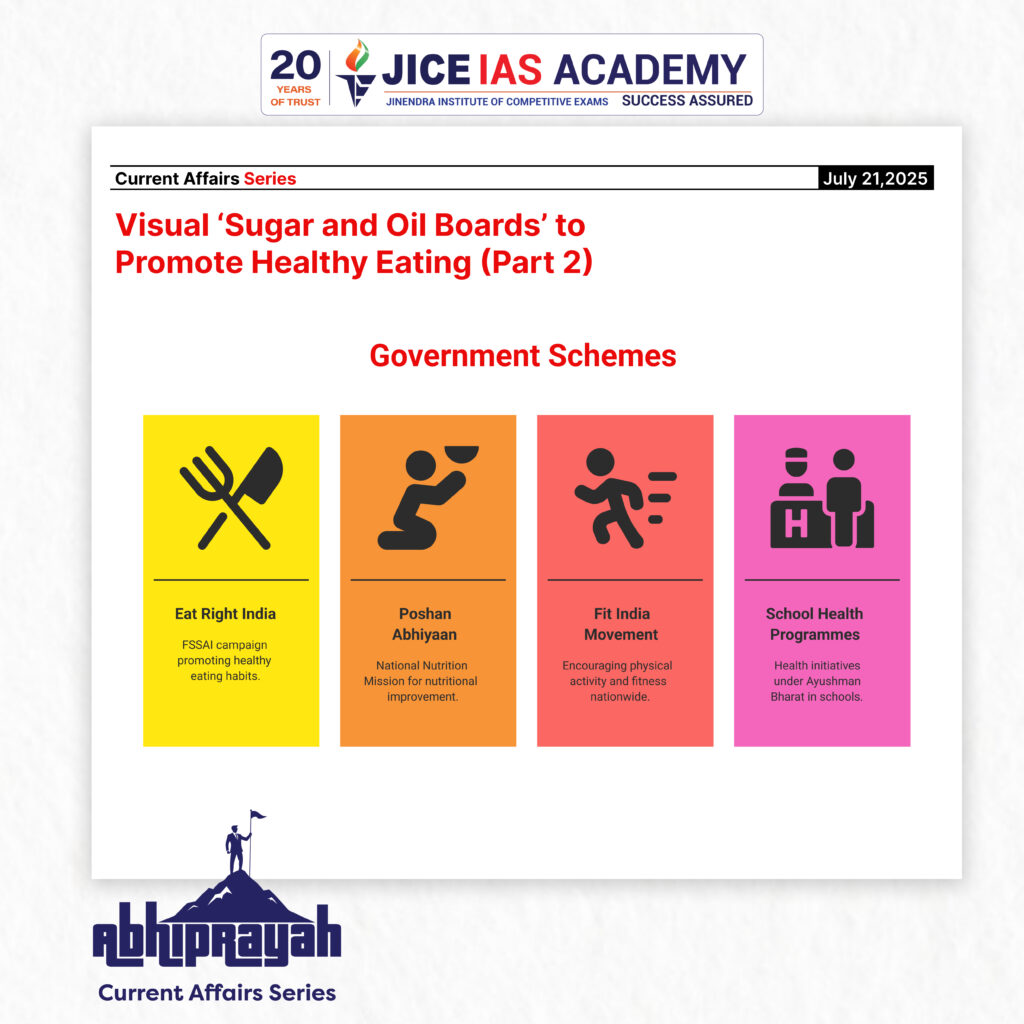
  • This initiative complements several other government schemes:

    • Eat Right India campaign by FSSAI
    • Poshan Abhiyaan for nutritional improvement
    • Fit India Movement for physical activity
    • School health programmes under the Ayushman Bharat mission
    • NP-NCD under the National Health Mission (NHM), which focuses on infrastructure, early diagnosis, awareness, and referral services for NCDs

Conclusion

  • The “Sugar and Oil Boards” initiative marks a significant step in India’s public health policy by targeting behavioural change through informed choices rather than punitive measures.
  • As part of a broader non-communicable disease control framework, this initiative strengthens the government’s preventive health strategy and supports a long-term vision of improving dietary awareness and reducing the burden of lifestyle-related diseases.

Economic Implications

For Indian Exporters

  • These reforms reduce transaction costs and compliance hurdles
  • Encourage a more competitive and efficient export environment
  • Promote value addition in key sectors like leather

For Tamil Nadu

  • The reforms particularly benefit the state’s leather industry, a major contributor to employment and exports
  • Boost the marketability of GI-tagged E.I. leather, enhancing rural and traditional industries

For Trade Policy

  • These decisions indicate a shift from regulatory controls to policy facilitation

Reinforce the goals of Make in India, Atmanirbhar Bharat, and India’s ambition to become a leading export power

Recently, BVR Subrahmanyam, CEO of NITI Aayog, claimed that India has overtaken Japan to become the fourth-largest economy in the world, citing data from the International Monetary Fund (IMF). 

India’s rank as the world’s largest economy varies by measure—nominal GDP or purchasing power parity (PPP)—each with key implications for economic analysis.

Significance and Applications

Leave a Reply

Your email address will not be published. Required fields are marked *

Call Us Now !

Copyright © JICE ACADEMY FOR EXCELLENCE PRIVATE LIMITED