UPSC CURRENT AFFAIRS – 21th May 2025

Home / UPSC / Current Affairs / WHO Adopts ‘Pandemic Agreement’ to Avoid Repeat of COVID-19 Failures

WHO Adopts ‘Pandemic Agreement’ to Avoid Repeat of COVID-19 Failures

who adopts pandemic agreement 2025

Why in News?

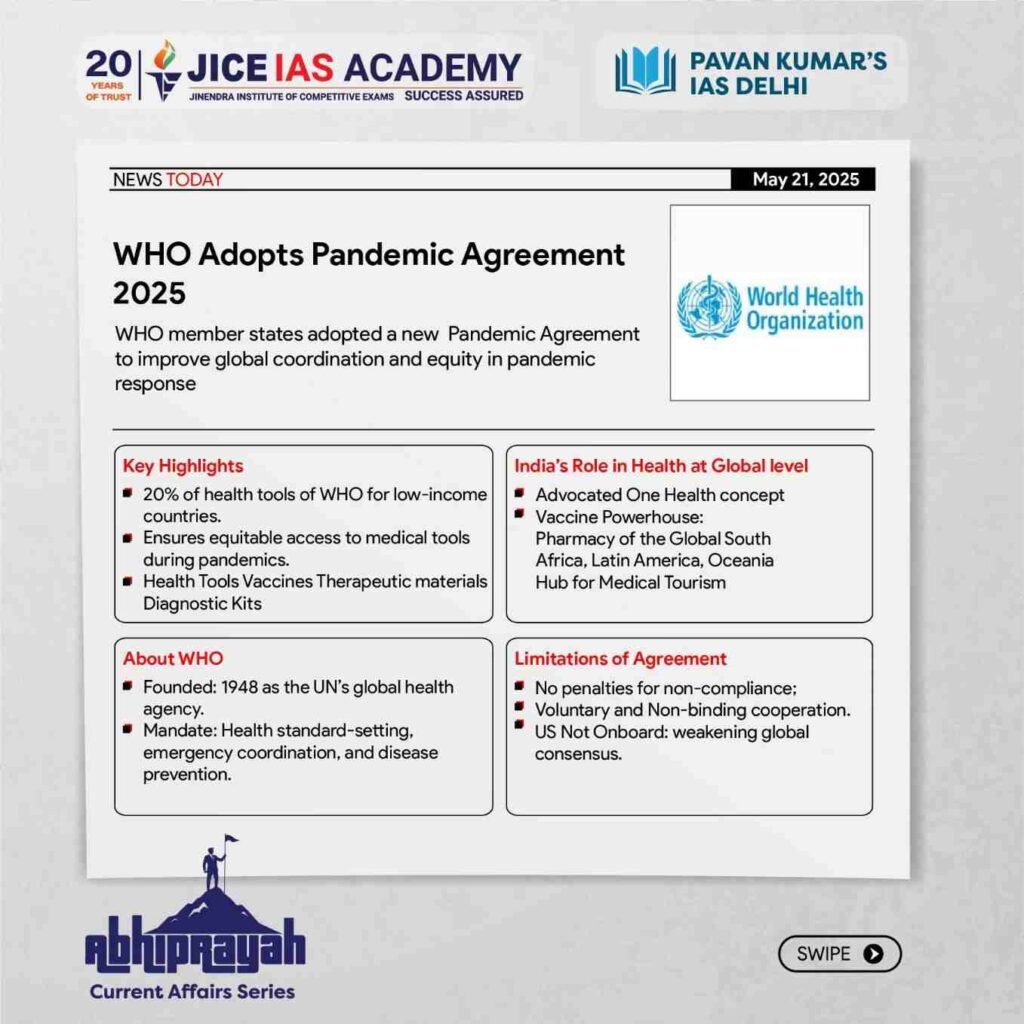
The World Health Organization (WHO) member states adopted a new pandemic agreement on May 20, 2025, aimed at improving global prevention, preparedness, and response to future pandemics.

Key Highlights:

Purpose:

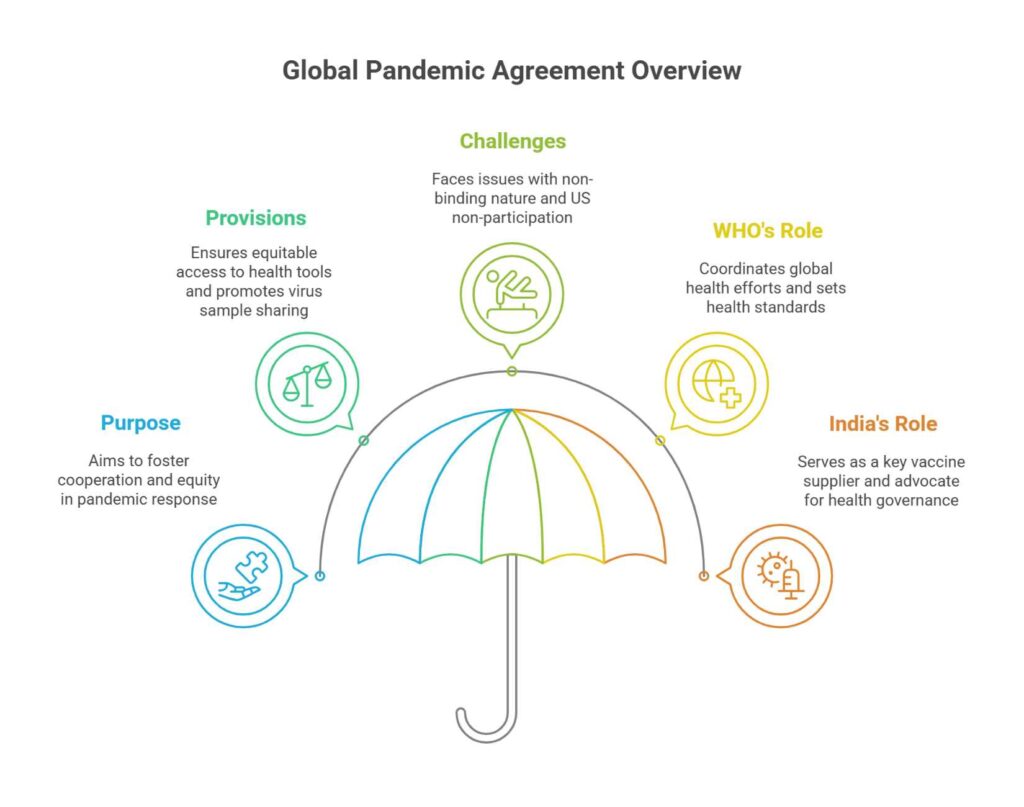
  • Designed to address the fragmented global response seen during COVID-19 by fostering cooperation, transparency, and equity.


Main Provisions:

  • Guarantees equitable access to tests, medicines, and vaccines.
  • Requires up to 20% of pandemic-related health tools (vaccines, diagnostics, treatments) to be contributed to WHO for distribution to low-income countries.
  • Promotes virus sample sharing to accelerate global research and vaccine development.


Symbol of Multilateralism:

  • WHO Director-General Dr. Tedros Adhanom Ghebreyesus hailed the pact as a “historic” multilateral achievement amid rising global nationalism.

Challenges Ahead:

  • Non-binding: No penalties for violations; success depends on voluntary compliance.
  • US Not Participating: The United States, WHO’s top historical funder, did not join the final agreement process, citing earlier withdrawal decisions.

Adopted At:

  • WHO Annual Assembly, Geneva, after three years of negotiations among member states.

About WHO and Its Role During COVID-19:

  • Established: In 1948 as the UN’s specialized health agency.
  • Mandate: To promote global health, set health standards, coordinate responses to health emergencies, and support member states in disease prevention and control.

  • Role During COVID-19:
    • Declared COVID-19 a global pandemic on March 11, 2020.
    • Launched the COVAX initiative with GAVI and CEPI to ensure fair global access to COVID-19 vaccines.
    • Faced criticism for delayed response, over-reliance on member state disclosures (notably China), and lack of enforcement powers.
    • Later strengthened its role in guiding health protocols, testing standards, and data sharing.
global pandemic agreement overview

India’s Role and Impact:

  • Support for Multilateral Health Governance:
    India advocated for One Health, pandemic preparedness, and equitable vaccine access during its G20 presidency (2023).

  • Global Vaccine Supplier:
    • Home to the Serum Institute of India and Bharat Biotech, India was a key supplier of vaccines through COVAX and bilateral arrangements.
    • The new WHO agreement reinforces India’s strategic role as the “pharmacy of the Global South”.

  • Health Diplomacy and Infrastructure:
    • India’s collaboration with WHO could see expansion through vaccine diplomacy, biosecurity, and pandemic surveillance systems.
    • Legal reforms may be needed to align with the treaty, including updates to the Epidemic Diseases Act, 1897, and Disaster Management Act, 2005.
  • Decreased oxygen-carrying capacity of RBCs.
  • Increased fragility and cell stiffness.
  • Vascular blockage, causing pain and organ injury.
  • Increased susceptibility to infections, anemia, and stroke.

Past Illegal Allotments Invalid

Leave a Reply

Your email address will not be published. Required fields are marked *

Call Us Now !

Copyright © JICE ACADEMY FOR EXCELLENCE PRIVATE LIMITED