
UPSC CURRENT AFFAIRS – 15th July 2025

Home / UPSC / Current Affairs / Women, STEM careers and a more receptive industry

Women, STEM careers and a more receptive industry

women in stem and industry readiness

Why in News?

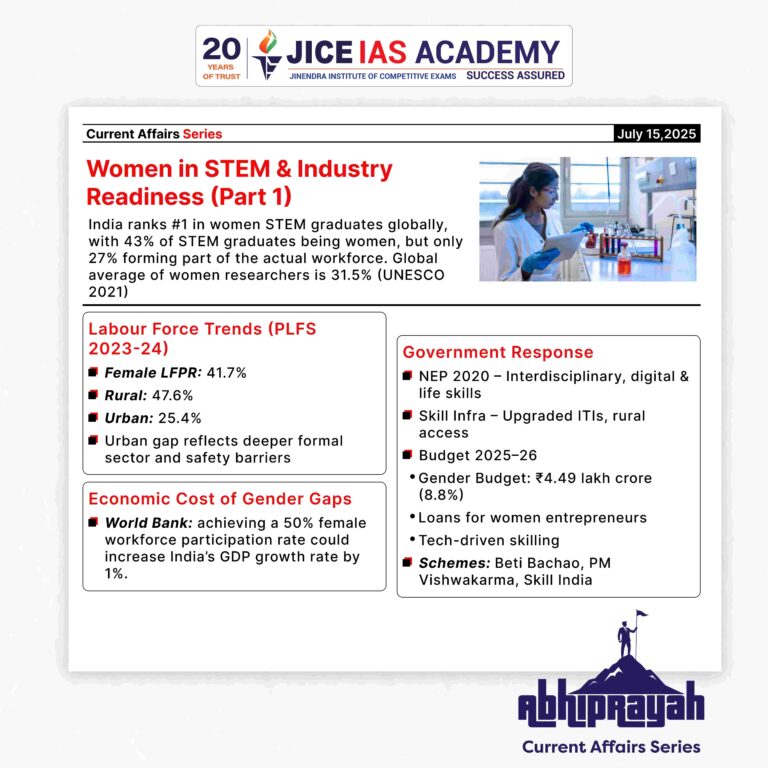
On World Youth Skills Day 2025, the gender gap in India’s STEM workforce is under focus, with 43% of STEM graduates being women, but only 27% forming part of the actual workforce. 

female scientist stands in a laboratory

Introduction

  • World Youth Skills Day, observed every year on July 15, serves as a global reminder of the importance of equipping young people with the necessary skills for employment, decent work, and entrepreneurship. 
  • In the Indian context, it also highlights a major paradox: while women account for a significant share of STEM graduates, their presence in the workforce remains disproportionately low. 
  • Addressing this disconnect is vital for inclusive development, gender equality, and economic growth.

The STEM Paradox: Education vs. Employment

  • India boasts the highest percentage of women STEM (Science, Technology, Engineering, and Mathematics) graduates among major economies—43%
  • However, only 27% of the STEM workforce is composed of women. This disparity indicates that while access to STEM education has improved, structural and social barriers prevent women from entering or remaining in the STEM job market.
  • Globally, according to UNESCO Institute for Statistics (2021), only 31.5% of researchers are women. This trend is replicated in India, despite significant progress in women’s educational attainment.

Labour Force Participation Trends

  • The Periodic Labour Force Survey (PLFS) 2023-24 reflects a significant improvement in Female Labour Force Participation Rate (FLFPR) in India, now standing at 41.7%. Notably:
    • Rural women: 47.6%
    • Urban women: 25.4%
  • While this increase suggests progress, the disparity between rural and urban areas indicates persistent barriers in formal employment, workplace safety, and social expectations, especially in urban India. 
  • In STEM, these barriers are amplified due to entrenched gender biases in technical and scientific roles.

The Economic Cost of Gender Disparity in STEM

The economic benefits of bridging the gender gap in employment are substantial:

  • McKinsey Global Institute estimates that if 68 million more women were added to India’s workforce, the GDP could rise by up to $700 billion by 2025.
  • The World Bank suggests that achieving a 50% female workforce participation rate could increase India’s GDP growth rate by 1%.

This makes the issue not just a matter of gender justice but also an economic imperative.

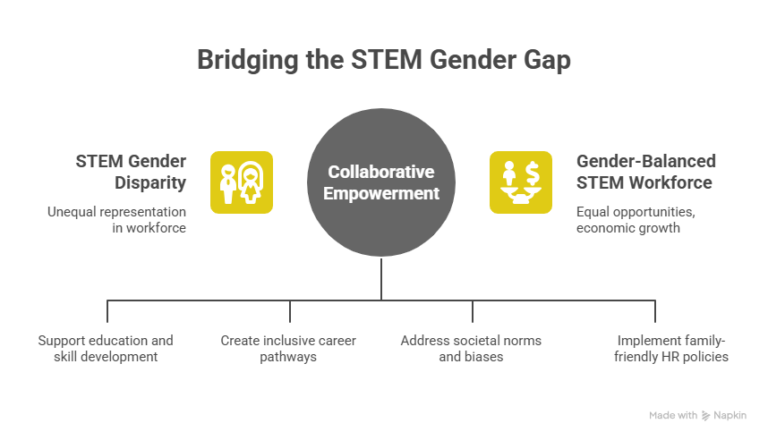
bridging the stem gender gap

Government Initiatives: Education and Skilling Reforms

  1. New Education Policy (NEP) 2020
    • Emphasises interdisciplinary learning, digital literacy, and life skills training.
    • Promotes integration of vocational education at all levels, especially in rural and under-served regions.
  1. Skill Development Infrastructure
    • Expansion and modernisation of Industrial Training Institutes (ITIs).
    • Focus on high-quality technical training accessible to rural youth.
  1. Union Budget 2025–26 Provisions
    • Increase in Gender Budget allocation from 6.8% (2024–25) to 8.8% (2025–26), totalling ₹4.49 lakh crore.
    • Introduction of:
      • Term loans for women entrepreneurs.
      • New National Skill Training Institutes.
      • Investments in technology-driven skilling.
  1. Other Supportive Policies
    • Skill India, Digital India, Beti Bachao, Beti Padhao, and PM Vishwakarma Yojana aim to enhance women’s capabilities, particularly in STEM.

However, while these policy frameworks are robust, government efforts alone are insufficient. The missing link remains industry engagement in translating skills into employment.

Industry’s Critical Role in Bridging the Gap

1. Challenging Gender Stereotypes

  • Deep-rooted societal norms like “mechanical is masculine” or “coding is not for girls” discourage women from pursuing or sustaining careers in STEM.
  • Studies by World Bank and UNESCO confirm that gendered perceptions are a major barrier to women’s entry and retention in technical fields.

2. Workplace Barriers

Women often exit STEM careers not due to a lack of skills, but because of:

  • Unwelcoming workplace cultures
  • Lack of family support and career awareness
  • Inflexible policies around marriage, motherhood, and caregiving responsibilities
  • Concerns regarding safety and wage disparity
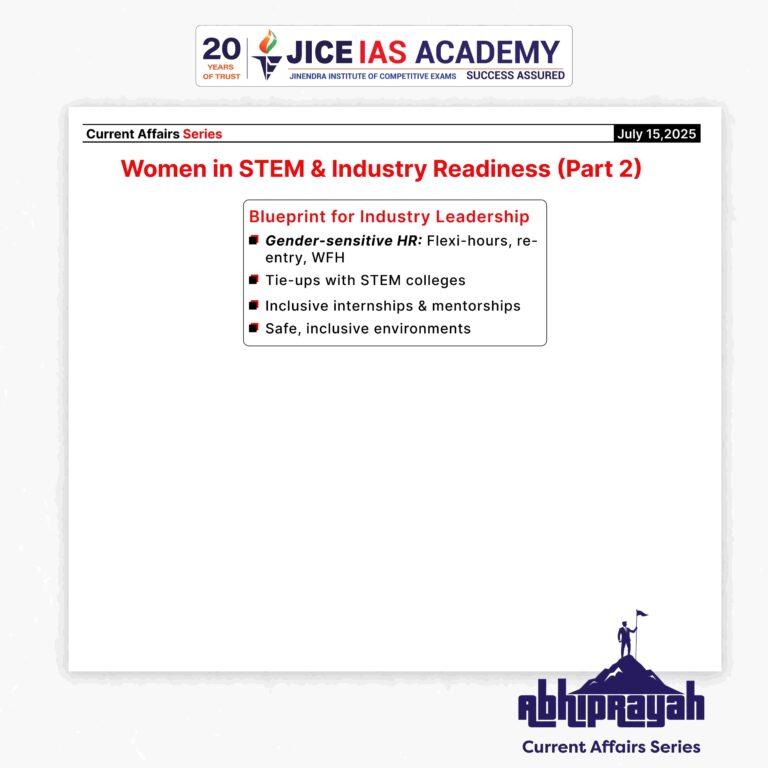
women in stem and industry readiness blueprint for industry leadership

Emerging Corporate Initiatives

Private sector participation is on the rise through:

  • Mentorship programmes
  • Industry-linked skilling and internships
  • Collaborations with educational institutions

Example:

The UN Women’s WeSTEM programme, supported by the Micron Foundation and implemented in Madhya Pradesh and Gujarat, offers:

  • Skill-building and technical training
  • Community and family engagement
  • Exposure to female role models
  • Workplace safety sensitisation

Such efforts acknowledge that mindset shifts, alongside skill acquisition, are vital for women’s successful integration into the workforce.

Blueprint for Industry Leadership

To bridge the education-employment gap for women in STEM, industry must:

  • Forge partnerships with universities and training institutes
  • Institutionalise mentorship between professionals and students
  • Develop gender-sensitive HR policies that support:
    • Work-life balance
    • Flexible work arrangements
    • Career re-entry opportunities
    • Safe and inclusive work environments

Conclusion:

  • India’s ambition of becoming a Viksit Bharat (Developed India) cannot be realised without fully leveraging the potential of its women, especially in STEM. 
  • The path ahead requires collaborative action—government framing enabling policies and industry creating inclusive career pathways.
  • By transforming from passive employers to active enablers, industries can dismantle systemic barriers, empower women, and unlock a demographic dividend that fuels economic and social transformation.
  • As we commemorate World Youth Skills Day 2025, the message is clear: Equipping young women with skills is not just an act of inclusion—it is a strategic investment in India’s future.

Economic Implications

For Indian Exporters

  • These reforms reduce transaction costs and compliance hurdles
  • Encourage a more competitive and efficient export environment
  • Promote value addition in key sectors like leather

For Tamil Nadu

  • The reforms particularly benefit the state’s leather industry, a major contributor to employment and exports
  • Boost the marketability of GI-tagged E.I. leather, enhancing rural and traditional industries

For Trade Policy

  • These decisions indicate a shift from regulatory controls to policy facilitation

Reinforce the goals of Make in India, Atmanirbhar Bharat, and India’s ambition to become a leading export power

Recently, BVR Subrahmanyam, CEO of NITI Aayog, claimed that India has overtaken Japan to become the fourth-largest economy in the world, citing data from the International Monetary Fund (IMF). 

India’s rank as the world’s largest economy varies by measure—nominal GDP or purchasing power parity (PPP)—each with key implications for economic analysis.

Significance and Applications

Leave a Reply

Your email address will not be published. Required fields are marked *

Call Us Now !

Copyright © JICE ACADEMY FOR EXCELLENCE PRIVATE LIMITED