India-Maldives Relations: Reaffirming the ‘Neighbourhood First’ Policy
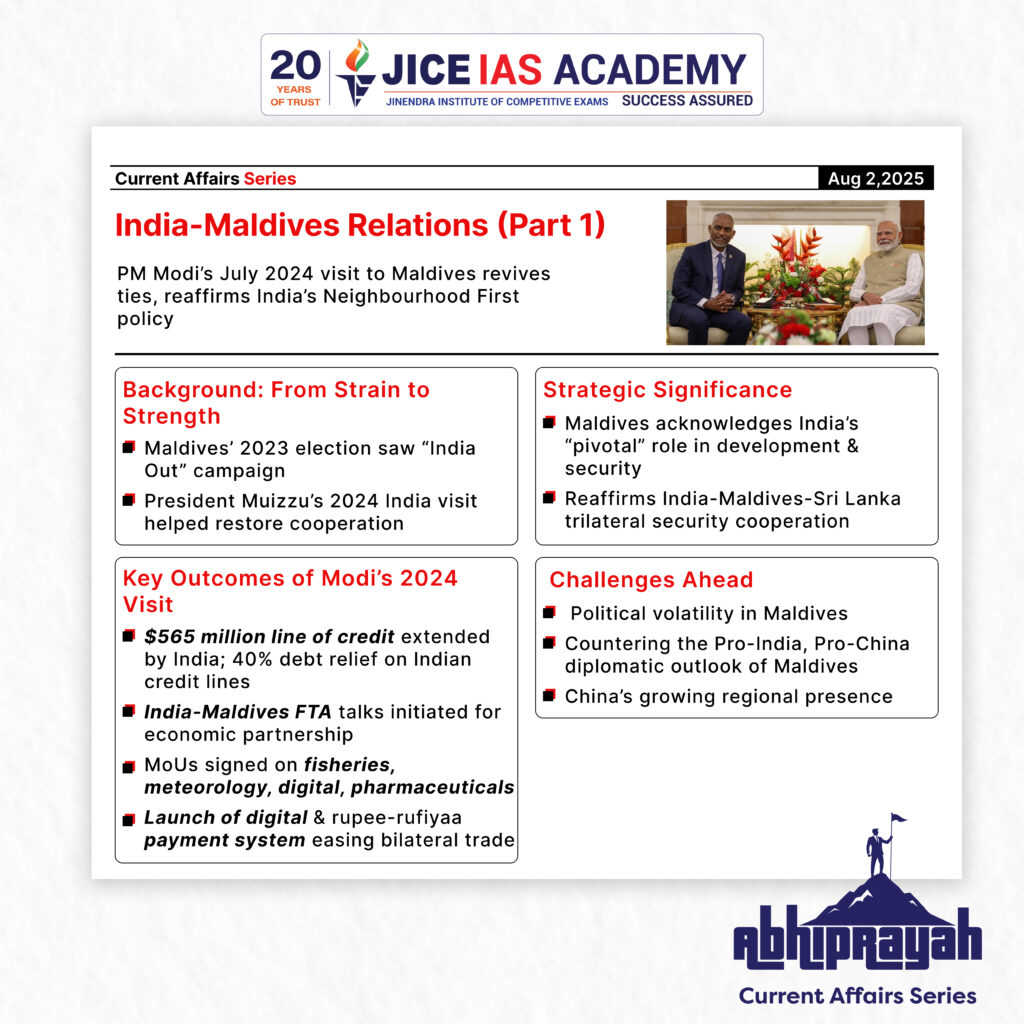
UPSC CURRENT AFFAIRS – 02nd August 2025 Home / India-Maldives Relations: Reaffirming the ‘Neighbourhood First’ Policy Why in News? Prime Minister Narendra Modi’s July 2025 visit to the Maldives marked the revival of close bilateral ties and reaffirmed India’s commitment to its Neighbourhood First policy. Background: From Strain to Strengthening Ties On July 26, 2025, Prime Minister Narendra Modi visited the Maldives as the special guest for the country’s 60th Independence Day celebrations, marking a significant thaw and revival in bilateral relations that had faced turbulence after the 2023 elections in the Maldives. Political Shift: Maldives President Mohamed Muizzu’s 2023 election victory was backed by an “India Out” campaign, which temporarily strained ties. In India, this triggered a “Boycott Maldives” campaign on social media. Repair and Re-engagement: Since 2023, diplomatic efforts on both sides have worked towards repairing the relationship. President Muizzu’s state visit to India in 2024 helped lay the foundation for renewed cooperation. India Maldives Areas of Co-operation 1. Economic & Developmental Cooperation Line of credit of ₹4,850 crore (2025), rupee-denominated, for priority Maldivian projects. Debt Relief & Financial Support Greater Malé Connectivity Project (GMCP), the Thilamale Bridge, water and sanitation infrastructure, and 3,300 social housing units (delivered 2025). High Impact Community Development Projects (HICDPs) 2. Trade and Digital Economy Trade Partner: India remains the Maldives’ second largest trading partner with bilateral trade touching $1B. Agreements for UPI digital payments, RuPay card usage in Maldives Bilateral Investment Treaty and FTA negotiations ongoing 3. Maritime Security, Defence & Disaster Relief Joint “Ekuverin”, “Ekatha”, and “Dosti” exercises India remains Maldives’ “First Responder” in crises—Operation Cactus (1988 coup), Operation Neer (2014 water crisis), COVID-19 pandemic response, and medical aid. 4. Health, Education & Humanitarian Assistance Aarogya Maitri Health Cubes (BHISHM) (2025), and a commitment to set up Jan Aushadhi Kendras Water & Sanitation: $100 million project spanning 28 islands, i Education & Youth Exchanges. 5. Tourism & People-to-People Ties India is a top source of tourists for the Maldives. Cultural & Legislative Ties: Joint parliamentary forums, commemorative stamps (2025), film collaborations, and diaspora engagement foster stronger bonds. 6. Climate Action & Blue Economy Climate Resilience: Collaboration on water management, sanitation, and renewable energy projects. India is a key player in Maldives’ climate adaptation infrastructure and disaster risk reduction efforts. Fisheries Cooperation: Newly signed agreements (2025) on joint research, aquaculture, and sustainable fisheries management. 7. Digital Governance & Technology Digital Infrastructure: India is assisting with governance platforms, digital payments, and undersea cable links to boost digital transformation and cyber security in the Maldives Key Outcomes of PM Modi’s 2024 Visit Economic Cooperation India extended a line of credit worth $565 million (₹4,850 crore). Debt burden reduced by 40% on existing Indian credit lines. Initiation of India-Maldives Free Trade Agreement (FTA) negotiations, opening new avenues for trade and economic partnership. Sectoral Collaboration Signing of MoUs in: Fisheries Meteorological sciences Digital solutions Pharmaceuticals Launch of digital and rupee-rufiyaa national currency payment system to ease bilateral transactions. Strategic Significance Maldives acknowledged India’s “pivotal” role in its development and security. Reaffirmation of India’s trilateral security cooperation with Maldives and Sri Lanka. Follow-up visit of Sri Lankan President Anura Kumara Dissanayake to the Maldives highlights growing regional cooperation. India’s ‘Neighbourhood First’ Policy in Action Regional Balancing Amid Global Turbulence: PM Modi’s visit comes at a time when India is navigating global challenges — from U.S. trade protectionism and wars in Ukraine and Gaza, to tensions with Pakistan (post-Pahalgam attacks) and concerns with Bangladesh. Strategic Outreach: India is reasserting its leadership in South Asia. New Delhi’s upcoming welcome for Nepal Prime Minister K.P. Sharma Oli — his first since assuming office — reflects this intent. Symbolic Diplomacy: A commemorative stamp released by the Maldives featuring Indian and Maldivian boats symbolised the shared civilisational journey, which PM Modi described as “fellow voyagers on a shared journey”. Significance of the Visit Diplomatic Reboot: The visit reflects a conscious effort to reset ties with the Maldives — an important maritime neighbour in the Indian Ocean. Geopolitical Relevance: In the face of China’s growing footprint in the Indian Ocean Region (IOR), India’s continued engagement with island nations like Maldives is crucial. Economic Diplomacy: Lines of credit, FTA talks, and currency linkages signal India’s readiness to play a proactive role in regional development and financial integration. Challenges Ahead Political Volatility in the Maldives: Domestic politics could again sway public opinion and foreign policy alignment. China Factor: Maldives continues to engage with China economically and strategically, requiring India to remain diplomatically agile. Sustainability of Economic Support: India must ensure that its economic support translates into sustainable partnerships rather than debt dependencies. Introduction Economic Implications For Indian Exporters These reforms reduce transaction costs and compliance hurdles Encourage a more competitive and efficient export environment Promote value addition in key sectors like leather For Tamil Nadu The reforms particularly benefit the state’s leather industry, a major contributor to employment and exports Boost the marketability of GI-tagged E.I. leather, enhancing rural and traditional industries For Trade Policy These decisions indicate a shift from regulatory controls to policy facilitation Reinforce the goals of Make in India, Atmanirbhar Bharat, and India’s ambition to become a leading export power Recently, BVR Subrahmanyam, CEO of NITI Aayog, claimed that India has overtaken Japan to become the fourth-largest economy in the world, citing data from the International Monetary Fund (IMF). India’s rank as the world’s largest economy varies by measure—nominal GDP or purchasing power parity (PPP)—each with key implications for economic analysis. Significance and Applications
ICJ’s Landmark Advisory Opinion on Climate Change
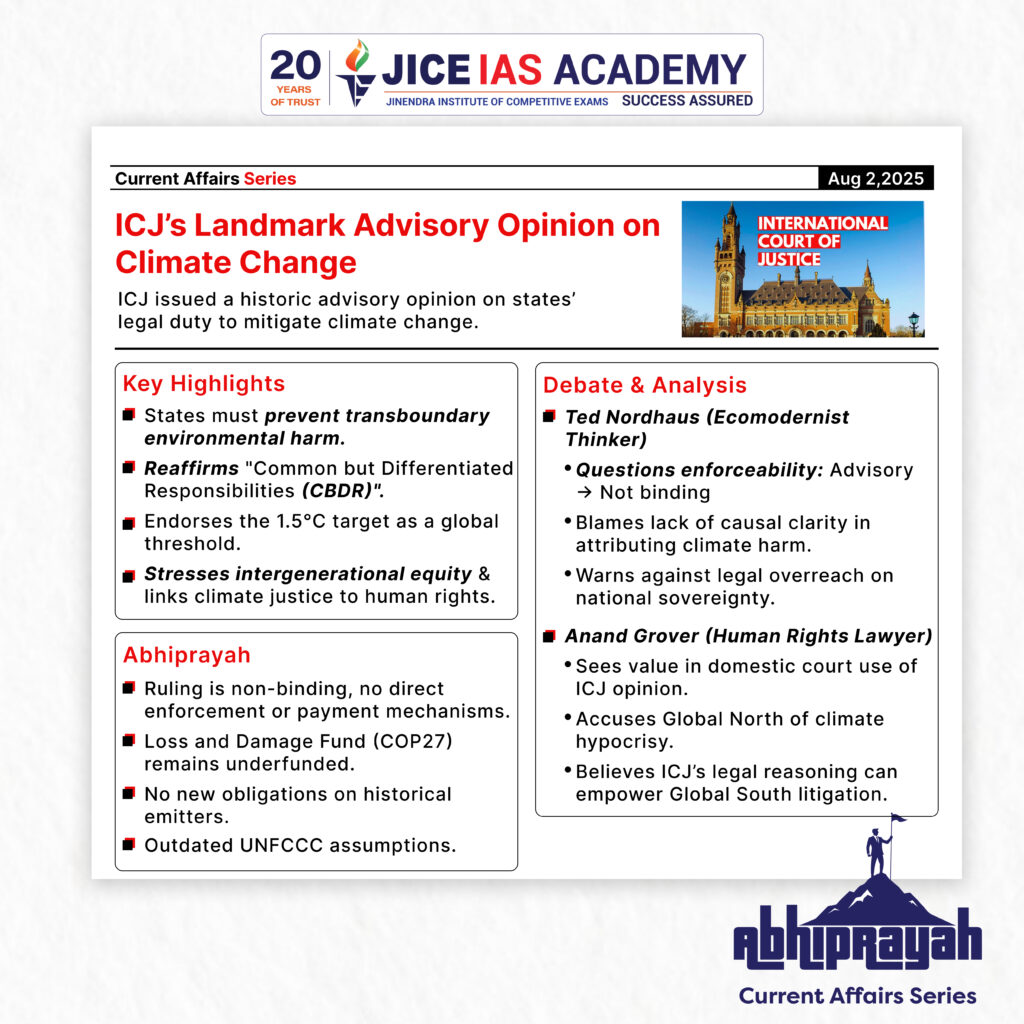
UPSC CURRENT AFFAIRS – 02nd August 2025 Home / ICJ’s Landmark Advisory Opinion on Climate Change Why in News? On July 23, 2024, the International Court of Justice (ICJ) issued a landmark advisory opinion reaffirming states’ legal obligations to mitigate climate change and support vulnerable nations. Introduction On July 23, 2024, the International Court of Justice (ICJ) delivered a historic advisory opinion that reaffirmed the legal obligations of states to mitigate climate change, reduce greenhouse gas (GHG) emissions, and support vulnerable nations. Although advisory and non-binding in nature, the ruling has significant legal, political, and symbolic implications in the global fight against climate change. Background Context The opinion came in response to a request led by Vanuatu and backed by over 130 countries. It builds upon international legal instruments like the Paris Agreement (2015) and UNFCCC (1992). It seeks to clarify the legal responsibilities of states under international environmental law, human rights law, and customary international law in the face of the climate crisis. Key Highlights of the Ruling Reaffirms the duty of states to prevent environmental harm beyond their borders (transboundary principle). Asserts that climate change mitigation is a shared global obligation, but also recognizes differentiated responsibilities. Supports the 1.5°C target from the Paris Agreement as a critical threshold to avoid catastrophic impacts. Emphasizes intergenerational equity, linking climate action to human rights frameworks. Debate Over the Ruling: Key Voices and Issues Ted Nordhaus (Environmental Policy Analyst, Ecomodernist) Critical of the ruling’s practical enforceability: Points to the scientific attribution challenge: Difficult to attribute specific extreme events or harms directly to the failure of a single nation. Questions the ability of international law to enforce liability or compel reparations. Notes that global warming at 1–1.5°C amplifies existing phenomena, not necessarily creating new ones — making litigation complex. Stresses national sovereignty: Major emitters like the US, China, and India are unlikely to comply with international legal directives that interfere with energy policy. On Historical Emissions: Historical responsibility has symbolic weight but lacks legal teeth or enforceability. Sovereign nations will not overhaul energy systems due to external legal pressures. Anand Grover (Human Rights Lawyer and Former UN Special Rapporteur) Sees legal and political value despite limitations: Agrees that causality is hard to establish in court, making direct reparations unlikely. But emphasizes that the ICJ opinion can strengthen domestic legal actions, especially in climate-vulnerable nations. Believes the ruling can empower civil society and courts in the Global South to hold governments accountable. On Sovereignty and Global Equity: Criticizes the double standards of the Global North — e.g., the US backing out of the Paris Agreement while subsidizing fossil fuels. Highlights that environmental justice norms are often used selectively by powerful states. Implications for Climate Reparations Can the ICJ Ruling Force Rich Nations to Pay? No, according to both experts. The ruling: Is non-binding and lacks enforcement mechanisms. Does not prescribe specific emission targets or compensation mechanisms. Cannot override the UN Security Council, where major powers have veto powers. Loss and Damage Fund, established under COP27, also suffers from limited contributions and political will. Developing countries hoping for large-scale reparations through international law are likely to be disappointed. Legal vs. Political vs. Developmental Pathways Legal: ICJ’s ruling provides moral legitimacy and legal basis for national-level litigation. Courts in countries with strong environmental jurisprudence (e.g., Netherlands, India pre-2015) may use it to pressure governments. However, increasing politicisation of judiciary (e.g., in India and US) may undermine this potential. Political: The ruling may be seen as a symbolic nudge rather than a transformational moment. Developed nations are unlikely to change their policies significantly due to this ruling. Developmental: Nordhaus argues that relying on reparations or international frameworks risks hindering domestic development goals. Advocates for technological self-reliance, clean energy transitions driven by national interests — not international pressure. Grover supports this but warns of corporate capture of energy transitions. Changing Global Landscape: Shift from 1990s Frameworks The UNFCCC framework of 1992, with its idea of common but differentiated responsibilities (CBDR) and technology transfer, is increasingly outdated. Today, technology flows are multi-directional: China is leading in clean technology exports. India is emerging as a player. Hence, the ICJ ruling, grounded in older paradigms, may not reflect new geopolitical and technological realities. Future Outlook and Strategy for Developing Nations Stop waiting for reparations; act in national self-interest to reduce emissions. Focus on: Domestic clean energy investment. Urban air pollution control (e.g., Delhi winters). Resilience-building for climate adaptation. Use ICJ ruling as a legal resource, not a political crutch. Conclusion The ICJ’s July 2024 advisory opinion is a significant symbolic and legal milestone, reaffirming the global responsibility to combat climate change. However, its lack of enforceability, the challenges of attribution, and geopolitical power dynamics limit its transformative potential. As both Ted Nordhaus and Anand Grover conclude, the real leverage lies within nations — in domestic courts, policy reforms, and technological innovations — not in the hope of legal enforcement or financial reparations from historical polluters. Introduction Economic Implications For Indian Exporters These reforms reduce transaction costs and compliance hurdles Encourage a more competitive and efficient export environment Promote value addition in key sectors like leather For Tamil Nadu The reforms particularly benefit the state’s leather industry, a major contributor to employment and exports Boost the marketability of GI-tagged E.I. leather, enhancing rural and traditional industries For Trade Policy These decisions indicate a shift from regulatory controls to policy facilitation Reinforce the goals of Make in India, Atmanirbhar Bharat, and India’s ambition to become a leading export power Recently, BVR Subrahmanyam, CEO of NITI Aayog, claimed that India has overtaken Japan to become the fourth-largest economy in the world, citing data from the International Monetary Fund (IMF). India’s rank as the world’s largest economy varies by measure—nominal GDP or purchasing power parity (PPP)—each with key implications for economic analysis. Significance and Applications
Return of the Sacred Piprahwa Buddhist Relics to India (2025)

UPSC CURRENT AFFAIRS – 01st August 2025 Home / Return of the Sacred Piprahwa Buddhist Relics to India (2025) Why in News? The sacred Piprahwa Buddhist relics were repatriated to India from Hong Kong through government intervention and public-private partnership. Overview India witnessed the historic repatriation of a portion of the sacred Piprahwa relics of Lord Buddha, which had been excavated in 1898 in present-day Uttar Pradesh. These relics, which were scheduled to be auctioned in Hong Kong in May 2025, were successfully returned following the decisive intervention of the Government of India, in partnership with the private sector. Historical Background: The Piprahwa relics were discovered in 1898 by British civil engineer William Claxton Peppé in Piprahwa, near the Indo-Nepal border. Archaeological evidence and an inscription in the Brahmi script confirm these relics to be associated with the Sakya clan, identifying them as the mortal remains of Lord Buddha. The relics were originally enshrined by followers of the Buddha around the 3rd century BCE, likely during the Mauryan period. Most of these relics were transferred to the Indian Museum in Kolkata in 1899 and classified as “AA” antiquities under Indian law, which prohibits their sale or removal. Significance of the Repatriation: Cultural and Spiritual Importance: The relics hold immense spiritual value for Buddhists around the world. They are regarded as symbols of peace, compassion, and enlightenment, central tenets of Buddha’s teachings. Cultural Diplomacy and Global Heritage: The return underscores India’s position as a global guardian of Buddhist heritage. Demonstrates the power of cultural diplomacy and collaboration in protecting global heritage. Preservation of Antiquities: Highlights India’s unwavering commitment to safeguard its ancient and sacred cultural artefacts. Reinforces the legal and moral claim of nations over their stolen or displaced heritage items. Public Engagement and Awareness: The relics will be formally unveiled and placed on public display, enabling Indian citizens and global visitors to pay homage. Broader Context: India’s Cultural Repatriation Efforts: The initiative aligns with the Government of India’s broader mission to reclaim ancient artefacts taken during the colonial era or lost through illicit trade. India has successfully brought back over 350 artefacts since 2014 from countries like the USA, Australia, and Canada. Conclusion: The return of the Piprahwa Buddhist relics is not merely a legal or diplomatic victory but a powerful reaffirmation of India’s cultural identity and civilizational pride. It represents a key moment in global efforts to restore sacred heritage to its rightful place, and sets a benchmark for public-private cooperation in heritage protection. Introduction Economic Implications For Indian Exporters These reforms reduce transaction costs and compliance hurdles Encourage a more competitive and efficient export environment Promote value addition in key sectors like leather For Tamil Nadu The reforms particularly benefit the state’s leather industry, a major contributor to employment and exports Boost the marketability of GI-tagged E.I. leather, enhancing rural and traditional industries For Trade Policy These decisions indicate a shift from regulatory controls to policy facilitation Reinforce the goals of Make in India, Atmanirbhar Bharat, and India’s ambition to become a leading export power Recently, BVR Subrahmanyam, CEO of NITI Aayog, claimed that India has overtaken Japan to become the fourth-largest economy in the world, citing data from the International Monetary Fund (IMF). India’s rank as the world’s largest economy varies by measure—nominal GDP or purchasing power parity (PPP)—each with key implications for economic analysis. Significance and Applications
Structural Strains in India-U.S. Ties Amid Rising Nationalism
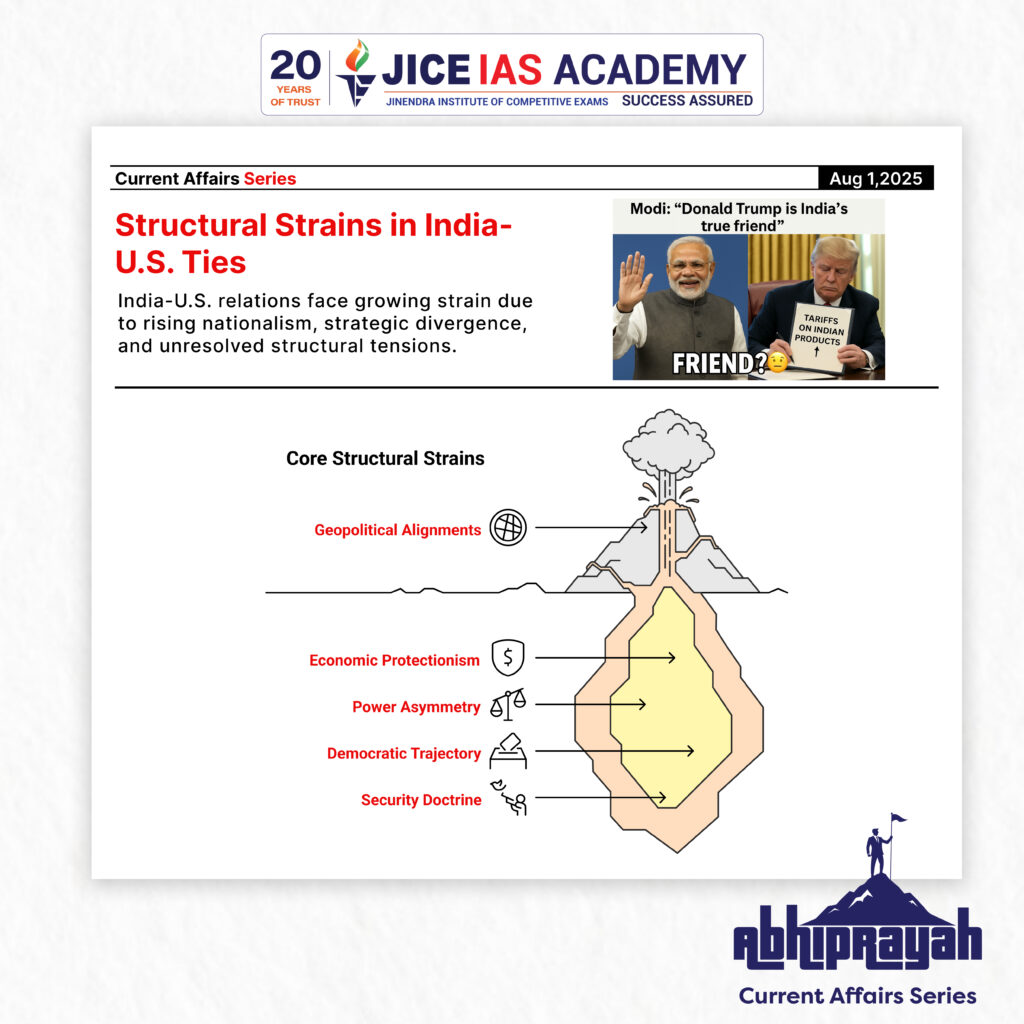
UPSC CURRENT AFFAIRS – 01st August 2025 Home / Structural Strains in India-U.S. Ties Amid Rising Nationalism Why in News? India-U.S. relations are now facing strain due to rising nationalism, strategic divergence, and unresolved structural tensions. Introduction India-U.S. relations have long been projected as a “definitive partnership of the 21st century”. The partnership has been marked by growing convergence on strategic, economic, and democratic values. However, recent tensions suggest that beneath the celebratory rhetoric, deeper structural fissures are becoming visible. These strains have been exacerbated by the rise of nationalist leadership in both countries. They also stem from enduring differences in strategic culture, geopolitical priorities, and economic expectations. Historical Context The relationship between India and the United States has evolved significantly since the Cold War era. During the bipolar world order, the two countries viewed each other with mutual suspicion. The ties shifted toward strategic partnership after the 1998 nuclear tests and especially after the 2005 civil nuclear agreement. Cooperation expanded across several domains such as defence, trade, energy, science and technology, and people-to-people linkages. Successive U.S. administrations viewed India as a potential counterbalance to China. India was also seen as a responsible democratic partner in the Indo-Pacific region. Present Challenges: President Trump’s volatile and transactional style aggravated certain bilateral tensions. However, the emerging rift is rooted in broader structural divergences. These divergences include conflicting national priorities, differing approaches to strategic partnerships, and mutual economic protectionism. Rise of Nationalism and Policy Assertiveness Both India and the U.S. have shifted towards nationalist and populist governance. Prime Minister Narendra Modi’s foreign policy is often termed “India First”. President Donald Trump followed the “America First” doctrine. Trump emphasized transactionalism, economic protectionism, and strategic unilateralism. Modi’s approach promotes strategic autonomy and muscular diplomacy, including military retaliation against terrorism. This parallel rise in nationalism has undermined earlier notions of strategic altruism. When both countries adopt self-serving postures, it becomes difficult to sustain long-term cooperation. Power Asymmetry and the Expectation Gap The United States, as a global superpower, maintains multiple and sometimes contradictory alliances. For example, it engages both India and Pakistan, or Qatar and Saudi Arabia. The U.S. expects partners to accept this duality without question. However, it is less tolerant when countries like India follow similar multi-vector diplomacy. India continues strategic ties with Iran for energy and connectivity through Chabahar Port. India also relies on Russia for defence cooperation and energy. Washington views these relationships with suspicion. Conversely, U.S. outreach to Pakistan and efforts to reset ties with China worry Indian policymakers. This mutual unease reflects a core asymmetry in how both countries define national interest and partnership obligations. Diverging Geopolitical Alignments India’s foreign policy increasingly embraces a multi-alignment strategy. External Affairs Minister S. Jaishankar has articulated India’s ability to engage with all sides. India engages simultaneously with Russia and Ukraine, Israel and Iran, BRICS and QUAD, the West and the Global South. India views this flexibility as a strength in foreign policy. However, in Washington, such flexibility is often seen as ambiguity or unreliability. The U.S. wants clearer alignment from its partners in the context of renewed great-power rivalries. In particular, it expects alignment against China and Russia. India’s participation in BRICS and its neutral stance on the Ukraine war have raised concerns about its global intentions. Economic Protectionism and Trade Disputes Economic ties between India and the U.S. have become strained due to mutual protectionist measures. India has resisted full-scale market liberalisation in sensitive sectors like agriculture, dairy, and e-commerce. These protectionist policies are intended to safeguard small producers and promote domestic manufacturing. Initiatives like Atmanirbhar Bharat reflect India’s push for economic self-reliance. Meanwhile, the Trump administration pursued a confrontational and reciprocal trade policy. The U.S. withdrew India’s Generalized System of Preferences (GSP) benefits in 2019. Trade negotiations failed repeatedly due to issues like tariffs, data localization, and intellectual property protection. Despite being a large and fast-growing economy, India remains a difficult market for U.S. exporters. This has led to growing frustration in Washington. Human Rights Concerns and Democratic Backsliding A growing section of the American strategic community is critical of India’s democratic trajectory. Concerns have been raised about the Citizenship Amendment Act (CAA) and the abrogation of Article 370. Restrictions on civil liberties and rising majoritarian politics have also drawn criticism. These issues have been highlighted by U.S. media, think tanks, and members of Congress. While the U.S. administration tries to balance values and interests, concerns persist. Perceived democratic backsliding in India weakens the normative foundation of the partnership. Earlier, both countries celebrated their shared democratic values as a unifying factor. Security Doctrine and Strategic Restraint India’s security doctrine has shifted toward assertiveness in recent years. India has demonstrated a willingness to carry out cross-border strikes in response to terrorism. This marks a departure from India’s earlier posture of strategic restraint. While this enhances deterrence in Indian thinking, it raises concerns in Washington. The U.S. fears such assertiveness could escalate tensions in a nuclearised South Asia. Washington prefers India to act as a stabilising regional force. India’s new approach complicates this expectation. Tensions in Multilateral Forums and Strategic Autonomy India’s active participation in non-Western groupings like BRICS creates concern in the U.S. Continued defence and energy cooperation with Russia and Iran adds to this unease. These alignments prompt doubts about India’s long-term strategic direction. Even former advocates of U.S.-India ties, like Ashley Tellis, have voiced skepticism. He referred to India’s global ambitions as “great-power delusions”. President Trump, at times, linked India’s tariff policies to its role in BRICS. This indicates that multilateral affiliations are now being interpreted through a transactional lens. Conclusion The current strain in India-U.S. relations is not merely the result of President Trump’s erratic foreign policy, but a reflection of deep structural tensions that are likely to persist unless both sides recalibrate their expectations. As India seeks to project itself as an independent global power, its divergence from the American worldview becomes more pronounced. At the same time, strategic convergence still exists in areas such as the
Myanmar Junta Ends Emergency: Elections Announced Amid Ongoing Civil War
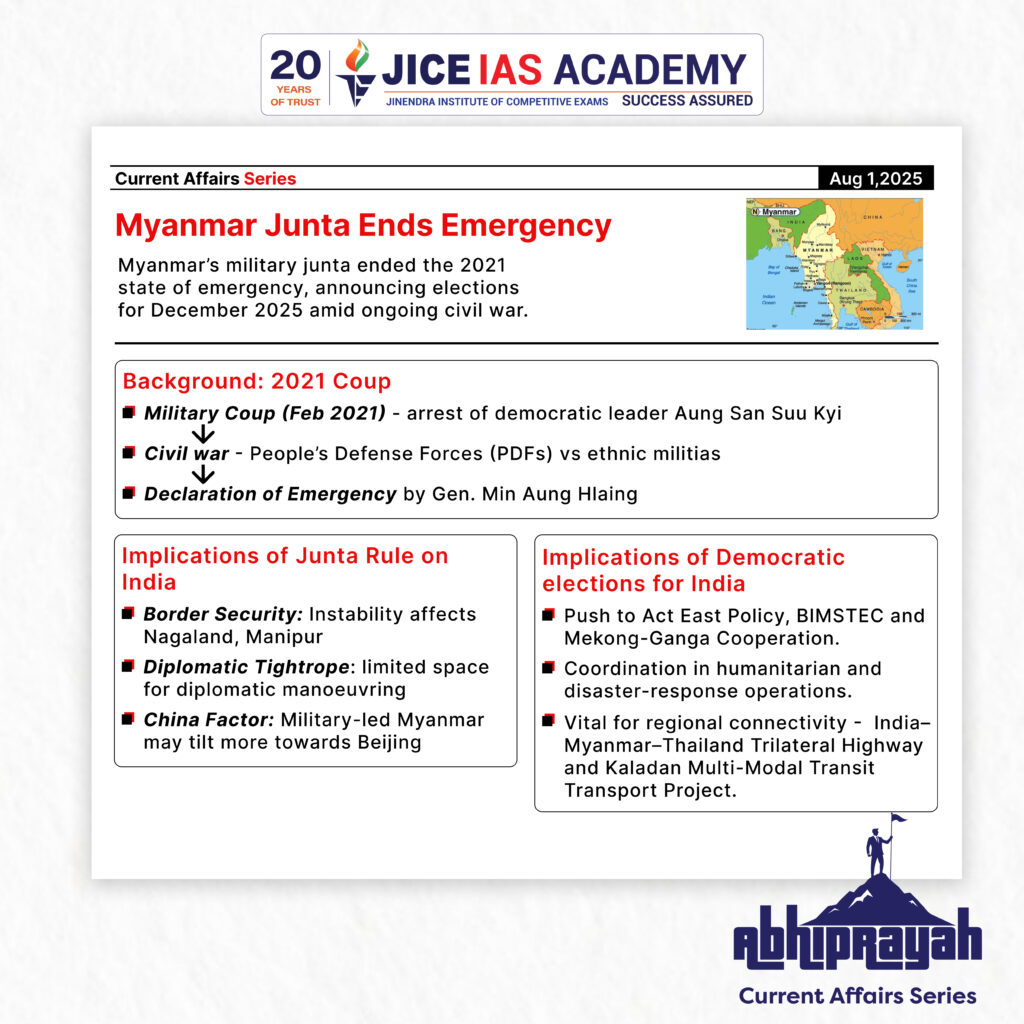
UPSC CURRENT AFFAIRS – 01st August 2025 Home / Myanmar Junta Ends Emergency: Elections Announced Amid Ongoing Civil War Why in News? Myanmar’s military junta has ended the state of emergency imposed since the 2021 coup, announcing elections for December 2025 amid an ongoing civil war and international criticism Background Myanmar’s military junta formally ended the state of emergency imposed in February 2021, a move that ostensibly paves the way for national elections in December 2025. The declaration comes amid ongoing civil unrest, mass displacement, and widespread international criticism. However, the planned elections are being boycotted by opposition groups, including members of the National Unity Government (NUG), and dismissed by global observers as illegitimate. Background: Military Coup and the State of Emergency On February 1, 2021, Myanmar’s military, led by General Min Aung Hlaing, staged a coup, detaining elected leaders including Aung San Suu Kyi and nullifying the results of the 2020 general election. A state of emergency was declared, transferring all powers of the legislature, judiciary, and executive to the Commander-in-Chief. The coup triggered nationwide protests, escalating into a multi-front civil war between the junta and a coalition of ethnic armed groups and pro-democracy forces, including the People’s Defense Forces (PDFs). Recent Developments End of Emergency Rule The junta officially lifted the state of emergency on July 31, 2025. The move is framed as a step toward multi-party democracy, with elections promised within six months, although no exact date has been declared. Junta spokesperson Zaw Min Tun stated that this step marks the beginning of a new phase towards democracy. Election Preparations Political party registration is ongoing. Electronic voting machine (EVM) training has been conducted. However, a census conducted in 2024 failed to account for over 19 million people, mainly due to security concerns and conflict zones. A new law criminalizing election-related dissent imposes up to 10 years in prison for speeches or protests that “destroy a part of the electoral process”. Security and Humanitarian Challenges The civil war has displaced more than 2 million people and led to thousands of civilian deaths, including in airstrikes on civilian infrastructure like monasteries. The junta has offered cash rewards to rebels willing to lay down arms and “return to the legal fold,” a move to reduce resistance ahead of the polls. Despite such incentives, rebel control of large territories, especially in border regions, may limit the actual conduct and reach of elections. Geopolitical Implications ASEAN’s role has been limited, with its Five-Point Consensus largely ignored by the junta. China, Russia, and India maintain pragmatic engagement with the junta, driven by strategic and economic interests. The unfolding situation affects regional stability, cross-border refugee flows, and insurgency dynamics along the India-Myanmar border (particularly in Nagaland and Manipur). Implications for India Strategic and Border Security India shares a 1,643 km porous border with Myanmar, and any instability directly affects the security situation in the northeastern states. Stability in Myanmar is essential to contain cross-border militancy. Peace and governance in Myanmar are vital for securing ongoing infrastructure projects like the India–Myanmar–Thailand Trilateral Highway and Kaladan Multi-Modal Transit Transport Project. Diplomatic Engagement India has maintained a cautious policy of engagement with Myanmar’s military regime. The lifting of emergency may provide limited space for diplomatic manoeuvring, but India must ensure it does not lend legitimacy to non-democratic processes. Humanitarian Cooperation A relatively stable governance structure, even under military control, can enable better coordination in such humanitarian and disaster-response operations. Regional Connectivity and Act East Policy Myanmar is a critical link in India’s Act East Policy and initiatives like BIMSTEC and Mekong-Ganga Cooperation. Political normalization in Myanmar, even if superficial, can facilitate regional cooperation and trade corridors essential for India’s strategic connectivity goals. Geopolitical Competition The geopolitical vacuum in Myanmar is often filled by external powers, especially China. A stable yet military-dominated Myanmar may continue to align more closely with Chinese interests. India must cautiously deepen engagement to maintain influence without compromising on democratic principles or regional credibility. Introduction Economic Implications For Indian Exporters These reforms reduce transaction costs and compliance hurdles Encourage a more competitive and efficient export environment Promote value addition in key sectors like leather For Tamil Nadu The reforms particularly benefit the state’s leather industry, a major contributor to employment and exports Boost the marketability of GI-tagged E.I. leather, enhancing rural and traditional industries For Trade Policy These decisions indicate a shift from regulatory controls to policy facilitation Reinforce the goals of Make in India, Atmanirbhar Bharat, and India’s ambition to become a leading export power Recently, BVR Subrahmanyam, CEO of NITI Aayog, claimed that India has overtaken Japan to become the fourth-largest economy in the world, citing data from the International Monetary Fund (IMF). India’s rank as the world’s largest economy varies by measure—nominal GDP or purchasing power parity (PPP)—each with key implications for economic analysis. Significance and Applications
Supreme Court Reserves Verdict on Challenge to Age Limits in Surrogacy Law

UPSC CURRENT AFFAIRS – 01st August 2025 Home / Supreme Court Reserves Verdict on Challenge to Age Limits in Surrogacy Law Why in News? The Supreme Court has reserved its verdict on petitions challenging the age limits for couples seeking surrogacy under the Surrogacy (Regulation) Act, 2021. Legal Framework Governing Surrogacy in India: Two key legislations regulate assisted reproduction and surrogacy: Assisted Reproductive Technology (Regulation) Act, 2021 Surrogacy (Regulation) Act, 2021 Together, these Acts: Ban commercial surrogacy Permit only altruistic surrogacy Set strict eligibility criteria, including age limits, for intending parents Age Criteria under the Surrogacy (Regulation) Act: Category Age Limit Married Woman 23 to 50 years Married Man 26 to 55 years Single Woman (Widow/Divorcee only) 35 to 45 years Note: Single unmarried women and single men are excluded from surrogacy under this law. The Supreme Court Case: Background: Several couples approached the Supreme Court after being denied eligibility certificates under the new surrogacy law due to age limits. Their argument was that: They had begun medical procedures before the Act was enacted (2022), And that denial of surrogacy now violates their reproductive rights and personal liberty. Example Case: One petition involved a couple: Husband aged 62, wife aged 56 Lost their only child in 2018 Started fertility treatment in 2019 Embryo transfer attempted in 2022, which failed Age restrictions now prevent them from proceeding further Key Legal Issues Raised: Retrospective Application: The petitioners argue that applying the age criteria retrospectively is unjust, as they had already begun the process under the earlier legal vacuum. The law lacks a transitional provision (also known as a “grandfather clause”) to protect ongoing cases. Violation of Fundamental Rights: Article 14 (Right to Equality): The age restriction is said to create arbitrary classifications, discriminating against older couples and unmarried single women. Article 21 (Right to Life & Personal Liberty): Petitioners argue that reproductive autonomy is an essential part of the right to life. Exclusion of Unmarried Women: The law allows only widowed/divorced single women between 35 and 45 years to avail surrogacy. The exclusion of unmarried single women is challenged as unconstitutional, though this point is not being adjudicated in the current batch of cases. Court’s Observations and Concerns: Justice B.V. Nagarathna raised critical concerns: “Why outlaw surrogacy for older couples when natural geriatric pregnancies are allowed?” “The Act aims to curb commercial surrogacy, not to punish genuine intending parents.” The court noted the absence of any relief or exemption for those who were already in the process when the law came into effect. Justice Nagarathna remarked that the law effectively says: “Stop, no children! Look how harsh it is.” Legal and Ethical Dilemmas: Issue Argument Medical Safety vs Reproductive Autonomy Should the State impose age-based restrictions even when couples are medically fit? Retrospective Effect Should ongoing procedures be stopped midway due to a new law? Inclusivity in Parenthood Rights Should unmarried women and older couples be given equal rights to parenthood? Welfare of Child Can concerns of the child’s future be balanced with reproductive rights? Conclusion & Way Forward: The Supreme Court’s impending verdict will have far-reaching implications for: Reproductive rights jurisprudence in India Policy formulation in assisted reproductive technologies The scope of individual autonomy under Article 21 If the court rules in favour of the petitioners, it may direct the government to: Include transitional safeguards (grandfather clauses) Re-evaluate age restrictions to allow medical discretion Broaden the definition of eligible single women At stake is not just the legal recognition of surrogacy procedures but the deeper constitutional question of balancing public health policy with fundamental rights. Introduction Economic Implications For Indian Exporters These reforms reduce transaction costs and compliance hurdles Encourage a more competitive and efficient export environment Promote value addition in key sectors like leather For Tamil Nadu The reforms particularly benefit the state’s leather industry, a major contributor to employment and exports Boost the marketability of GI-tagged E.I. leather, enhancing rural and traditional industries For Trade Policy These decisions indicate a shift from regulatory controls to policy facilitation Reinforce the goals of Make in India, Atmanirbhar Bharat, and India’s ambition to become a leading export power Recently, BVR Subrahmanyam, CEO of NITI Aayog, claimed that India has overtaken Japan to become the fourth-largest economy in the world, citing data from the International Monetary Fund (IMF). India’s rank as the world’s largest economy varies by measure—nominal GDP or purchasing power parity (PPP)—each with key implications for economic analysis. Significance and Applications
Additional Budget allocation for the Pradhan Mantri Kisan Sampada Yojana (PMKSY)
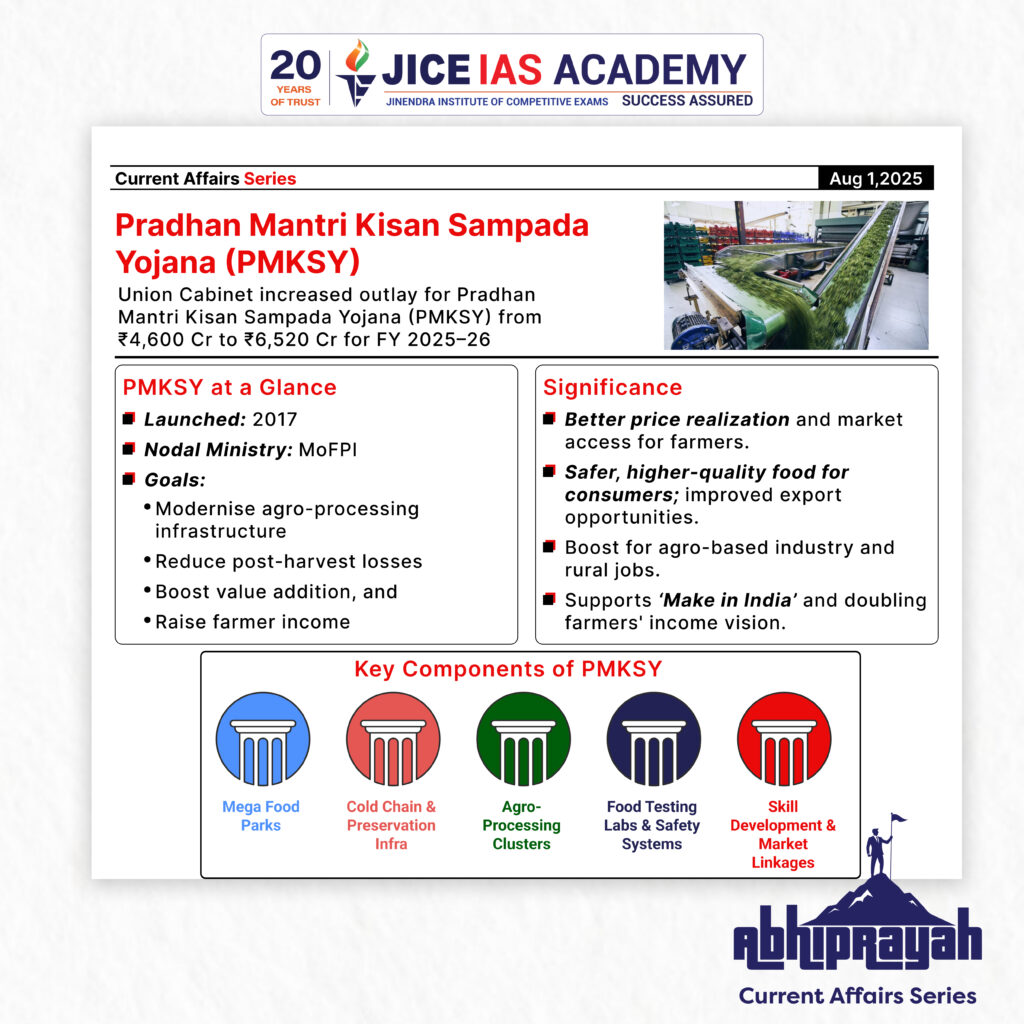
UPSC CURRENT AFFAIRS – 01st August 2025 Home / Additional Budget allocation for the Pradhan Mantri Kisan Sampada Yojana (PMKSY) Why in News? The Union Cabinet approved an additional ₹1,920 crore for PMKSY, raising its total outlay to ₹6,520 crore for FY 2025–26. Introduction The Union Cabinet, under the chairmanship of Prime Minister Narendra Modi, approved an additional budgetary allocation of ₹1,920 crore for the Pradhan Mantri Kisan Sampada Yojana (PMKSY). This decision raises the total outlay for the scheme from ₹4,600 crore to ₹6,520 crore for the current fiscal year 2025–26. This enhanced funding will be directed towards strengthening the food processing infrastructure, with a focus on setting up 50 multi-product food irradiation units and 100 food testing laboratories. Overview of PMKSY Pradhan Mantri Kisan Sampada Yojana (PMKSY) is a centrally sponsored scheme launched in 2017 by the Ministry of Food Processing Industries (MoFPI). It aims to modernize the food processing sector in India by creating robust supply chain infrastructure from farm gate to retail outlets. The scheme is designed to reduce food wastage, increase processing levels, enhance value addition, and improve the income of farmers. Objectives of PMKSY Develop modern infrastructure and efficient supply chain systems. Reduce post-harvest losses and food wastage. Promote value addition in agricultural produce. Ensure better price realization for farmers. Enhance employment generation in rural areas. Key Components of PMKSY Mega Food Parks: Integrated infrastructure for food processing units. Integrated Cold Chain and Value Addition Infrastructure: For preserving perishable produce. Creation/Expansion of Food Processing and Preservation Capacities. Infrastructure for Agro-Processing Clusters. Backward and Forward Linkages: Linking farmers to processors and markets. Food Safety and Quality Assurance Infrastructure: Includes laboratories and certifications. Human Resource and Skill Development in Food Processing Sector. Linkages with Other Government Initiatives Atmanirbhar Bharat Abhiyan: Supports self-reliance in the food processing sector. PM Formalisation of Micro Food Processing Enterprises (PMFME): Complements PMKSY by focusing on small-scale processors. One District One Product (ODOP): Food irradiation and testing labs will enhance the quality and marketability of ODOP items. National Export Policy for Agro Products: The move supports the export preparedness of agro-industrial goods. Way Ahead While PMKSY offers a comprehensive roadmap to reduce food wastage, boost farmer incomes, and strengthen value chain linkages, its effectiveness is hindered by administrative red tape, uneven funding support, limited outreach, and maintenance bottlenecks. For PMKSY to truly realize its objectives, policymakers must streamline clearances, improve outreach infrastructure, enhance capacity-building, and ensure equitable access for small and marginal farmers. Introduction Economic Implications For Indian Exporters These reforms reduce transaction costs and compliance hurdles Encourage a more competitive and efficient export environment Promote value addition in key sectors like leather For Tamil Nadu The reforms particularly benefit the state’s leather industry, a major contributor to employment and exports Boost the marketability of GI-tagged E.I. leather, enhancing rural and traditional industries For Trade Policy These decisions indicate a shift from regulatory controls to policy facilitation Reinforce the goals of Make in India, Atmanirbhar Bharat, and India’s ambition to become a leading export power Recently, BVR Subrahmanyam, CEO of NITI Aayog, claimed that India has overtaken Japan to become the fourth-largest economy in the world, citing data from the International Monetary Fund (IMF). India’s rank as the world’s largest economy varies by measure—nominal GDP or purchasing power parity (PPP)—each with key implications for economic analysis. Significance and Applications
INS Himgiri a Boost to Indigenous Naval Power

UPSC CURRENT AFFAIRS – 01st August 2025 Home / INS Himgiri a Boost to Indigenous Naval Power Why in News? INS Himgiri, the third frigate of Project 17A, was delivered to the Indian Navy. Introduction On August 1, 2025, the Indian Navy received INS Himgiri, an advanced guided-missile frigate built by Garden Reach Shipbuilders and Engineers (GRSE), Kolkata, under Project 17A (Nilgiri-class). This marks a significant step forward in India’s maritime security, indigenisation of defence manufacturing, and naval modernization drive. Background: Project 17A and the Nilgiri-class Project 17A is the follow-up of the Project 17 (Shivalik-class frigates). It involves the construction of seven stealth frigates—four at Mazagon Dock Shipbuilders Ltd. (MDL) and three at GRSE. These frigates are designed by the Warship Design Bureau (WDB) of the Indian Navy and are an improved version of earlier stealth ships with more indigenous content and modular construction techniques. INS Himgiri: Key Features and Capabilities Reincarnation of Legacy Named Himgiri (Yard 3022), the new ship revives the name of the erstwhile INS Himgiri, a Leander-class frigate that served the Navy for 30 years and was decommissioned on May 6, 2025. The new Himgiri embodies India’s technological and strategic evolution. Stealth and Strike Power Equipped with: BrahMos supersonic cruise missiles for anti-ship and land attack roles. Barak 8 surface-to-air missiles for air defence. Advanced stealth features include reduced radar cross-section, infrared and acoustic signatures, enhancing survivability in modern warfare. Multi-Mission Warfare Capable of anti-air, anti-surface, and anti-submarine warfare. Powered by a Combined Diesel and Gas (CODAG) propulsion system, providing both speed and fuel efficiency. Armed with Advanced AESA (Active Electronically Scanned Array) radars, and modern electronic warfare systems. Aviation and Accommodation Full-fledged aviation facilities for helicopters, enhancing its reconnaissance and anti-submarine capability. Designed for 225 personnel, with ergonomic and modular accommodation, ensuring crew comfort on extended missions. Technological and Industrial Significance Indigenous Design and Manufacturing Designed indigenously by the Navy’s Warship Design Bureau and overseen by the Warship Overseeing Team (Kolkata). Built using modular construction techniques—a first in India at this scale—enabling faster assembly and integration. High Indigenous Content Over 75% of the equipment and systems onboard are indigenously developed. Involvement of over 200 MSMEs, with significant contributions from the Indian private sector and DRDO labs. Employment generated: ~4,000 directly and over 10,000 indirectly. Timeline and Efficiency Launched in December 2020, delivered within projected timelines. Demonstrates improved project management, quality control, and production efficiency in Indian shipyards. Strategic and National Importance Maritime Security Part of India’s efforts to enhance blue water naval capabilities in the Indo-Pacific. Provides the Navy with a technologically advanced platform to respond to regional challenges, including maritime piracy, territorial threats, and disaster relief operations. Atmanirbhar Bharat in Defence A symbol of India’s push for self-reliance in defence production under the Atmanirbhar Bharat Abhiyan. Reduces dependence on foreign suppliers and strengthens defence exports potential. Regional Stability and Power Projection Enhances India’s deterrence capability and strengthens its status as a net security provider in the Indian Ocean Region (IOR). Supports missions related to maritime diplomacy, freedom of navigation, and regional cooperation. Introduction Economic Implications For Indian Exporters These reforms reduce transaction costs and compliance hurdles Encourage a more competitive and efficient export environment Promote value addition in key sectors like leather For Tamil Nadu The reforms particularly benefit the state’s leather industry, a major contributor to employment and exports Boost the marketability of GI-tagged E.I. leather, enhancing rural and traditional industries For Trade Policy These decisions indicate a shift from regulatory controls to policy facilitation Reinforce the goals of Make in India, Atmanirbhar Bharat, and India’s ambition to become a leading export power Recently, BVR Subrahmanyam, CEO of NITI Aayog, claimed that India has overtaken Japan to become the fourth-largest economy in the world, citing data from the International Monetary Fund (IMF). India’s rank as the world’s largest economy varies by measure—nominal GDP or purchasing power parity (PPP)—each with key implications for economic analysis. Significance and Applications
Massive 8.8 Magnitude Earthquake Hits Kamchatka Peninsula

UPSC CURRENT AFFAIRS – 31st July 2025 Home / Massive 8.8 Magnitude Earthquake Hits Kamchatka Peninsula Why in News? A massive 8.8 magnitude earthquake struck Russia’s Kamchatka Peninsula—part of the Pacific “Ring of Fire”—triggering a tsunami. Overview of the Event A massive 8.8 magnitude earthquake — among the strongest ever recorded — struck the Kamchatka Peninsula in Russia’s far east, approximately 6,500 km east of Moscow. The earthquake triggered a tsunami that affected various regions across the northern Pacific Ocean. Tsunami wave heights: Kamchatka and surrounding areas: 3–4 metres Hawaii: 5 feet (1.5 metres) Japan: 2 feet (0.6 metres) While infrastructure damage and flooding were reported, no human casualties occurred, primarily due to the sparse population in the affected region. Context: How Rare Are Such Earthquakes? Earthquakes of magnitude 8.5 and above are extremely rare. Only five such events have occurred globally in the past 20 years. The Kamchatka earthquake is the strongest since the 9.1 magnitude quake that struck Japan in 2011, which led to a devastating tsunami and the Fukushima nuclear disaster. Seismic Geography: Why Kamchatka? Location on the Ring of Fire: The Kamchatka Peninsula lies on the Circum-Pacific Seismic Belt, also called the Ring of Fire — the most seismically active region on Earth. This belt: Encircles the Pacific Ocean Includes the western coasts of the Americas and the eastern coasts of Asia and Oceania Passes through countries like Russia, Japan, Philippines, Indonesia, New Zealand, Chile, and the USA Tectonic Mechanism: Subduction Zone Earthquakes What Is Subduction? Subduction is a geological process where one tectonic plate slides under another. The denser oceanic plate (usually the Pacific Plate) is forced beneath a lighter continental plate. This causes accumulation of stress along the plate boundary. The release of this stress results in major earthquakes and sometimes tsunamis. The Kamchatka earthquake was caused by the subduction of the Pacific Plate beneath the North American Plate (in Russia’s far-east region). Other Regions of Subduction Himalayas: Caused by the Indian Plate pushing against the Eurasian Plate. Subduction here is happening over land, unlike the oceanic subduction seen in the Pacific. Global Seismic Belts: Three Major Zones Circum-Pacific Belt (Ring of Fire) Covers nearly 40,000 km around the Pacific. Responsible for 80% of all earthquakes. Hosts multiple subduction zones, leading to frequent earthquakes and volcanic eruptions. Alpide Belt Extends from Indonesia to Turkey, passing through the Himalayas, Iran, and Afghanistan. Contributes about 15–17% of global earthquakes. Although earthquakes here are less intense than in the Pacific, they are more deadly due to high population density. Example: Nepal Earthquake (2015), 7.6 magnitude, killed 15,000+ people. Mid-Atlantic Ridge A divergent boundary (not subduction-based) that runs through the Atlantic Ocean, from the Arctic to Antarctica. Produces moderate earthquakes. Being deep underwater and far from land, the impact is minimal. Magnitude and Faultline Length: Can There Be a Magnitude 10 Earthquake? Earthquake magnitude is partially determined by the length of the faultline. The longer the faultline, the greater the potential magnitude. The largest recorded earthquake (Chile 1960) had a magnitude of 9.5. A magnitude 10 earthquake would require a faultline stretching across the entire Earth — geologically impossible with current plate configurations. Conclusion The 8.8 magnitude earthquake in Kamchatka is a reminder of Earth’s powerful geological forces. While rare, such mega-quakes are not unusual in the seismically active Ring of Fire. With increasing coastal urbanisation and climate-linked vulnerabilities, early warning systems, disaster preparedness, and population awareness remain key to mitigating earthquake and tsunami impacts. Introduction Economic Implications For Indian Exporters These reforms reduce transaction costs and compliance hurdles Encourage a more competitive and efficient export environment Promote value addition in key sectors like leather For Tamil Nadu The reforms particularly benefit the state’s leather industry, a major contributor to employment and exports Boost the marketability of GI-tagged E.I. leather, enhancing rural and traditional industries For Trade Policy These decisions indicate a shift from regulatory controls to policy facilitation Reinforce the goals of Make in India, Atmanirbhar Bharat, and India’s ambition to become a leading export power Recently, BVR Subrahmanyam, CEO of NITI Aayog, claimed that India has overtaken Japan to become the fourth-largest economy in the world, citing data from the International Monetary Fund (IMF). India’s rank as the world’s largest economy varies by measure—nominal GDP or purchasing power parity (PPP)—each with key implications for economic analysis. Significance and Applications
Challenges and Gaps in India’s Legal Aid System

UPSC CURRENT AFFAIRS – 31st July 2025 Home / Challenges and Gaps in India’s Legal Aid System Why in News? Despite a legal mandate to provide free legal aid to nearly 80% of India’s population, access remains limited due to low funding, poor utilisation, and shrinking human resources. Introduction Legal aid is a constitutional right in India, enshrined under Article 39A of the Constitution, which mandates the state to ensure that opportunities for securing justice are not denied to any citizen by reason of economic or other disabilities. To institutionalise this, the Legal Services Authorities Act, 1987 was enacted, creating a framework of Legal Services Institutions (LSIs) at the national, state, district, and taluk levels. However, despite this robust framework, legal aid remains severely underutilised and under-resourced, with a significant gap between its mandate and actual reach. Mandate and Actual Reach As per the Legal Services Authorities Act, legal aid is intended to benefit nearly 80% of India’s population, including economically weaker sections, Scheduled Castes (SCs), Scheduled Tribes (STs), women, children, persons in custody, and victims of disasters or violence. However, the actual reach remains modest. Only 15.50 lakh people received legal aid services between April 2023 and March 2024. Although this marks a 28% increase from the previous year (12.14 lakh), it still falls short of the scale envisioned. Legal aid is typically delivered through front offices at: District and subordinate courts, Prisons, Juvenile justice boards, Legal aid clinics in rural and remote areas (1 clinic per 163 villages as per the India Justice Report 2025). The reach and quality of services remain dependent on financial and human resource availability. Per Capita Legal Aid Spending National average (2022-23): ₹6 per capita. Highest: Haryana (₹16). Below average: Jharkhand, Assam (₹5 each), Uttar Pradesh (₹4), Bihar (₹3), and West Bengal (₹2). Spending doubled from ₹3 in 2019 to ₹7 in 2023, but disparities persist. Shrinking Human Resources: Para-Legal Volunteers Para-legal volunteers (PLVs) play a crucial role as intermediaries between the public and legal aid institutions. However, their numbers are declining due to financial neglect: PLVs declined by 38% from 2019 to 2024. In 2023, there were only 3.1 PLVs per lakh population, down from 5.7 in 2019. States like West Bengal and Uttar Pradesh had just 1 PLV per lakh. Legal Aid Defence Counsel (LADC) Scheme To improve representation for accused persons, NALSA launched the LADC Scheme in 2022, modelled on the public defender system. Key Features: Dedicated to defending only the accused. Aims to reduce burden on panel lawyers and enhance quality of legal representation. Operational in 610 of 670 districts. Persistent Structural Issues Despite budgetary increases in some States, several systemic issues continue to hinder the effectiveness of legal aid: Inconsistent quality of service across regions. Lack of accountability and monitoring. Low trust among citizens regarding the efficacy of free legal aid. Insufficient outreach and awareness programs. Delayed justice delivery undermining people’s faith in the system. Introduction Economic Implications For Indian Exporters These reforms reduce transaction costs and compliance hurdles Encourage a more competitive and efficient export environment Promote value addition in key sectors like leather For Tamil Nadu The reforms particularly benefit the state’s leather industry, a major contributor to employment and exports Boost the marketability of GI-tagged E.I. leather, enhancing rural and traditional industries For Trade Policy These decisions indicate a shift from regulatory controls to policy facilitation Reinforce the goals of Make in India, Atmanirbhar Bharat, and India’s ambition to become a leading export power Recently, BVR Subrahmanyam, CEO of NITI Aayog, claimed that India has overtaken Japan to become the fourth-largest economy in the world, citing data from the International Monetary Fund (IMF). India’s rank as the world’s largest economy varies by measure—nominal GDP or purchasing power parity (PPP)—each with key implications for economic analysis. Significance and Applications