
UPSC CURRENT AFFAIRS – 31st July 2025
Massive 8.8 Magnitude Earthquake Hits Kamchatka Peninsula
Why in News?
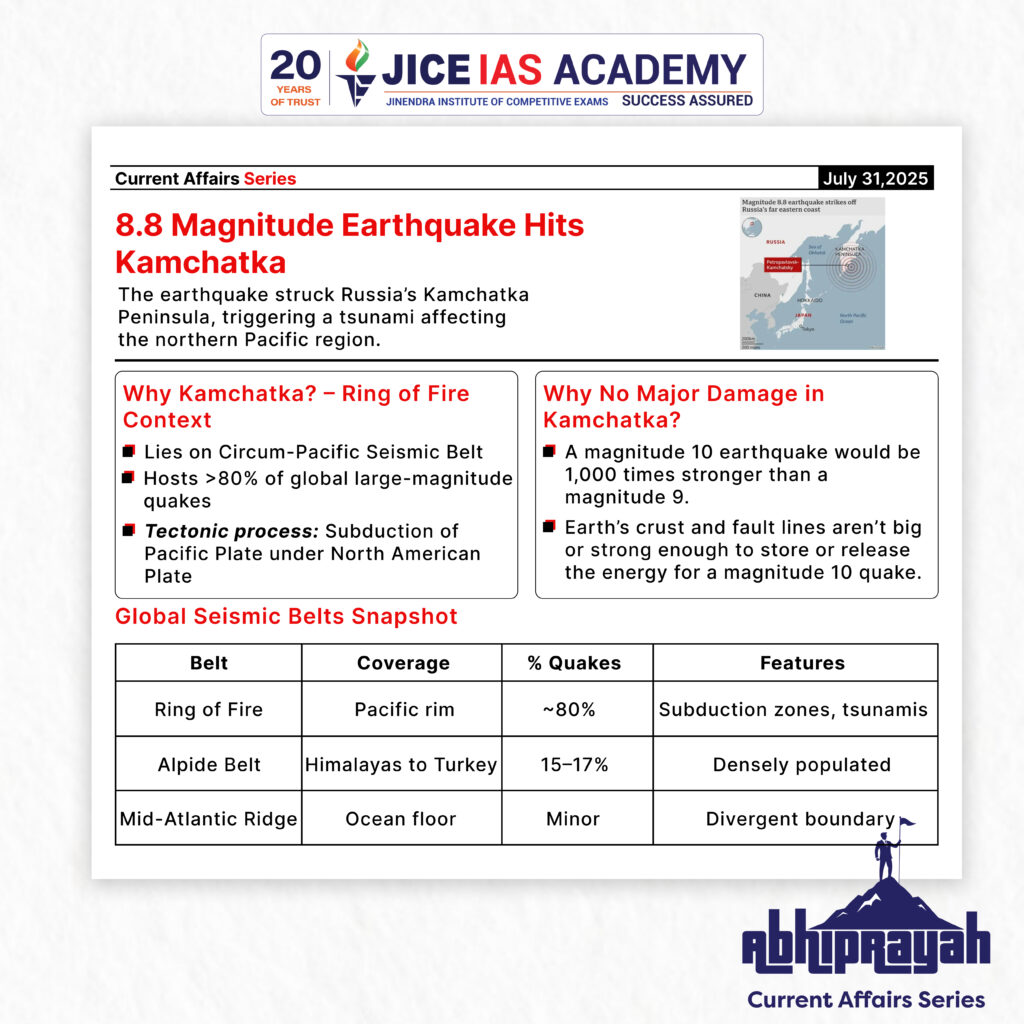
- A massive 8.8 magnitude earthquake struck Russia’s Kamchatka Peninsula—part of the Pacific “Ring of Fire”—triggering a tsunami.
Overview of the Event
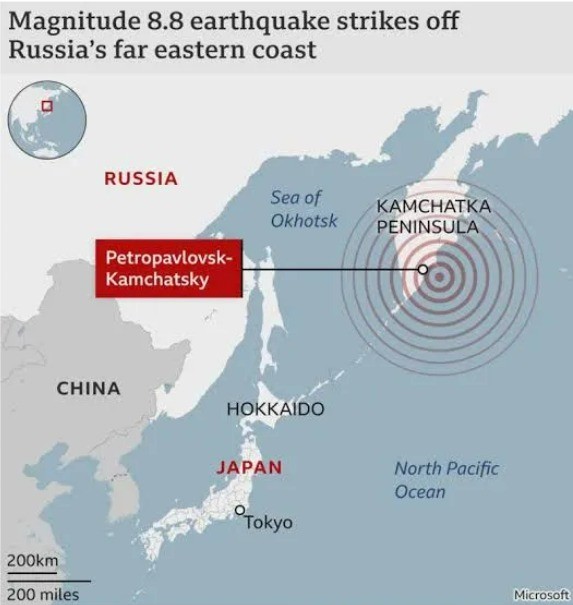
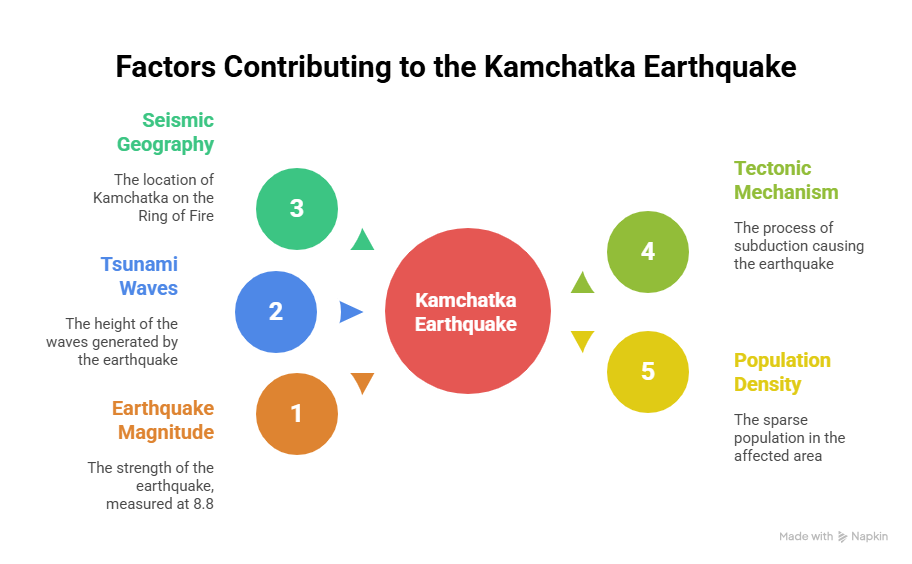
- A massive 8.8 magnitude earthquake — among the strongest ever recorded — struck the Kamchatka Peninsula in Russia’s far east, approximately 6,500 km east of Moscow.
- The earthquake triggered a tsunami that affected various regions across the northern Pacific Ocean.
- Tsunami wave heights:
- Kamchatka and surrounding areas: 3–4 metres
- Hawaii: 5 feet (1.5 metres)
- Japan: 2 feet (0.6 metres)
- While infrastructure damage and flooding were reported, no human casualties occurred, primarily due to the sparse population in the affected region.
Context: How Rare Are Such Earthquakes?
- Earthquakes of magnitude 8.5 and above are extremely rare.
- Only five such events have occurred globally in the past 20 years.
- The Kamchatka earthquake is the strongest since the 9.1 magnitude quake that struck Japan in 2011, which led to a devastating tsunami and the Fukushima nuclear disaster.
Seismic Geography: Why Kamchatka?
Location on the Ring of Fire:
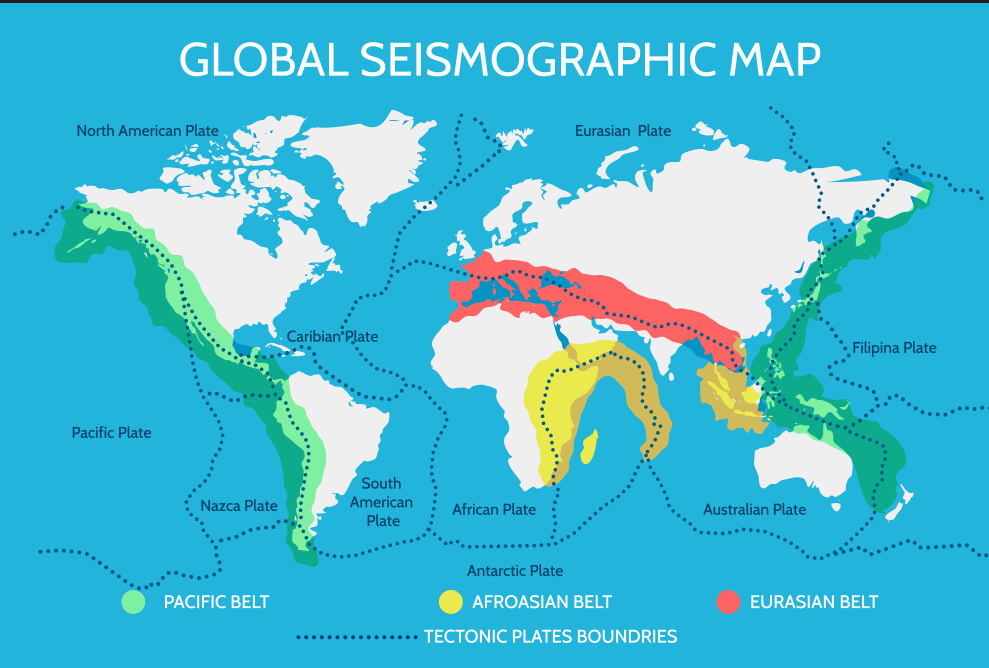
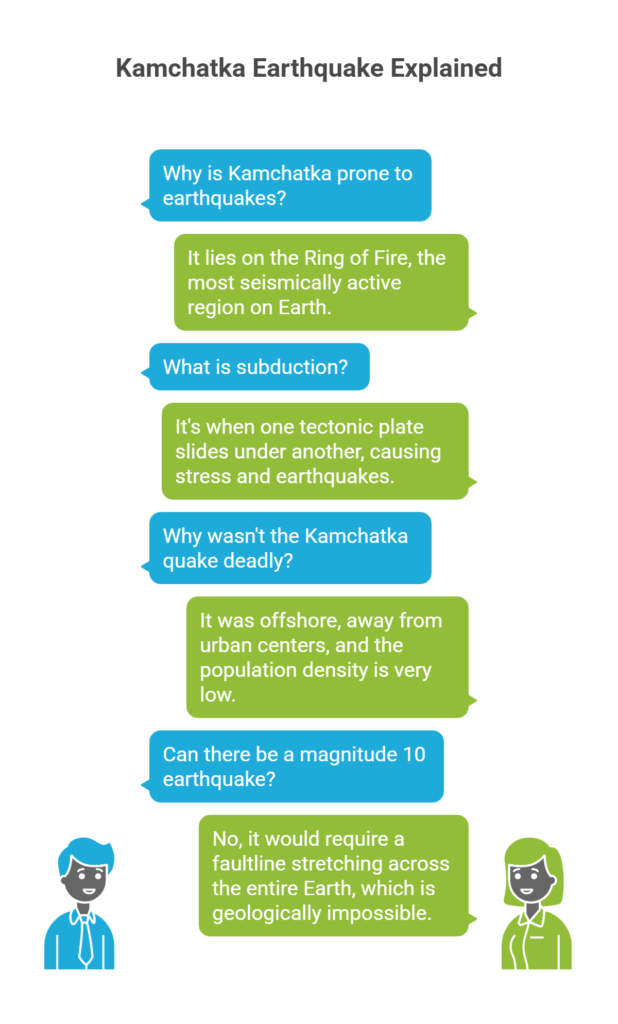
- The Kamchatka Peninsula lies on the Circum-Pacific Seismic Belt, also called the Ring of Fire — the most seismically active region on Earth.
- This belt:
- Encircles the Pacific Ocean
- Includes the western coasts of the Americas and the eastern coasts of Asia and Oceania
- Passes through countries like Russia, Japan, Philippines, Indonesia, New Zealand, Chile, and the USA
Tectonic Mechanism: Subduction Zone Earthquakes
What Is Subduction?
- Subduction is a geological process where one tectonic plate slides under another.
- The denser oceanic plate (usually the Pacific Plate) is forced beneath a lighter continental plate.
- This causes accumulation of stress along the plate boundary.
- The release of this stress results in major earthquakes and sometimes tsunamis.
The Kamchatka earthquake was caused by the subduction of the Pacific Plate beneath the North American Plate (in Russia’s far-east region).
Other Regions of Subduction
- Himalayas: Caused by the Indian Plate pushing against the Eurasian Plate.
- Subduction here is happening over land, unlike the oceanic subduction seen in the Pacific.
Global Seismic Belts: Three Major Zones
- Circum-Pacific Belt (Ring of Fire)
- Covers nearly 40,000 km around the Pacific.
- Responsible for 80% of all earthquakes.
- Hosts multiple subduction zones, leading to frequent earthquakes and volcanic eruptions.
- Alpide Belt
- Extends from Indonesia to Turkey, passing through the Himalayas, Iran, and Afghanistan.
- Contributes about 15–17% of global earthquakes.
- Although earthquakes here are less intense than in the Pacific, they are more deadly due to high population density.
- Example: Nepal Earthquake (2015), 7.6 magnitude, killed 15,000+ people.
- Mid-Atlantic Ridge
- A divergent boundary (not subduction-based) that runs through the Atlantic Ocean, from the Arctic to Antarctica.
- Produces moderate earthquakes.
- Being deep underwater and far from land, the impact is minimal.
Magnitude and Faultline Length: Can There Be a Magnitude 10 Earthquake?
- Earthquake magnitude is partially determined by the length of the faultline.
- The longer the faultline, the greater the potential magnitude.
- The largest recorded earthquake (Chile 1960) had a magnitude of 9.5.
- A magnitude 10 earthquake would require a faultline stretching across the entire Earth — geologically impossible with current plate configurations.
Conclusion
- The 8.8 magnitude earthquake in Kamchatka is a reminder of Earth’s powerful geological forces.
- While rare, such mega-quakes are not unusual in the seismically active Ring of Fire.
- With increasing coastal urbanisation and climate-linked vulnerabilities, early warning systems, disaster preparedness, and population awareness remain key to mitigating earthquake and tsunami impacts.

3rd UN conference on landlocked countries
UPSC CURRENT AFFAIRS – 08th August 2025 Home / 3rd UN conference on landlocked countries Why in News? At the

Issue of soapstone mining in Uttarakhand’s Bageshwar
UPSC CURRENT AFFAIRS – 08th August 2025 Home / Issue of soapstone mining in Uttarakhand’s Bageshwar Why in News? Unregulated

Groundwater Pollution in India – A Silent Public Health Emergency
UPSC CURRENT AFFAIRS – 08th August 2025 Home / Groundwater Pollution in India – A Silent Public Health Emergency Why

Universal banking- need and impact
UPSC CURRENT AFFAIRS – 08th August 2025 Home / Universal banking- need and impact Why in News? The Reserve Bank

India’s “Goldilocks” Economy: A Critical Appraisal
UPSC CURRENT AFFAIRS – 08th August 2025 Home / India’s “Goldilocks” Economy: A Critical Appraisal Why in News? The Finance

U.S.-India Trade Dispute: Trump’s 50% Tariffs and India’s Oil Imports from Russia
UPSC CURRENT AFFAIRS – 07th August 2025 Home / U.S.-India Trade Dispute: Trump’s 50% Tariffs and India’s Oil Imports from

Eco-Friendly Solution to Teak Pest Crisis: KFRI’s HpNPV Technology
UPSC CURRENT AFFAIRS – 07th August 2025 Home / Eco-Friendly Solution to Teak Pest Crisis: KFRI’s HpNPV Technology Why in

New Species of Non-Venomous Rain Snake Discovered in Mizoram
UPSC CURRENT AFFAIRS – 07th August 2025 Home / New Species of Non-Venomous Rain Snake Discovered in Mizoram Why in
Introduction
Economic Implications
For Indian Exporters
- These reforms reduce transaction costs and compliance hurdles
- Encourage a more competitive and efficient export environment
- Promote value addition in key sectors like leather
For Tamil Nadu
- The reforms particularly benefit the state’s leather industry, a major contributor to employment and exports
- Boost the marketability of GI-tagged E.I. leather, enhancing rural and traditional industries
For Trade Policy
- These decisions indicate a shift from regulatory controls to policy facilitation
Reinforce the goals of Make in India, Atmanirbhar Bharat, and India’s ambition to become a leading export power
Recently, BVR Subrahmanyam, CEO of NITI Aayog, claimed that India has overtaken Japan to become the fourth-largest economy in the world, citing data from the International Monetary Fund (IMF).
India’s rank as the world’s largest economy varies by measure—nominal GDP or purchasing power parity (PPP)—each with key implications for economic analysis.