
UPSC CURRENT AFFAIRS – 23th May 2025

Home / UPSC / Current Affairs / Development without the savaging of urban biodiversity

Development without the savaging of urban biodiversity

development without the savaging of urban biodiversity

Why in News?

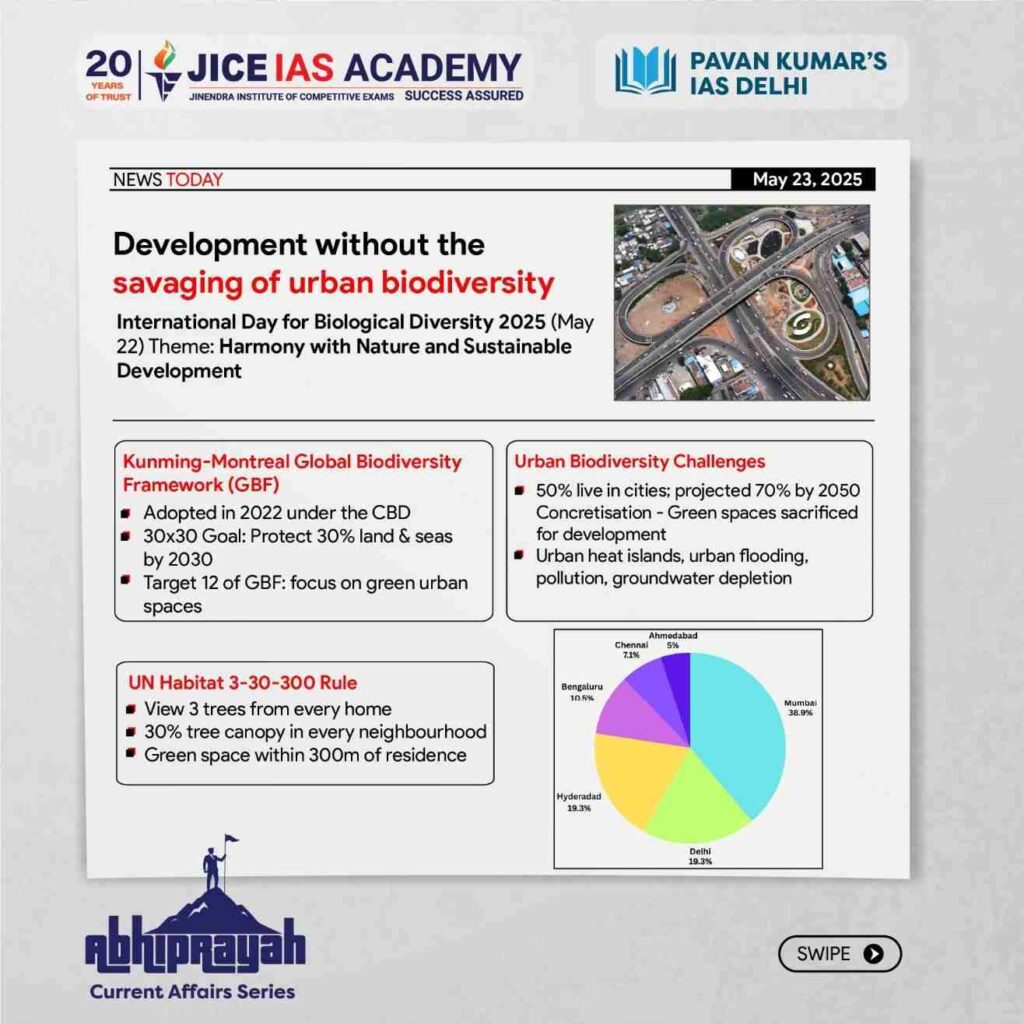
  • International Day for Biological Diversity 2025 was observed on May 22 with the theme “Harmony with Nature and Sustainable Development,” highlighting the need to integrate biodiversity into sustainable development goals.
Urban Biodiversity in India

Understanding Biodiversity and Its Importance

  • Biodiversity refers to the variety and variability of living organisms on Earth.
  • It plays a foundational role in maintaining ecosystem balance.
  • It supports human well-being and sustainable economic growth.
  • Approximately 25% of global species are currently threatened with extinction.
  • The primary drivers of this loss include urbanisation, pollution, habitat destruction, and climate change.

International Day for Biological Diversity

  • The International Day for Biological Diversity is observed annually on May 22.
  • It commemorates the adoption of the Convention on Biological Diversity (CBD) in 1992.
  • The 2025 theme is “Harmony with Nature and Sustainable Development”.
  • This theme underscores the need to align biodiversity protection with sustainability goals.

Global Initiatives

  1. Kunming-Montreal Global Biodiversity Framework (GBF):
    • Adopted under the Convention on Biological Diversity (CBD) in 2022.
    • Aims to halt and reverse biodiversity loss through 4 overarching goals and 23 specific targets to be achieved by 2030.
    • Key Target:
      • 30×30 Goal – Conservation and effective management of at least 30% of the world’s terrestrial and marine areas.
  1. Urban Focus – Target 12 of Global Biodiversity Framework (GBF):
    • Target 12 of the Kunming-Montreal GBF aims to significantly increase the area and quality of access to green and blue spaces in urban areas by 2030.
    • Promotes ecosystem connectivity and human well-being through nature-based solutions.
    • Supports biodiversity-inclusive urban planning.
  1. Linkage with Sustainable Development Goals (SDGs):
    • Goal 11 (Sustainable Cities and Communities):
      • Aims to make cities inclusive, safe, resilient, and sustainable.
      • Encourages the integration of natural ecosystems into city planning and infrastructure.
    • Both GBF and SDG frameworks converge on biodiversity mainstreaming in urban policy.
  1. Significance:
    • Reflects a holistic approach linking biodiversity, climate resilience, and urban sustainability.
    • Supports Nature-Based Solutions (NBS) to tackle climate change, urban heat islands, and pollution.

The Challenge of Urban Biodiversity

  • Urbanisation is occurring at a rapid pace worldwide. Nearly half of the global population resides in cities. This figure is expected to rise to 70% by 2050. Urban land is under intense pressure due to competing developmental needs.
  • Green spaces are often neglected in urban planning due to perceived space constraints. However, it is possible to integrate greenery if its benefits are prioritised.

Benefits of Urban Green Spaces

Health Benefits

  • Urban vegetation helps regulate ambient temperatures. It mitigates the urban heat island effect. It supports flood control and stormwater management.
  • Trees absorb pollutants and sequester carbon dioxide. Vegetation conserves water and filters suspended particulate matter.
  • Green belts in Frankfurt were found to lower city temperature by 3.5°C. These belts also increased relative humidity by 5%. Parks and green areas provide recreational and spiritual benefits.

Economic Benefits

  • Urban trees contribute significantly to ecosystem services. According to Theodore Endreny, mega-city trees provide services worth $967,000 (₹8 crore) per square kilometre annually.
  • Green infrastructure enhances urban public health. It also contributes to economic sustainability by reducing healthcare and climate adaptation costs. Promoting parks, tree-lined avenues, and conserving rivers and lakes can offer long-term returns.
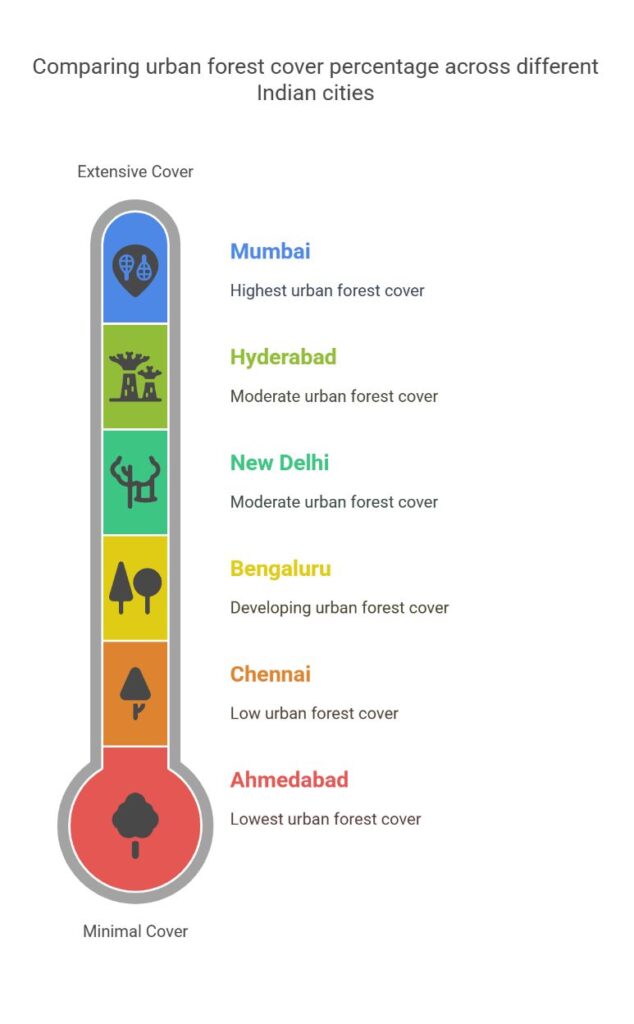
comparing urban forest cover percentage across different indian cities

Status of Urban Forest Cover in India

  • The Forest Survey of India has assessed forest cover in major cities.
  • The average urban forest cover is 10.26% of geographical area.
  • City-wise data include: 
    • Mumbai: 25.43%
    • New Delhi: 12.6%
    • Hyderabad: 12.6%
    • Bengaluru: 6.85%
    • Chennai: 4.66%
    • Ahmedabad: 3.27%
  • Between 2021 and 2023, Chennai and Hyderabad lost 2.6 and 1.6 square kilometres of forest cover respectively.

Frameworks for Urban Biodiversity Conservation

  • The GBF offers guidelines for conserving urban biodiversity.
  • It recommends protecting and enhancing green and blue spaces.
  • It suggests improving native biodiversity and ecological connectivity.
  • The UN Habitat proposes the 3-30-300 rule:
    • Each home, workplace, or school should view at least three mature trees.
    • Neighbourhoods should have a minimum of 30% tree canopy cover.
    • A public green space of 0.5 to 1 hectare should be accessible within 300 metres.

     City Biodiversity Index and Local Planning

  • The City Biodiversity Index evaluates biodiversity across three parameters:
    • Native biodiversity
    • Ecosystem services
    • Governance mechanisms
  • ICLEI South Asia has developed indices for cities like Kochi, Gangtok, and Nagpur using 23 indicators.
  • Based on the assessment, a Local Biodiversity Strategy and Action Plan (LBSAP) is formulated.
  • These strategies aim to improve biodiversity and ensure sustainable urban development.
urban biodiversity conservation frameworks

Urban Case Studies and Best Practices

  • Urban areas can support rich biodiversity with proper planning.
  • In Chennai, the greening of the Koyambedu market in 2021 promoted natural regeneration.
  • Within two years, 141 higher plant species from 39 families were recorded.
  • The site also attracted 35 bird and 27 butterfly species—key bioindicators.
  • The model used mimics a three-layered forest and may be more effective than the Miyawaki method in small spaces.
  • In 2018, Care Earth Trust developed a strategy to plant one million native trees in Chennai over five years.
  • The Madras Race Club land is being converted into a water body to aid groundwater recharge.
  • However, unregulated urban development has encroached upon many waterbodies in Chennai and Bengaluru.
  • The Pallikaranai Marsh in Chennai, once considered a wasteland, has been partially restored and declared a Ramsar site.
  • Most urban waterbodies suffer from pollution due to untreated sewage and solid waste.
  • Ecological restoration should include waste management and sewage treatment.
  • Legal protection is necessary to safeguard remaining urban lakes and waterbodies.

Benefits of Urban Green Spaces

Leave a Reply

Your email address will not be published. Required fields are marked *

Call Us Now !

Copyright © JICE ACADEMY FOR EXCELLENCE PRIVATE LIMITED