UPSC CURRENT AFFAIRS – 26th July 2025

Home / UPSC / Current Affairs / 15th Conference of the Contracting Parties to the Ramsar Convention on Wetlands (COP15)

15th Conference of the Contracting Parties to the Ramsar Convention on Wetlands (COP15)

Why in News?

  • Ramsar COP15, held in Victoria Falls, Zimbabwe (July 2025), aims to address the accelerating global loss of wetlands through the Victoria Falls Declaration, new funding mechanisms, and integration into climate policy.

Introduction

    • The 15th Conference of the Contracting Parties to the Ramsar Convention on Wetlands (COP15) is being held from July 23 to 31, 2025, in Victoria Falls, Zimbabwe. The summit brings together over 3,000 delegates from 172 countries to address the urgent need for wetland conservation amid accelerating global loss and degradation.

         About the Ramsar Convention

    • The Ramsar Convention on Wetlands, adopted in 1971 in Ramsar, Iran, is the only global treaty focused specifically on the conservation and wise use of wetlands.
    • It promotes the “wise use” of wetlands and encourages international cooperation for sustainable management of wetland ecosystems.
    • As of 2025, it includes 172 contracting parties and covers over 2,400 Ramsar Sites globally.

COP15 Highlights and Significance

  • 2021 (Italy): First G20 Start-up competition – G20 Innovation League.
  • 2022 (Indonesia): G20 Digital Innovation Network established.
  • 2023 (India): Formal institutionalisation of Startup20 as a G20 Engagement Group.

This journey reflected a growing consensus: start-ups and SMEs are critical engines of inclusive, sustainable, and innovation-driven global growth.

India’s Vision and Contributions

India, with its rapidly expanding start-up ecosystem, spearheaded the creation of Startup20 with two primary objectives:

  1. Policy harmonisation of global start-up ecosystems.
  2. Preservation of national ecosystem diversity and autonomy.

India’s inaugural policy communiqué under Startup20 proposed:

  • A collective investment goal of $1 trillion by 2030 into global start-up ecosystems.
  • Development of a global start-up definition and governance framework.
  • Enabling cross-border access to capital, talent, and markets.
  • Promoting inclusion (gender, geography, sectors).
  • Scaling start-ups aligned with Sustainable Development Goals (SDGs).


Key Issues and Agenda at COP15

Launched on July 21, 2025, in Johannesburg, South Africa’s Startup20 focuses on:

Five Key Task Forces

  1. Foundation and Alliances
  2. Finance and Investment
  3. Inclusion and Sustainability
  4. Trade and Market Access
  5. Township and Rural Entrepreneurship

Notable Firsts under South Africa

  • First-time focus on rural and township entrepreneurship.
  • Private-sector leaders representing national start-up interests.

A deliberate push to develop an implementation mechanism for policy recommendations.

Key Issues and Agenda at COP15

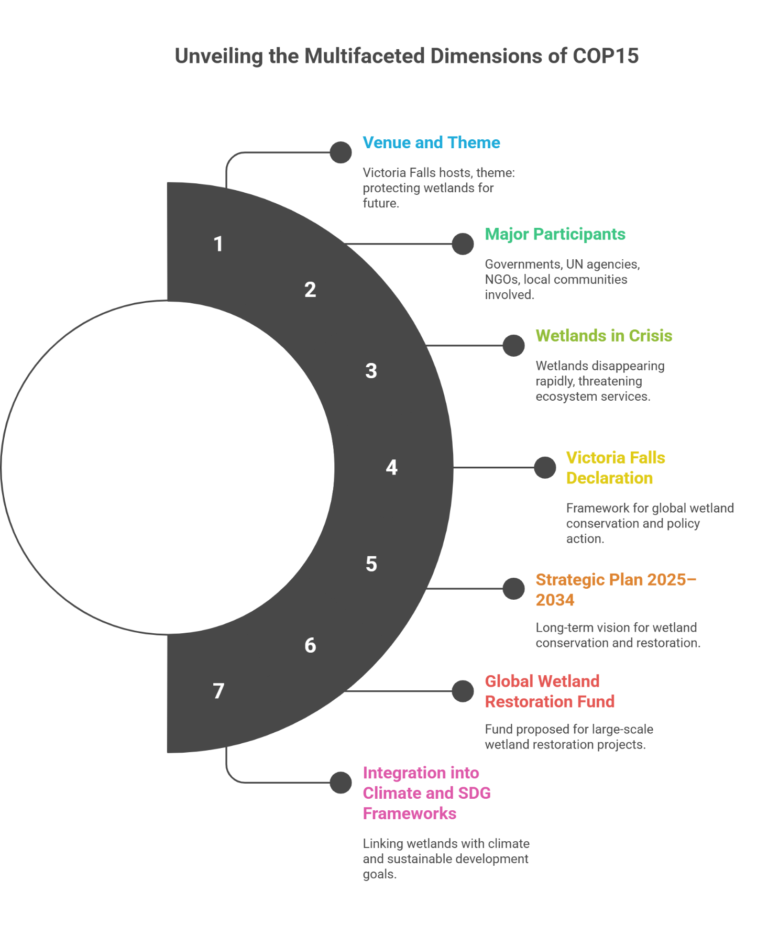
  1. Wetlands in Crisis
  • Since 1970, 35% of wetlands have disappeared, three times faster than forests.
  • GWO 2025 Report (Global Wetland Outlook 2025) warns:
    • 20% more wetlands may vanish by 2050.
    • Potential loss of $39 trillion in ecosystem services.
    • Wetlands cover 6% of Earth’s surface, yet provide 7.5% of global GDP in ecosystem benefits.
  1. Victoria Falls Declaration
  • A landmark framework for global wetland conservation.
  • Aims to:
    • Galvanise policy action
    • Mainstream wetlands into national climate policies
    • Enhance financing and innovation
  • Will guide wetland strategy for the 2025–2034 period.
  1. Strategic Plan 2025–2034
  • Sets the long-term vision and policy direction for wetland conservation.
  • Emphasis on:
    • Restoring degraded wetlands
    • Enhancing community engagement
    • Integrating wetland protection into climate resilience, water security, and biodiversity goals
  1. Global Wetland Restoration Fund
  • Proposed to finance large-scale restoration projects.
  • Focus on innovation, climate mitigation, and inclusion.
  1. Integration into Climate and SDG Frameworks
  • Delegates are considering how to better link wetland conservation with:
    • Nationally Determined Contributions (NDCs) under the Paris Agreement
    • Sustainable Development Goals (SDGs)

Why Wetlands Matter

    • Called the “kidneys of the Earth”, wetlands:
      • Filter pollutants and purify water
      • Mitigate floods and store carbon
      • Provide livelihoods through agriculture, aquaculture, and tourism
      • Support 40% of global biodiversity

    Economic Value

    • Wetlands offer ecosystem services worth trillions of dollars, yet are undervalued and underprotected.
    • Loss of 0.52% annually is eroding climate resilience and biodiversity.

Zimbabwe’s Leadership Role

  • Zimbabwe assumes Ramsar Presidency (2025–2028).
  • Hosts 7 Ramsar Sites, including Victoria Falls.
  • President Emmerson Mnangagwa emphasised the urgent need for:
    • Collaborative restoration efforts
    • Policy innovation
    • Community-based conservation

Outcomes Expected from COP15

  1. Adoption of Victoria Falls Declaration
  2. Launch of the Strategic Plan 2025–2034
  3. Approval of the Global Wetland Fund
  4. Commitment to integrate wetlands into climate strategies
  5. Emphasis on rural, coastal, and urban wetland restoration

Challenges in Wetland Conservation

  • Urbanisation, agriculture, pollution, and climate change continue to threaten wetland ecosystems.
  • Gaps in financing, governance, and data limit conservation efforts.
  • Local communities often lack awareness or support to protect wetlands sustainably.

Way Forward

  • Urbanisation, agriculture, pollution, and climate change continue to threaten wetland ecosystems.
  • Gaps in financing, governance, and data limit conservation efforts.
  • Local communities often lack awareness or support to protect wetlands sustainably.

Introduction

Economic Implications

For Indian Exporters

  • These reforms reduce transaction costs and compliance hurdles
  • Encourage a more competitive and efficient export environment
  • Promote value addition in key sectors like leather

For Tamil Nadu

  • The reforms particularly benefit the state’s leather industry, a major contributor to employment and exports
  • Boost the marketability of GI-tagged E.I. leather, enhancing rural and traditional industries

For Trade Policy

  • These decisions indicate a shift from regulatory controls to policy facilitation

Reinforce the goals of Make in India, Atmanirbhar Bharat, and India’s ambition to become a leading export power

Recently, BVR Subrahmanyam, CEO of NITI Aayog, claimed that India has overtaken Japan to become the fourth-largest economy in the world, citing data from the International Monetary Fund (IMF). 

India’s rank as the world’s largest economy varies by measure—nominal GDP or purchasing power parity (PPP)—each with key implications for economic analysis.

Significance and Applications

Leave a Reply

Your email address will not be published. Required fields are marked *

Call Us Now !

Copyright © JICE ACADEMY FOR EXCELLENCE PRIVATE LIMITED