
UPSC CURRENT AFFAIRS – 26th June 2025

Home / UPSC / Current Affairs / Union Cabinet passes resolution marking 50 years of Emergency

Union Cabinet passes resolution marking 50 years of Emergency

emergency provisions

Why in News?

  • India marked the 50th anniversary of the Emergency (1975–77) remembering it as a dark chapter in democracy and honouring those who resisted the suspension of constitutional rights. 

Introduction

  • On June 25, 2025, India marked the 50th anniversary of the declaration of the Emergency, one of the most controversial periods in the nation’s democratic journey. 
  • Declared on June 25, 1975, under Article 352 of the Constitution, the Emergency suspended civil liberties, curtailed press freedom, and centralized executive power — casting a long shadow over Indian democracy.
  • Prime Minister Narendra Modi led the Union Cabinet in commemorating this anniversary, paying tribute to those who resisted what is now termed as ‘Samvidhan Hatya Diwas’ (Constitution Murder Day).

What Was the Emergency?

  • The Emergency (1975–77) was declared by then Prime Minister Indira Gandhi citing “internal disturbance” under Article 352 of the Constitution. 
  • It lasted 21 months, from June 25, 1975, to March 21, 1977.

Emergency Provisions in the Indian Constitution

  • Articles 352 to 360 of the Indian Constitution deal with Emergency provisions
  • These provisions enable the Union government to deal with extraordinary situations threatening the nation’s security, stability, or financial health.

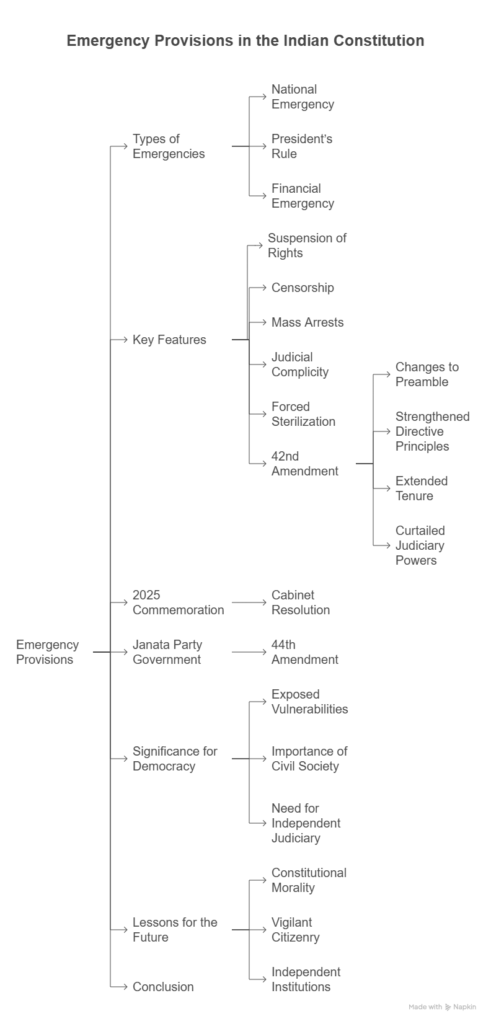
Types of Emergencies

Type of Emergency

Constitutional Article

Common Name

Reason for Declaration

1. National Emergency

Article 352

External or Internal Threat Emergency

War, External Aggression, or Armed Rebellion

2. President’s Rule

Article 356 (with Article 365)

State Emergency

Failure of Constitutional Machinery in a State

3. Financial Emergency

Article 360

Economic Emergency

Threat to Financial Stability or Credit of India

emergency provisions in indian constitution

Key Features of the Emergency:

  • Suspension of Fundamental Rights (especially under Article 19)
  • Censorship of the Press
  • Mass Arrests of political opponents under the Maintenance of Internal Security Act (MISA)
  • Judicial Complicity, highlighted by the ADM Jabalpur v. Shivkant Shukla case, where the Supreme Court upheld suspension of habeas corpus
  • Forced Sterilization Campaigns, especially targeting the poor
  • 42nd Constitutional Amendment, also called the “Mini-Constitution”, which increased centralization of power

The 2025 Commemoration: A Cabinet Resolution

  • At a special Union Cabinet meeting, the government passed a resolution honouring the resistance to the Emergency. 
  • Prime Minister Modi stated that the Emergency was one of the “darkest chapters in India’s democratic history.”

42nd Constitutional Amendment and Its Legacy

The 42nd Amendment Act, 1976, passed during the Emergency, made sweeping changes:

  • Preamble changed: “Sovereign Democratic Republic” became “Sovereign Socialist Secular Democratic Republic”
  • Strengthened the Directive Principles of State Policy over Fundamental Rights
  • Extended the tenure of legislatures
  • Curtailed the powers of the judiciary

After the Emergency, the Janata Party Government (1977–79) passed the 44th Amendment Act, undoing many of these changes and safeguarding constitutional democracy.

Significance for Democratic Institutions

The Emergency is a crucial turning point in India’s political history. It:

  • Exposed vulnerabilities in institutional checks and balances
  • Demonstrated the importance of civil society and political opposition
  • Highlighted the need for independent judiciary and media

Lessons for the Future

  1. Constitutional Morality must guide those in power, not just legal legitimacy.
  2. Vigilant citizenry is essential to sustain democratic governance.
  3. Institutions must remain independent and assert their roles during crises.

Conclusion

  • The Emergency’s 50th anniversary is not merely a ceremonial remembrance but a reassertion of democratic values. By remembering the sacrifices of those who resisted authoritarianism, 
  • India reaffirms its commitment to constitutional democracy and the rule of law. 
  • As Prime Minister Modi stated, this is a moment to honor those who ensured that India’s democracy was not only restored but emerged stronger.

Economic Implications

For Indian Exporters

  • These reforms reduce transaction costs and compliance hurdles
  • Encourage a more competitive and efficient export environment
  • Promote value addition in key sectors like leather

For Tamil Nadu

  • The reforms particularly benefit the state’s leather industry, a major contributor to employment and exports
  • Boost the marketability of GI-tagged E.I. leather, enhancing rural and traditional industries

For Trade Policy

  • These decisions indicate a shift from regulatory controls to policy facilitation

Reinforce the goals of Make in India, Atmanirbhar Bharat, and India’s ambition to become a leading export power

Recently, BVR Subrahmanyam, CEO of NITI Aayog, claimed that India has overtaken Japan to become the fourth-largest economy in the world, citing data from the International Monetary Fund (IMF). 

India’s rank as the world’s largest economy varies by measure—nominal GDP or purchasing power parity (PPP)—each with key implications for economic analysis.

Significance and Applications

Leave a Reply

Your email address will not be published. Required fields are marked *

Call Us Now !

Copyright © JICE ACADEMY FOR EXCELLENCE PRIVATE LIMITED