
UPSC CURRENT AFFAIRS – 20th June 2025

Home / UPSC / Current Affairs / Addressing India’s Propulsion Gap

Addressing India’s Propulsion Gap

Why in News?

India’s persistent propulsion gap continues to constrain its aerospace ambitions, despite advancements like the AMCA.

Introduction

  • India’s aspiration to emerge as a self-reliant global power in defence is evident in projects like the Advanced Medium Combat Aircraft (AMCA) — a fifth-generation stealth multirole fighter. 
  • However, a critical vulnerability continues to haunt the Indian aerospace and defence ecosystem: engine dependency
  • Despite multiple ambitious programmes since independence, the inability to design and produce indigenous jet engines has severely undermined India’s strategic autonomy.

The HF-24 Marut: A Historical Cautionary Tale

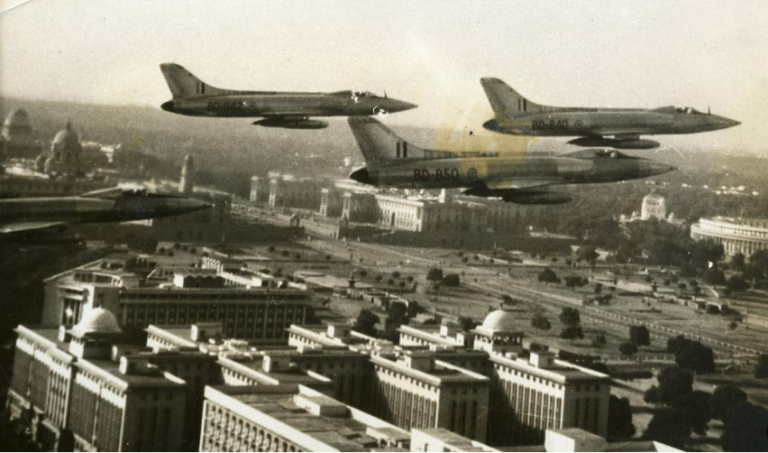
  • India’s tryst with fighter aircraft indigenisation began with the HF-24 Marut, developed in the 1950s by Hindustan Aeronautics Limited (HAL) under German engineer Kurt Tank
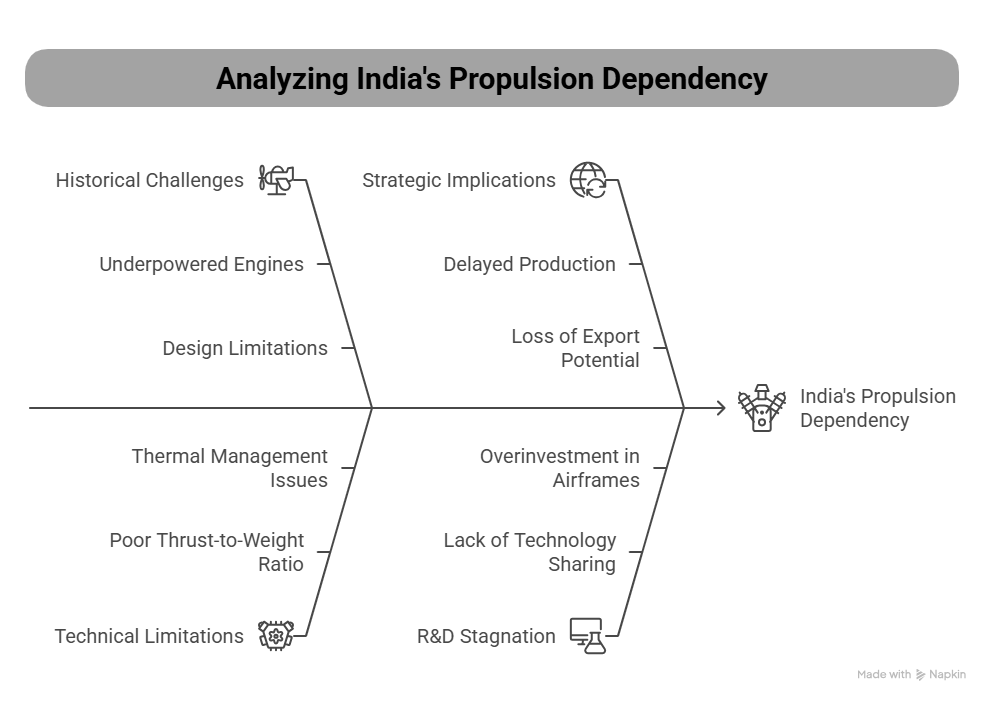
  • The Marut was advanced for its time but was crippled by an underpowered imported engine (British Orpheus 703), as the envisioned high-thrust engine never materialised.
  • Performance: While Marut performed credibly during the 1971 India-Pakistan War, its operational ceiling and overall performance remained suboptimal.
  • Outcome: Only 147 aircraft were produced, with the fleet phased out by 1990 — highlighting that even a well-designed airframe cannot compensate for weak propulsion.

The Kaveri Engine Saga: Chronic Shortfalls

  • In the 1980s, the Gas Turbine Research Establishment (GTRE) was tasked with developing the Kaveri GTX-35VS afterburning turbofan engine for the Light Combat Aircraft (LCA) project.
  • Timeline and Cost: Despite 35 years of R&D and over ₹2,032 crore in expenditure (as of 2020), the engine failed to meet desired benchmarks.
  • Technical Limitations:
    • Poor thrust-to-weight ratio
    • Thermal management issues
    • Reliability under sustained conditions
  • Revival Efforts and Failures
  • Attempts to revive Kaveri with foreign partnerships — including Snecma (Safran) and later through Rafale offset clauses — collapsed due to disagreements over technology sharing and institutional rigidity.

Current Dependence: A Matter of Strategic Concern

Light Combat Aircraft (LCA) – Tejas

  • The LCA Mk1 and Mk1A variants are powered by GE F404-IN20 engines.
  • Mk2 and AMCA Mk1 plan to use the more powerful GE F414 engine.
  • A $716 million contract for 99 F404 engines (signed in 2021) faced delays, with the first engine delivered only in April 2025, citing supply chain issues.

Consequences

  • Delay in commissioning LCA Mk1A squadrons
  • Criticism from Air Chief Marshal A.P. Singh over HAL’s repeated delivery failures
  • IAF’s combat squadron strength has plummeted to around 30, far below the sanctioned 42.5

Why Engine Technology Matters

Jet engines are not mere components — they are the core enablers of aerospace sovereignty, defining a fighter’s:

  • Thrust & Speed
  • Maneuverability & Payload
  • Mission Endurance
  • Export potential
  • Without engine autonomy, India remains vulnerable to geopolitical disruptions, cost escalations, and third-party export restrictions.

Across the Armed Forces: A Universal Vulnerability

  • India’s propulsion dependency is not limited to aircraft:
    • Army
    • Arjun Main Battle Tank: Powered by German MTU engines
    • Zorawar Light Tank: Uses U.S. Cummins engine
    • Navy
  • Entire fleet — from frigates to fast attack crafts — depends on Russian, French, German, Ukrainian, or U.S. engines
  • This blanket reliance on imported powerpacks for land, air, and sea platforms undercuts India’s ambitions for defence export leadership and strategic autonomy.

Indigenous Engine Development: The Road Ahead

Immediate Challenges

  • Negotiation stalemate with GE over local manufacture of F414 (GE demands additional $500 million)
  • GE is unwilling to share critical technologies:
    • Single-crystal turbine blades
    • Thermal barrier coatings
    • Advanced cooling systems
  • These are essential for developing high-thrust, long-life jet engines, but are closely guarded as strategic assets by OEMs.

Strategic Implications of Propulsion Dependency

  • Delayed Production and Induction: Delays in engine supply translate into delays in fighter induction — as seen with LCA Mk1A.
  • Loss of Export Potential: Export of fighters like Tejas requires third-party clearance from engine OEMs.
  • Strategic Vulnerability: Dependence on Western or Russian suppliers for propulsion opens India to supply-chain disruptions and foreign leverage.
  • Stagnation in R&D: Failure to master propulsion sidelines core R&D innovation and leads to overinvestment in airframes without matching propulsion capacity.

What Needs to Change?

  • Long-Term Vision and Political Will
      • Defence planning must transcend 5-year cycles and adopt a 20–30 year roadmap.
      • Political and budgetary commitment must match rhetoric like Atmanirbhar Bharat.
  • Structural Reform in R&D
      • Consolidate and empower institutions like GTRE with stable leadership and clear deliverables.
      • Encourage DRDO–private sector–academia collaboration in propulsion.
  • International Collaboration with Safeguards
      • Joint ventures with firms like Safran or Rolls-Royce must go beyond license production and include co-development with tech transfer.
      • The government must be prepared to invest heavily in acquiring such capabilities.
  • Private Sector Integration
    • India’s private sector (e.g., Godrej, Tata Advanced Systems, L&T) must be incentivised to enter propulsion R&D.
    • Promote competitive grants and incubation ecosystems around propulsion innovation.

Conclusion

  • India’s ambitions to become a global defence manufacturing hub and a net security provider in the Indo-Pacific rest heavily on one missing piece: a sovereign engine development capability
  • Without mastering propulsion technology — the heart of aerospace and defence — India risks repeating the tragedy of the Marut with every new platform it dreams of.
  • Engine development is not just a technological or financial challenge; it is a strategic necessity
  • If India truly wishes to assert itself as a 21st-century power, it must treat propulsion as its national mission, with the same intensity and unity as space, nuclear, and missile programmes.

Economic Implications

For Indian Exporters

  • These reforms reduce transaction costs and compliance hurdles
  • Encourage a more competitive and efficient export environment
  • Promote value addition in key sectors like leather

For Tamil Nadu

  • The reforms particularly benefit the state’s leather industry, a major contributor to employment and exports
  • Boost the marketability of GI-tagged E.I. leather, enhancing rural and traditional industries

For Trade Policy

  • These decisions indicate a shift from regulatory controls to policy facilitation

Reinforce the goals of Make in India, Atmanirbhar Bharat, and India’s ambition to become a leading export power

Recently, BVR Subrahmanyam, CEO of NITI Aayog, claimed that India has overtaken Japan to become the fourth-largest economy in the world, citing data from the International Monetary Fund (IMF). 

India’s rank as the world’s largest economy varies by measure—nominal GDP or purchasing power parity (PPP)—each with key implications for economic analysis.

Significance and Applications

Leave a Reply

Your email address will not be published. Required fields are marked *

Call Us Now !

Copyright © JICE ACADEMY FOR EXCELLENCE PRIVATE LIMITED