UPSC CURRENT AFFAIRS – 22nd July 2025

Home / UPSC / Current Affairs / Ancestral property rights for Adivasi women

Ancestral property rights for Adivasi women

Why in News?

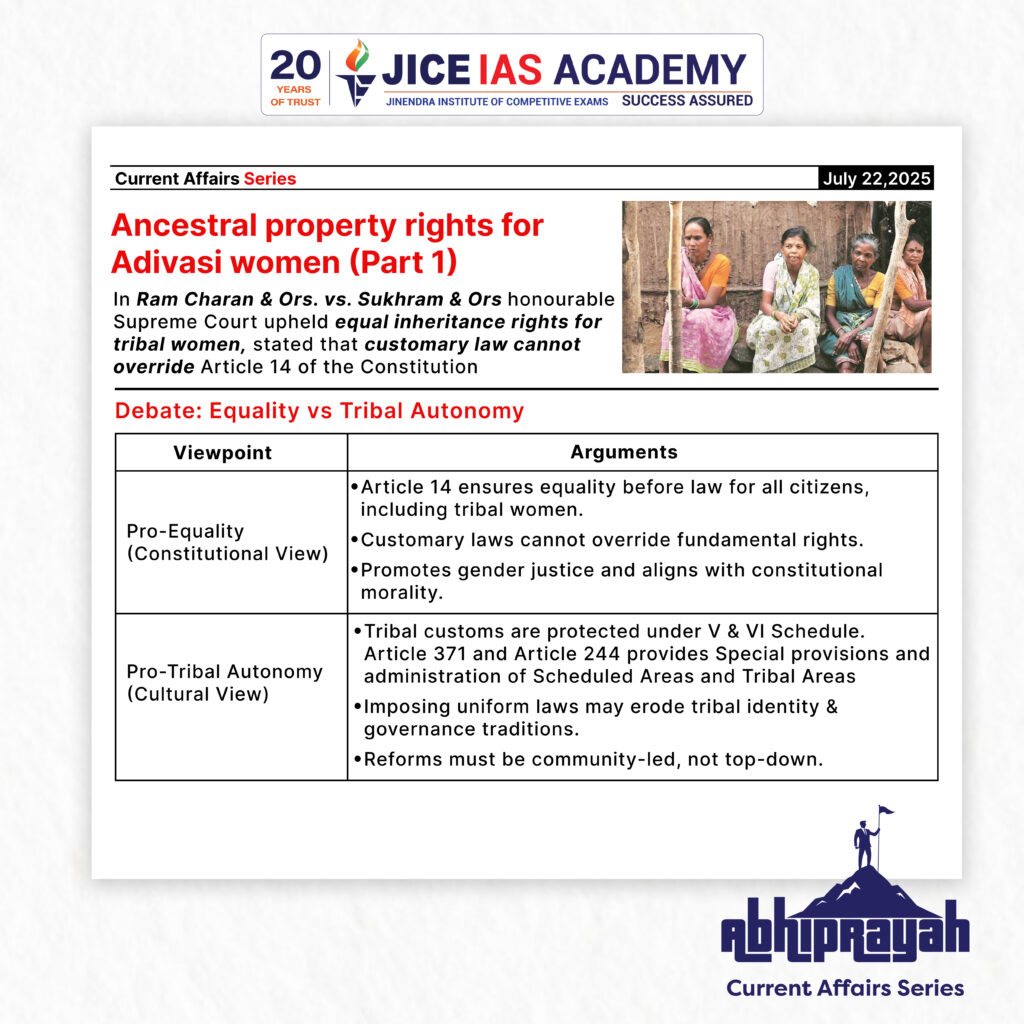
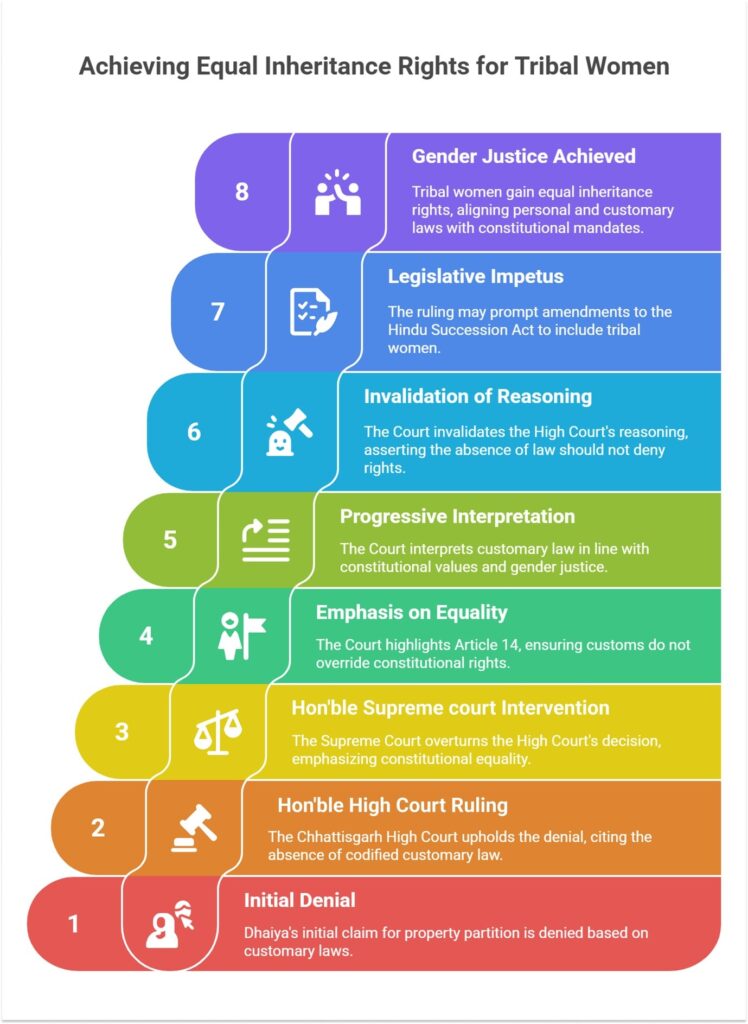
  • The Hon’ble Supreme Court, in July 2025, ruled that tribal women have equal inheritance rights, holding that customary laws cannot override constitutional guarantees of equality under Article 14.

Introduction

  • The Hon’ble Supreme Court of India delivered a landmark judgment upholding the right of a tribal woman to inherit ancestral property, affirming the constitutional guarantee of equality.
  • The Court overturned a 2022 ruling by the Hon’ble Chhattisgarh High Court, which had denied inheritance rights to the appellant based on the absence of a codified customary law supporting her claim.
  • The Apex Court’s intervention marks a crucial moment in advancing gender justice within tribal communities.

Background of the Case

  • The case dates back to 1992, when Dhaiya, a tribal woman from Chhattisgarh, sought partition of property belonging to her maternal grandmother.
  • Her claim was repeatedly denied—initially based on customary tribal laws and later by lower courts.
  • In its judgment, the Hon’ble Supreme Court emphasised that customary laws—while reflective of tribal autonomy—must not be static or discriminatory, especially when they infringe on fundamental rights.

Key Highlights of the Judgment

  1. Emphasis on Article 14 (Equality Before Law):
    • The Court held that customs and traditions cannot override constitutional rights, particularly the right to equality.
    • The exclusion of tribal women from inheritance was found to be arbitrary and discriminatory, violating the “collective ethos” of the Constitution.
  2. Progressive Interpretation of Customary Law:
    • The bench observed that “customs too, like the law, cannot remain stuck in time”.
    • The judgment highlighted that customs should evolve in light of constitutional values, especially gender justice.
  3. Invalidation of High Court’s Reasoning:
    • The Hon’ble Chhattisgarh High Court had earlier ruled that, in the absence of specific customary law allowing inheritance, the woman could not claim a share.
    • The Hon’ble SC ruled this as regressive, asserting that absence of law should not be a reason to deny rights.

Precedents and Legislative Gaps

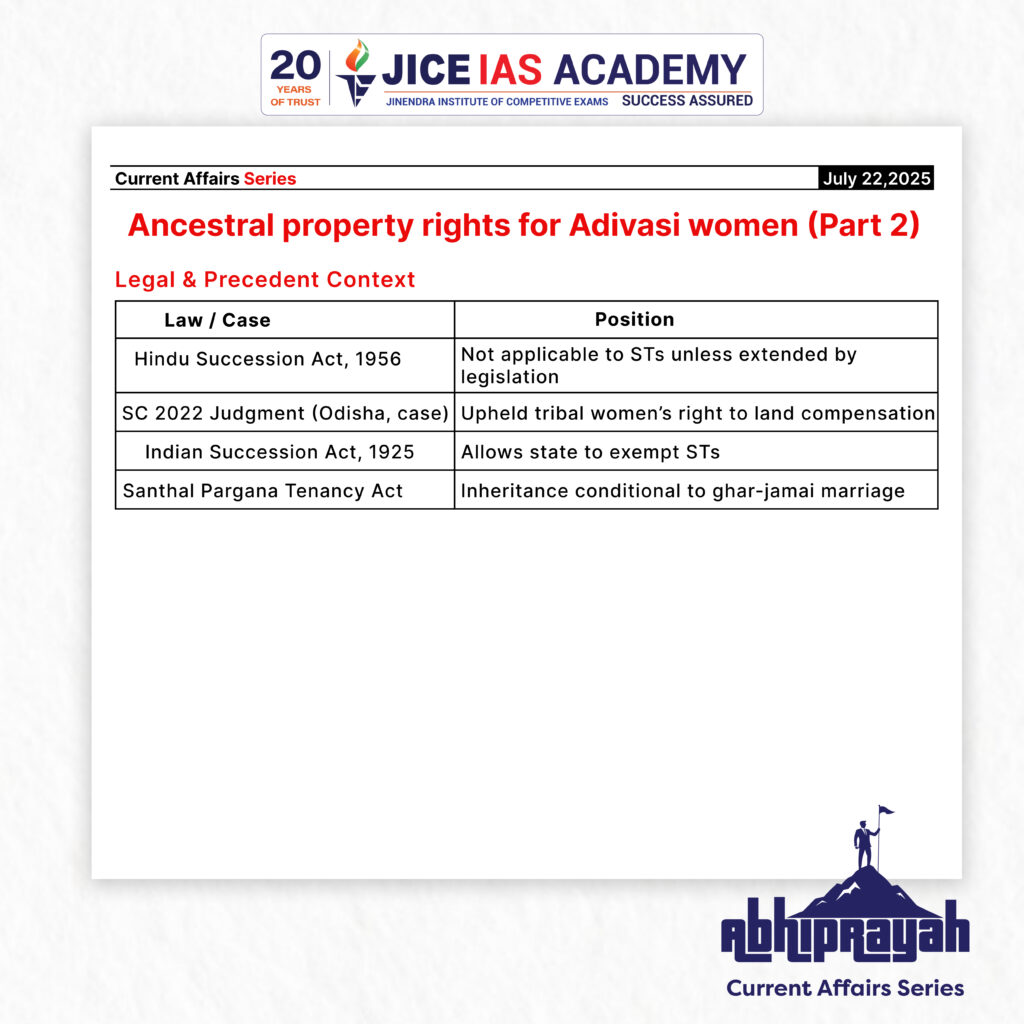
  1. December 2022 Judgment (Odisha Case):
    • The Hon’ble SC had previously ruled in favour of a tribal woman seeking compensation for land acquisition.
    • The Court had noted that “female tribal is entitled to parity with male tribal in intestate succession”.
  2. Hindu Succession Act, 1956:
    • The HSA does not apply to members of Scheduled Tribes unless specifically extended through legislation.
  3. Indian Succession Act, 1925:
    • Section 3 of the Act permits the State to exempt Scheduled Tribes, further contributing to legal exclusion.
  4. Santhal Pargana Tenancy Act, 1949:
    • Section 20 allows tribal women to inherit if they marry a ghar-jamai (resident son-in-law), but only during the father’s lifetime, limiting women’s independent rights.

Significance of the Ruling

  1. Advancement of Gender Justice:
    • The ruling recognises the constitutional right of tribal women to equality and dignity, aligning personal and customary laws with constitutional mandates.
  2. Challenge to Patriarchal Norms within Tribal Custom:
    • It directly questions and invalidates gender bias inherent in many customary inheritance laws.
  3. Constitutional Morality over Cultural Relativism:
    • Reaffirms the position that constitutional values must prevail over regressive customs.
  4. Potential Legislative Impetus:
    • The Court’s suggestion in the 2022 case for the Centre to consider amending the Hindu Succession Act might gain momentum following this verdict.

Concerns and Counterpoints

  1. Autonomy of Tribal Communities:
    • Some tribal rights activists argue that enforcing uniform succession laws may undermine tribal identity, autonomy, and cultural distinctiveness.
  2. Tension Between Constitutional Values and Customary Rights:
    • The verdict raises important questions about how to balance tribal customary law with constitutional mandates, especially when the Constitution itself (Article 13 and 371) recognizes tribal autonomy in certain respects.
  3. Implementation Challenges:
    • In remote tribal regions, enforcement of legal rights and awareness among women remains limited.
    • There may be resistance from patriarchal institutions within tribal societies.

Way Forward

  1. Codification of Customary Laws:
    • States must initiate a consultative process to document and codify customary laws in a manner that respects tribal culture while aligning with constitutional principles.
  2. Legislative Amendments:
    • Parliament may consider extending inheritance rights to tribal women through a suitable amendment, as recommended by the SC.
  3. Awareness and Legal Aid: Legal literacy campaigns must be conducted in tribal areas to empower women with knowledge of their rights.
  4. Community Engagement: Judicial and legislative reforms must be preceded by dialogue with tribal leaders and women’s groups to ensure cultural sensitivity and wider acceptance.

Economic Implications

For Indian Exporters

  • These reforms reduce transaction costs and compliance hurdles
  • Encourage a more competitive and efficient export environment
  • Promote value addition in key sectors like leather

For Tamil Nadu

  • The reforms particularly benefit the state’s leather industry, a major contributor to employment and exports
  • Boost the marketability of GI-tagged E.I. leather, enhancing rural and traditional industries

For Trade Policy

  • These decisions indicate a shift from regulatory controls to policy facilitation

Reinforce the goals of Make in India, Atmanirbhar Bharat, and India’s ambition to become a leading export power

Recently, BVR Subrahmanyam, CEO of NITI Aayog, claimed that India has overtaken Japan to become the fourth-largest economy in the world, citing data from the International Monetary Fund (IMF). 

India’s rank as the world’s largest economy varies by measure—nominal GDP or purchasing power parity (PPP)—each with key implications for economic analysis.

Significance and Applications

Leave a Reply

Your email address will not be published. Required fields are marked *

Call Us Now !

Copyright © JICE ACADEMY FOR EXCELLENCE PRIVATE LIMITED