UPSC CURRENT AFFAIRS – 13th July 2025

Home / UPSC / Current Affairs / India’s AYUSH Innovations Featured in WHO’s Landmark Brief on AI in Traditional Medicine

India’s AYUSH Innovations Featured in WHO’s Landmark Brief on AI in Traditional Medicine

Why in News?

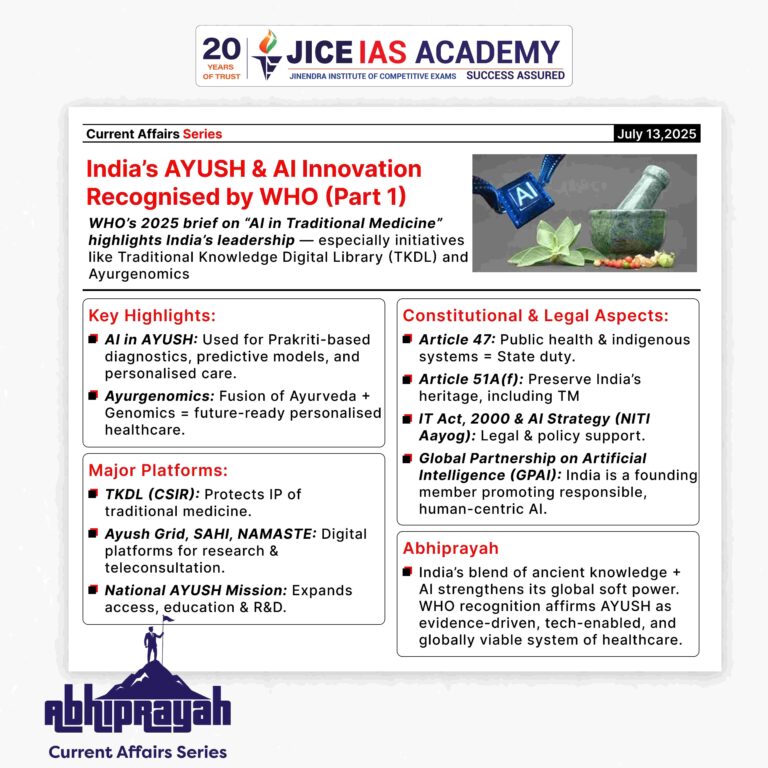
  • The World Health Organization (WHO) has released its first-ever technical brief titled “Mapping the Application of Artificial Intelligence in Traditional Medicine,” prominently highlighting India’s pioneering efforts.
  • India is the first country to launch a Traditional Knowledge Digital Library (TKDL) to systematically document and protect traditional medical knowledge from biopiracy.
  • This recognition aligns with the vision of Azadi Ka Amrit Mahotsav, showcasing India’s commitment to preserving its heritage and promoting innovation through AI in traditional medicine.
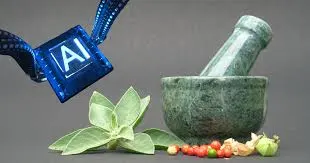
ai and traditional mortar and pestle with herbs

Key Concepts & Initiatives.

  • AYUSH Sector: AYUSH stands for Ayurveda, Yoga & Naturopathy, Unani, Siddha, and Homeopathy, India’s officially recognised traditional and alternative systems of medicine. It focuses on holistic, preventive, and lifestyle-based healthcare, forming an integral part of India’s intangible cultural heritage.
  • AI Applications: Include predictive diagnostics, diagnosis support systems, and Prakriti-based machine learning models for personalised treatment.
  • Ayurgenomics: Combines Ayurveda’s concept of body constitution with modern genomics to identify disease markers and customize healthcare.
  • Traditional Knowledge Digital Library (TKDL): A globally acclaimed CSIR initiative to protect India’s traditional knowledge from misuse and wrongful patents.
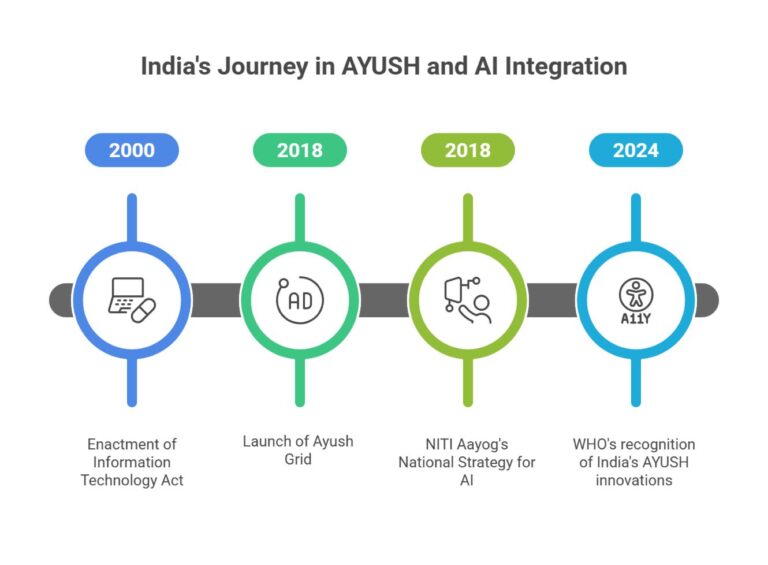
  • Ayush Grid: A comprehensive digital health platform launched in 2018 to integrate AYUSH with mainstream digital health services.
  • SAHI and NAMASTE Portals: Citizen-centric digital platforms for online consultations and collaborative AYUSH research.
india journey in ayush and ai integration

Constitutional Aspect.

  • Directive Principles of State Policy (Part IV):
    • Article 47 directs the State to improve public health and nutrition levels, which includes promoting indigenous systems like AYUSH.
  • Fundamental Duties (Article 51A(f)): Requires citizens to value and preserve India’s rich heritage, including traditional medicine.
  • Federal Context: Health is primarily a State Subject (Entry 6, State List) but overlaps with concurrent aspects like education, research, and medical professions (Entry 25 & 26, Concurrent List).
india ayush and ai innovation recognised by who

Legal & Policy Framework.

  • Ministry of Ayush: Nodal body for education, research, and promotion of India’s traditional medicine systems.
  • National Ayush Mission (NAM): Strengthens AYUSH infrastructure and access to services.
  • TKDL (CSIR): Legally protects traditional medical knowledge under national and international intellectual property frameworks.
  • Information Technology Act, 2000: Provides a legal basis for secure digital health data and governance.
  • NITI Aayog’s National Strategy for AI (2018): Guides inclusive AI applications in healthcare and traditional systems.
  • Global Partnership on Artificial Intelligence (GPAI): India is a founding member promoting responsible, human-centric AI.

Conclusion / Summary

  • India’s recognition by the WHO reinforces its leadership in blending centuries-old traditional knowledge with cutting-edge AI, positioning the AYUSH sector — Ayurveda, Yoga & Naturopathy, Unani, Siddha, and Homeopathy — as an evidence-based, globally relevant healthcare system.
  • AYUSH reflects India’s strength in delivering holistic, natural, and preventive care, now modernised through digital platforms and scientific validation.
  • Organisations like the WHO, Ministry of Ayush, CSIR-TKDL, NITI Aayog, and AYUSH Research Councils have enabled this milestone. Together, they demonstrate India’s commitment to ‘AI for All’, digital health transformation, and safeguarding bio-cultural heritage — aligning with constitutional values of health promotion, affordable access, and preserving traditional wisdom.

Economic Implications

For Indian Exporters

  • These reforms reduce transaction costs and compliance hurdles
  • Encourage a more competitive and efficient export environment
  • Promote value addition in key sectors like leather

For Tamil Nadu

  • The reforms particularly benefit the state’s leather industry, a major contributor to employment and exports
  • Boost the marketability of GI-tagged E.I. leather, enhancing rural and traditional industries

For Trade Policy

  • These decisions indicate a shift from regulatory controls to policy facilitation

Reinforce the goals of Make in India, Atmanirbhar Bharat, and India’s ambition to become a leading export power

Recently, BVR Subrahmanyam, CEO of NITI Aayog, claimed that India has overtaken Japan to become the fourth-largest economy in the world, citing data from the International Monetary Fund (IMF). 

India’s rank as the world’s largest economy varies by measure—nominal GDP or purchasing power parity (PPP)—each with key implications for economic analysis.

Significance and Applications

Leave a Reply

Your email address will not be published. Required fields are marked *

Call Us Now !

Copyright © JICE ACADEMY FOR EXCELLENCE PRIVATE LIMITED