UPSC CURRENT AFFAIRS – 28th June 2025
China’s Trilateral Diplomacy in South Asia
Why in News?
China recently hosted trilateral meetings with Pakistan and Bangladesh, and earlier with Afghanistan, aiming to expand its regional influence and counterbalance India’s growing strategic assertiveness in South Asia.
Introduction
- In June 2025, China hosted a trilateral meeting with Pakistan and Bangladesh in Kunming, following a similar engagement with Pakistan and Afghanistan in May 2025.
- These meetings mark a renewed Chinese diplomatic offensive in South Asia, aimed at expanding its regional influence, sustaining Pakistan’s strategic relevance, and complicating India’s neighbourhood diplomacy.
- These trilaterals underscore China’s intent to shape a regional order conducive to its interests while limiting India’s rise as a regional and global power.
China-Pakistan Axis: Historical and Strategic Context
The India-China war of 1962 fundamentally reshaped the geopolitical landscape of South Asia. Post-war, China and Pakistan forged a deep strategic partnership, based on a shared interest in containing India. Pakistan benefited from unconditional Chinese military and economic assistance, while China saw Pakistan as a means to keep India distracted with regional security challenges.
Today, Pakistan remains heavily dependent on China:
- Over $29 billion in loans as of end-2024.
- Around 80% of arms imports from China.
- Diplomatic cover at global forums, including protection of UN-designated terrorists.
This dependence allows China to use Pakistan as a regional lever against India, a pattern that continues in the 2025 trilaterals.
Operation Sindoor and Escalating Tensions
In response to the Pakistan-sponsored terror attack in Pahalgam (April 2025), India launched Operation Sindoor, targeting terror infrastructure. China reacted by:
- Calling India’s military response “regrettable”.
- Backing Pakistan’s demand for an “investigation”.
- Reaffirming ties through high-level bilateral meetings.
Pakistan deployed Chinese-origin military equipment, highlighting their growing military interoperability. These events reaffirm the deep strategic alignment between Beijing and Islamabad, with China actively shielding and empowering Pakistan’s confrontational posture toward India.
Revival of the “+1” Strategy
The trilateral diplomacy reflects a re-emergence of a “+1” strategy — using Pakistan and a third South Asian country to counterbalance India. This was previously seen in the 1965 plan to use East Pakistan and Nepal against India.
China and Pakistan are now attempting to replicate this by:
- Drawing Afghanistan and Bangladesh closer.
- Creating diplomatic, security, and economic complexities for India.
- Promoting Chinese Belt and Road Initiative (BRI) projects through regional access and influence.
India’s Strategic Response
India has adopted a multi-pronged strategy in response to the China-Pakistan nexus:
1 Robust Military Posture
- Surgical strikes post-Uri (2016) and Balakot airstrikes post-Pulwama (2019).
- Operation Sindoor in 2025 demonstrated India’s willingness to cross the escalation threshold.
- Border standoffs at Doklam (2017) and Galwan (2020) met with firm military pushback.
2. Diplomatic Isolation of Pakistan
- Suspension of Indus Waters Treaty mechanisms.
- Halt in trade and port access.
- Highlighting Pakistan’s role in terrorism at global forums.
3. Regional Engagement and Balancing
- Strategic outreach to Nepal, Maldives, and Sri Lanka.
- Emphasis on developmental partnerships and mutual respect for sovereignty.
- Pragmatic engagement even with Bangladesh and Taliban-led Afghanistan, to maintain dialogue.
China’s Setbacks in South Asia
Despite its assertive diplomacy, China’s ambitions face resistance:
Country | Chinese Outreach | India’s Counterbalance |
Maldives | President Muizzu’s initial anti-India tone | India remains economic lifeline amid debt concerns |
Nepal | BRI framework signed | Slow implementation and unresolved funding issues |
Sri Lanka | Past Chinese alignment | President Dissanayake visited India first |
Bangladesh | Closer ties post-2024 elections | India continues trilateral energy cooperation |
These developments show that India’s regional diplomacy has created friction in China’s plans, slowing BRI momentum and preventing a Chinese-led bloc in South Asia.
Security Implications for India
- Pakistan’s use of Bangladesh and Afghanistan as potential terror hubs, backed by China, can create cross-border terrorism and radicalisation risks.
- China may use Pakistan to open new fronts against India, especially in the Northeast.
- The trilaterals aim to keep India embroiled in immediate neighbourhood conflicts, thereby distracting it from its global strategic objectives (e.g., Indo-Pacific, QUAD, Global South leadership).
Way Forward for India
- Clear Redlines: India must communicate consequences for any anti-India activities by neighbours.
- Assertive Diplomacy: Engage regional countries to prevent their drift toward China.
- Strategic Partnerships: Deepen ties with the U.S., Japan, Australia, and other like-minded nations.
- Counter-Narrative to BRI: Promote transparent, sustainable, and inclusive development models.
- Regional Integration: Strengthen SAARC, BIMSTEC, and IORA as platforms for Indian leadership.
Conclusion
The recent trilateral meetings led by China signal an evolving strategic playbook to reshape South Asia’s geopolitical architecture. By leveraging Pakistan and wooing India’s neighbours, China aims to build a counterbalance to India’s regional leadership. However, India’s resolute military posture, economic clout, and diplomatic engagements offer a strong defence against these moves. Sustained vigilance, regional diplomacy, and strategic foresight will be essential for India to uphold its interests and maintain its primacy in South Asia.

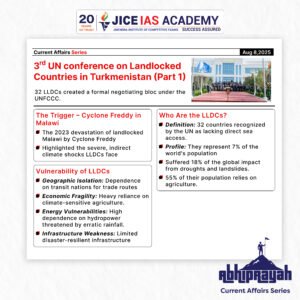
3rd UN conference on landlocked countries
UPSC CURRENT AFFAIRS – 08th August 2025 Home / 3rd UN conference on landlocked countries Why in News? At the
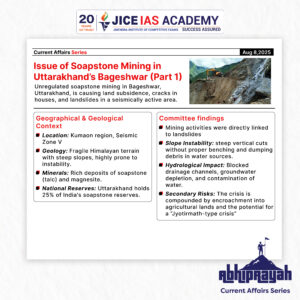
Issue of soapstone mining in Uttarakhand’s Bageshwar
UPSC CURRENT AFFAIRS – 08th August 2025 Home / Issue of soapstone mining in Uttarakhand’s Bageshwar Why in News? Unregulated

Groundwater Pollution in India – A Silent Public Health Emergency
UPSC CURRENT AFFAIRS – 08th August 2025 Home / Groundwater Pollution in India – A Silent Public Health Emergency Why
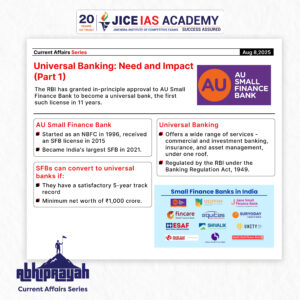
Universal banking- need and impact
UPSC CURRENT AFFAIRS – 08th August 2025 Home / Universal banking- need and impact Why in News? The Reserve Bank
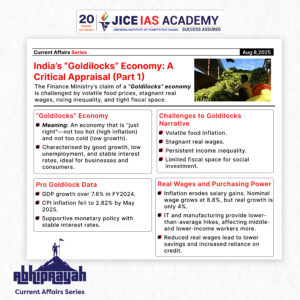
India’s “Goldilocks” Economy: A Critical Appraisal
UPSC CURRENT AFFAIRS – 08th August 2025 Home / India’s “Goldilocks” Economy: A Critical Appraisal Why in News? The Finance
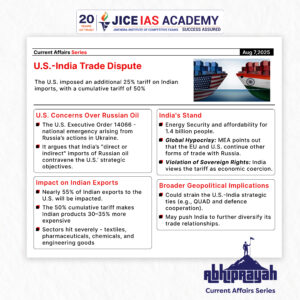
U.S.-India Trade Dispute: Trump’s 50% Tariffs and India’s Oil Imports from Russia
UPSC CURRENT AFFAIRS – 07th August 2025 Home / U.S.-India Trade Dispute: Trump’s 50% Tariffs and India’s Oil Imports from
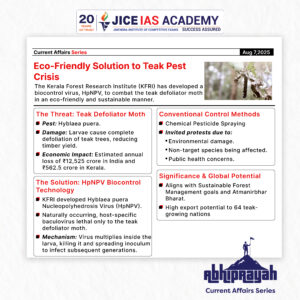
Eco-Friendly Solution to Teak Pest Crisis: KFRI’s HpNPV Technology
UPSC CURRENT AFFAIRS – 07th August 2025 Home / Eco-Friendly Solution to Teak Pest Crisis: KFRI’s HpNPV Technology Why in

New Species of Non-Venomous Rain Snake Discovered in Mizoram
UPSC CURRENT AFFAIRS – 07th August 2025 Home / New Species of Non-Venomous Rain Snake Discovered in Mizoram Why in

Economic Implications
For Indian Exporters
- These reforms reduce transaction costs and compliance hurdles
- Encourage a more competitive and efficient export environment
- Promote value addition in key sectors like leather
For Tamil Nadu
- The reforms particularly benefit the state’s leather industry, a major contributor to employment and exports
- Boost the marketability of GI-tagged E.I. leather, enhancing rural and traditional industries
For Trade Policy
- These decisions indicate a shift from regulatory controls to policy facilitation
Reinforce the goals of Make in India, Atmanirbhar Bharat, and India’s ambition to become a leading export power
Recently, BVR Subrahmanyam, CEO of NITI Aayog, claimed that India has overtaken Japan to become the fourth-largest economy in the world, citing data from the International Monetary Fund (IMF).
India’s rank as the world’s largest economy varies by measure—nominal GDP or purchasing power parity (PPP)—each with key implications for economic analysis.