
UPSC CURRENT AFFAIRS – 25th June 2025

Home / UPSC / Current Affairs / Critical and Emerging Technologies Index

Critical and Emerging Technologies Index

Critical and Emerging Technologies Index

Why in News?

  • India ranks below global leaders like the U.S., China, and Europe in the Critical and Emerging Technologies Index.

Introduction

A new Critical and Emerging Technologies (CET) Index has been introduced to assess the relative performance of 25 countries across five strategically significant technology sectors. These sectors represent the frontiers of innovation, security, and economic development in the 21st century:

  1. Artificial Intelligence (AI)
  2. Biotechnology
  3. Semiconductors
  4. Space Technology
  5. Quantum Technologies

The index is based on public and commercial datasets, offering a transparent and comparative lens through which policymakers can evaluate each nation’s technological strengths, weaknesses, and readiness.

Sectoral Weights and Strategic Criteria

Recognising the varying strategic value of each sector, the index assigns them different weights:

Sector

Weight (%)

Semiconductors

35%

Artificial Intelligence

25%

Biotechnology

20%

Space Technology

15%

Quantum Technologies

5%

These weights are derived from six strategic and operational criteria:

  • Geopolitical relevance
  • Dual-use potential (civilian and military)
  • Global economic impact
  • Innovation spillover effects
  • Supply chain complexity
  • National security implications

Overall Ranking: India’s Global Position

  • The United States emerges as the top performer, with leadership in all five sectors. This dominance is attributed to a vibrant R&D ecosystem, substantial public-private partnerships, and a diverse scientific workforce.
  • China ranks second, with particular strength in biotechnology and quantum, but lags behind in semiconductors and certain areas of AI due to dependence on foreign technologies and tools.
  • Europe occupies the third position, performing well in biotechnology and quantum, but showing relative weakness in semiconductors and space.
  • India is positioned below France but above Russia, Canada, and Australia, with an overall score of 15.2. While it demonstrates some strengths, it lags considerably behind the top three technology powers.
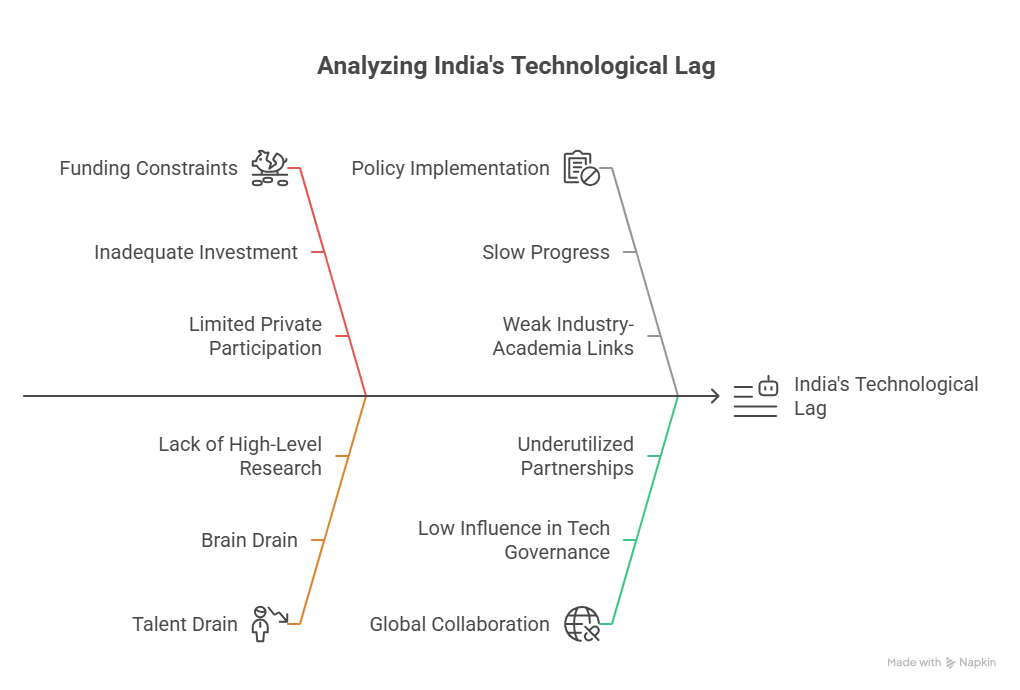
analyzing india technological lag

Artificial Intelligence (AI) – Weight: 25%

  • Pillars Assessed (8 total):
    • Core: Funding, Talent
    • Technical: Algorithms, Computing Infrastructure, Data
    • Supporting: Regulation, Global Influence
  • Top Performers:
    • United States (large lead), followed by China and Europe
  • India’s Position:
    India lags behind due to inadequate high-level research, brain drain of AI talent, and limited funding. It needs to expand AI research centres and public-private innovation labs to close the gap.

Biotechnology – Weight: 20%

  • Pillars Assessed (9 total):
    • Key: Human Capital, Funding, Core Capabilities (pharma manufacturing, genetic engineering, vaccine R&D)
  • Top Performers:
    • U.S. and China dominate due to robust ecosystems and investments
    • Europe maintains strength in legacy biotech sectors
  • India’s Position:
    India shows moderate strength, particularly in vaccine production (e.g., Covaxin, Covishield), but lacks depth in cutting-edge biotech research and bioscience infrastructure.

Semiconductors – Weight: 35% (Highest)

  • Pillars Assessed (8 total):
    • Critical: Chip Design, Funding, Talent, Manufacturing
    • Supporting: Equipment, Raw Materials, Policy
  • Top Performers:
    • U.S., Taiwan, Japan, and South Korea
    • Europe ranks lower due to underdeveloped fabrication capacities
  • India’s Position: Performance is poor. India is dependent on imports for chip manufacturing and tools. Despite the launch of the Semicon India Programme, progress remains slow.

Space Technology – Weight: 15%

  • Pillars Assessed (10 total):
    • Highest: Funding, Talent, Defence Space Capabilities
    • Others: Launch Infrastructure, Navigation Systems, Regulation, Global Reach
  • Top Performers:
    • U.S. leads, with Russia in third position
  • India’s Position: Ranked 7th, India benefits from ISRO’s cost-effective missions but suffers due to limited private participation, low investment, and underutilised global partnerships.

Quantum Technologies – Weight: 5% (Lowest)

  • Pillars Assessed (8 total):
    • Key: Funding, Talent, Core Tech (e.g., quantum computing, communication)
    • Supporting: Policy, Security, Collaboration
  • Top Performers:
    • U.S., China, and Europe with major public investments and strategic missions
  • India’s Position:
    An emerging player. India has recently launched the National Quantum Mission, but research output and innovation capabilities remain nascent.

Economic Implications

For Indian Exporters

  • These reforms reduce transaction costs and compliance hurdles
  • Encourage a more competitive and efficient export environment
  • Promote value addition in key sectors like leather

For Tamil Nadu

  • The reforms particularly benefit the state’s leather industry, a major contributor to employment and exports
  • Boost the marketability of GI-tagged E.I. leather, enhancing rural and traditional industries

For Trade Policy

  • These decisions indicate a shift from regulatory controls to policy facilitation

Reinforce the goals of Make in India, Atmanirbhar Bharat, and India’s ambition to become a leading export power

Recently, BVR Subrahmanyam, CEO of NITI Aayog, claimed that India has overtaken Japan to become the fourth-largest economy in the world, citing data from the International Monetary Fund (IMF). 

India’s rank as the world’s largest economy varies by measure—nominal GDP or purchasing power parity (PPP)—each with key implications for economic analysis.

Significance and Applications

Leave a Reply

Your email address will not be published. Required fields are marked *

Call Us Now !

Copyright © JICE ACADEMY FOR EXCELLENCE PRIVATE LIMITED