

UPSC CURRENT AFFAIRS – 29th June 2025
Digital Fossil-Mining Unveils Ancient Origins of Squids
Why in News?
- A pioneering study published in Science (June 2025) has used a new digital fossil-mining technique to uncover the hidden evolutionary history of squids. The breakthrough shows that modern squids diversified much earlier than previously thought and became key players in marine ecosystems well before the dinosaur extinction event 66 million years ago.
Key Highlights of the Study
- Unique Challenge:
Squids, having soft bodies, rarely fossilise except for their beaks, making their ancient evolution hard to trace. - Innovative Technique:
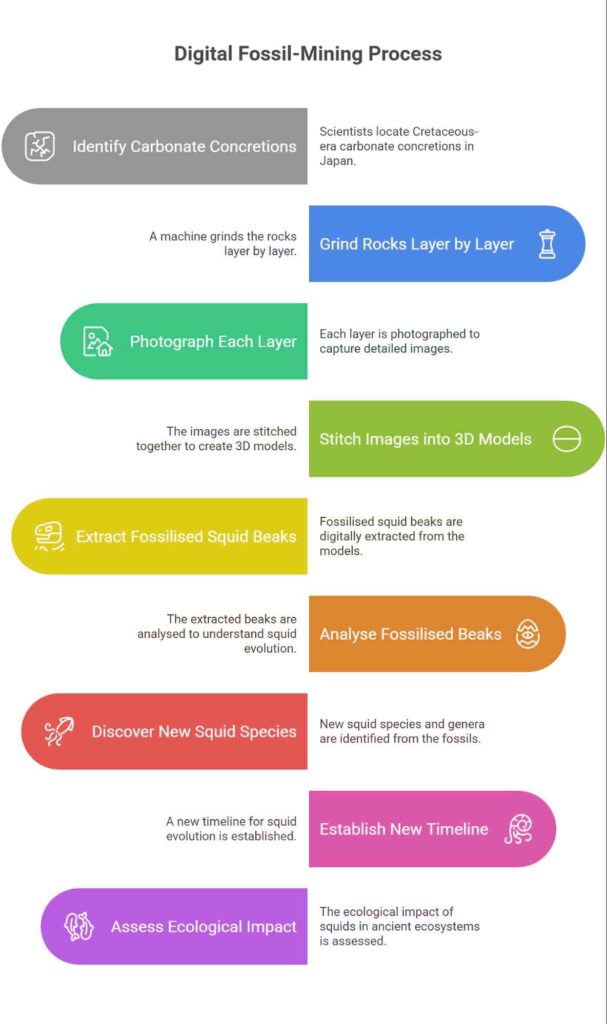
Japanese scientists developed a digital fossil-mining method that uses a machine to grind carbonate rocks layer by layer while photographing each layer. These images are then stitched into 3D models, allowing researchers to digitally extract fragile fossils that would otherwise be damaged by traditional methods. - Major Discovery:
The team studied Cretaceous-era carbonate concretions (110–70 million years old) in Japan and reconstructed 263 fossilised squid beaks.- The fossils represent at least 40 squid species, 23 genera, and five families.
- This is a huge leap from the previously known single fossil squid beak.
- New Timeline:
Evidence shows that both deep-sea squids (Oegopsida) and coastal squids (Myopsida) existed at least 100 million years ago — about 30 million years earlier than previously recorded. - Rapid Diversification:
Fossil evidence suggests that within just six million years of appearing, most known squid families evolved, highlighting their fast adaptive radiation. - Ecological Impact:
By the Late Cretaceous, squid fossils outnumbered ammonites and bony fish, showing squids were already significant in marine food webs.
Their rise coincided with the decline of shelled cephalopods (belemnites, ammonites) and predated the emergence of marine mammals, marking squids as early pioneers of the modern, fast-moving ocean ecosystems.
Concepts and Broader Context
- Digital Fossil-Mining:
A non-invasive method combining precision grinding with 3D reconstruction to detect and extract fossils otherwise hidden in rock layers. - Carbonate Concretions:
Hard, round sedimentary structures known for preserving delicate fossils, especially useful for studying soft-bodied organisms. - Cephalopod Evolution:
Squids are modern cephalopods, like octopuses and cuttlefish. Understanding their origin helps trace the shift from ancient shelled cephalopods to soft-bodied, agile marine species. - Adaptive Radiation:
A rapid evolutionary process where a single ancestral species diversifies into multiple new forms to exploit different ecological niches.
Challenges Highlighted
- Soft-bodied species are underrepresented in the fossil record due to their poor preservation potential.
- Conventional fossil extraction methods risk damaging delicate fossils hidden in rock.
- Limited fossil evidence historically hindered understanding of squids’ role in ancient ecosystems.
India-Specific Impact and Relevance
- India’s Marine Palaeontology:
India’s sedimentary basins, such as the Kutch and Cauvery basins, also contain Cretaceous-era marine fossils, including ammonites and belemnites. Applying digital fossil-mining could help Indian scientists uncover hidden soft-bodied fossils, enriching our understanding of India’s ancient marine life. - Marine Biodiversity Insights:
Squids play an important role in India’s current marine biodiversity and fisheries sector. Understanding their long evolutionary resilience can guide conservation strategies for cephalopod fisheries, which are significant for India’s coastal economy. - Research Collaboration Potential:
The method sets an example for Indian research institutions like the Geological Survey of India (GSI), Birbal Sahni Institute of Palaeosciences (BSIP), and universities to adopt advanced fossil recovery techniques, boosting India’s contributions to global evolutionary science. - Capacity Building:
Training Indian paleontologists and geologists in digital fossil-mining can modernise fossil studies, attract international collaborations, and enhance India’s heritage research in the Western Ghats and coastal marine deposits.
Way Forward
- Broader application of digital fossil-mining to India’s fossil-rich formations to uncover missing links in the subcontinent’s paleobiology.
- Integration of new fossil insights into school and university curricula to promote interest in evolutionary biology.
- Strengthen India’s scientific infrastructure for non-destructive fossil research and 3D imaging technologies.
- Use such discoveries to promote geo-heritage tourism in fossil-rich sites like the Ariyalur fossil beds in Tamil Nadu.

3rd UN conference on landlocked countries
UPSC CURRENT AFFAIRS – 08th August 2025 Home / 3rd UN conference on landlocked countries Why in News? At the
Issue of soapstone mining in Uttarakhand’s Bageshwar
UPSC CURRENT AFFAIRS – 08th August 2025 Home / Issue of soapstone mining in Uttarakhand’s Bageshwar Why in News? Unregulated

Groundwater Pollution in India – A Silent Public Health Emergency
UPSC CURRENT AFFAIRS – 08th August 2025 Home / Groundwater Pollution in India – A Silent Public Health Emergency Why

Universal banking- need and impact
UPSC CURRENT AFFAIRS – 08th August 2025 Home / Universal banking- need and impact Why in News? The Reserve Bank

India’s “Goldilocks” Economy: A Critical Appraisal
UPSC CURRENT AFFAIRS – 08th August 2025 Home / India’s “Goldilocks” Economy: A Critical Appraisal Why in News? The Finance

U.S.-India Trade Dispute: Trump’s 50% Tariffs and India’s Oil Imports from Russia
UPSC CURRENT AFFAIRS – 07th August 2025 Home / U.S.-India Trade Dispute: Trump’s 50% Tariffs and India’s Oil Imports from

Eco-Friendly Solution to Teak Pest Crisis: KFRI’s HpNPV Technology
UPSC CURRENT AFFAIRS – 07th August 2025 Home / Eco-Friendly Solution to Teak Pest Crisis: KFRI’s HpNPV Technology Why in

New Species of Non-Venomous Rain Snake Discovered in Mizoram
UPSC CURRENT AFFAIRS – 07th August 2025 Home / New Species of Non-Venomous Rain Snake Discovered in Mizoram Why in

Economic Implications
For Indian Exporters
- These reforms reduce transaction costs and compliance hurdles
- Encourage a more competitive and efficient export environment
- Promote value addition in key sectors like leather
For Tamil Nadu
- The reforms particularly benefit the state’s leather industry, a major contributor to employment and exports
- Boost the marketability of GI-tagged E.I. leather, enhancing rural and traditional industries
For Trade Policy
- These decisions indicate a shift from regulatory controls to policy facilitation
Reinforce the goals of Make in India, Atmanirbhar Bharat, and India’s ambition to become a leading export power
Recently, BVR Subrahmanyam, CEO of NITI Aayog, claimed that India has overtaken Japan to become the fourth-largest economy in the world, citing data from the International Monetary Fund (IMF).
India’s rank as the world’s largest economy varies by measure—nominal GDP or purchasing power parity (PPP)—each with key implications for economic analysis.