
UPSC CURRENT AFFAIRS – 05th July 2025

Home / UPSC / Current Affairs / Eight Years of GST in India: Milestones, Challenges, and the Road Ahead

Eight Years of GST in India: Milestones, Challenges, and the Road Ahead

gst

Why in News?

  • On the eighth anniversary of GST, India witnessed the slowest growth in tax collections in four years, highlighting the need for structural reforms such as rate simplification, inclusion of fuel under GST, and better Centre-State fiscal coordination.

Introduction

  • India marked the eighth anniversary of the Goods and Services Tax (GST) on July 1, 2025, a landmark reform hailed as a step toward “One Nation, One Tax”
  • However, the celebration was muted due to lacklustre tax collections, indicating growing structural challenges in the current GST framework. 
  • As India strives for a more robust and equitable indirect tax regime, recent data and stakeholder concerns point to the urgent need for policy reform and cooperative federalism.

Current Status of GST Collections

  • June 2025 GST collections stood at ₹1.85 lakh crore, the lowest in four months.
  • This represented only a 6.2% increase over June 2024 — the slowest growth in four years.
  • After refunds, the net revenue growth was just 3.3%.
  • Domestic transaction revenue (excluding imports) grew by a meagre 4.6%, barely above the average inflation rate, indicating stagnant consumption and weak demand.

Implication: GST, being a consumption-based tax, is sensitive to economic activity. Thus, slow growth in collections reflects either economic slowdown or tax compliance inefficiencies — or both.

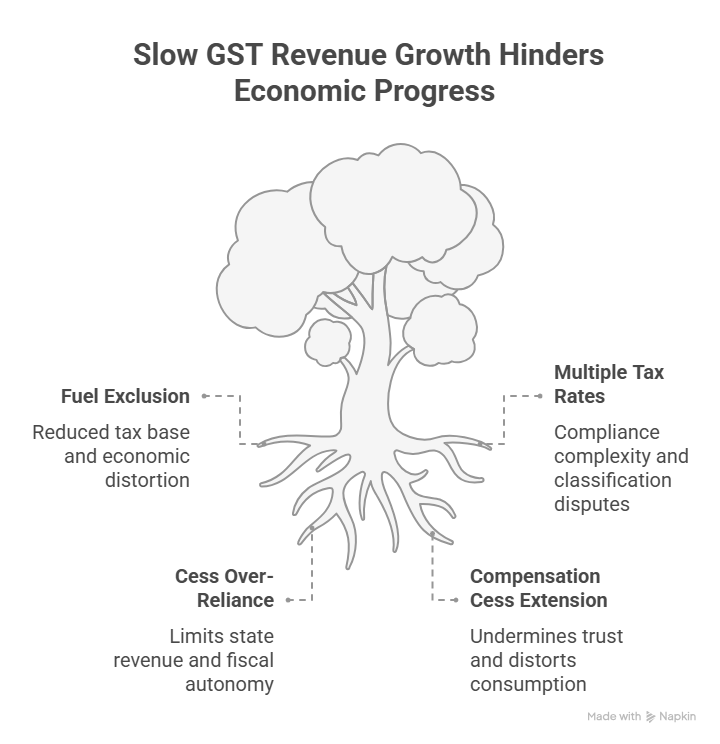
slow gst revenue growth hinders economic progress

Structural Challenges in the GST System

1. Exclusion of Key Items like Fuel and Alcohol

  • Petroleum products and alcoholic beverages remain outside GST, despite its “One Nation, One Tax” objective.
  • These items are major revenue sources for States, making them reluctant to bring them under GST.

Analysis:

  • Exclusion undermines the comprehensiveness and efficiency of GST.
  • The Centre must compensate States by offering a greater share in divisible tax pool if fuel is included in GST.

Way Forward:

  • Reform should be guided by principles of cooperative federalism. Revenue neutrality for States must be ensured, possibly via increased devolution and reduction of cesses.

2. Multiplicity of Tax Rates

  • GST currently operates with multiple slabs: 0%, 5%, 12%, 18%, and 28%, in addition to Compensation Cess on sin/luxury goods.
  • This complicates compliance, increases classification disputes, and burdens small businesses.

Reform Agenda:

  • Rate rationalisation is under review by the GST Council’s fitment and rate-setting committees.
  • A possible roadmap includes merging the 12% and 18% slabs, and phasing out the 28% slab for non-luxury goods.

3. Over-Reliance on Non-Shareable Cesses by the Centre

  • The Centre increasingly uses non-divisible cesses (e.g., GST Compensation Cess, Infrastructure Cess), which are not shared with States.
  • This undermines the spirit of fiscal federalism and limits the revenue autonomy of States.

Suggestion:

  • The Centre should limit the use of cesses and ensure the divisible pool grows, thereby strengthening the Centre-State revenue-sharing compact.

4. GST Compensation Cess and Its Future

  • Originally levied to compensate States for GST-related revenue shortfalls for five years (2017–2022).
  • Extended till March 2026 to repay loans taken during COVID-19 disruptions.

Recommendation:

  • Once the loan repayments are complete, the Compensation Cess must be abolished.
  • Subsuming it into general GST rates would violate public trust, as the cess was meant to be temporary.

Public Perception:

  • Removing unnecessary cesses may also stimulate urban consumption and bolster demand.

States’ Role and Responsibility

  • If the Centre agrees to share more revenues, States must commit to responsible fiscal behaviour.
  • There is increasing criticism of untargeted freebies and populist schemes that divert funds from essential development spending.

Balanced Fiscal Federalism:

  • Trust must be mutual: while the Centre empowers States financially, States must exercise accountability and fiscal prudence.

Way Forward: Reimagining GST for Viksit Bharat @2047

  1. Inclusion of Fuel and Alcohol under GST:
    • Gradual phasing with a revenue protection mechanism for States.
  2. Rate Simplification:
    • Move toward fewer slabs, especially merging 12% and 18%, and a review of the 28% slab.
  3. Abolition of GST Compensation Cess Post-2026:
    • Transparent fiscal governance and honouring sunset clauses.
  4. Expansion of GST base:
    • Digital tools, AI-based compliance systems, and e-invoicing must be leveraged to detect evasion.
  5. Harmonising GST with Public Interest:
    • Ensure that the indirect tax burden doesn’t fall disproportionately on the poor and middle class.
  6. Strengthening GST Council Mechanisms:
    • Encourage data-driven decisions, regular reviews, and improved coordination between Centre and States.

Conclusion

As the GST regime completes eight years, it stands at a critical inflection point. While the reform has brought uniformity, digitisation, and transparency, its current challenges — tepid revenue growth, multiple rates, exclusions, and Centre-State trust deficit — demand urgent attention. GST reform must now evolve from being a technical tax merger to a mature fiscal covenant between the Centre, the States, and the citizens of India. Achieving the true spirit of “One Nation, One Tax” will be crucial in India’s journey toward becoming a Viksit Bharat by 2047.

Economic Implications

For Indian Exporters

  • These reforms reduce transaction costs and compliance hurdles
  • Encourage a more competitive and efficient export environment
  • Promote value addition in key sectors like leather

For Tamil Nadu

  • The reforms particularly benefit the state’s leather industry, a major contributor to employment and exports
  • Boost the marketability of GI-tagged E.I. leather, enhancing rural and traditional industries

For Trade Policy

  • These decisions indicate a shift from regulatory controls to policy facilitation

Reinforce the goals of Make in India, Atmanirbhar Bharat, and India’s ambition to become a leading export power

Recently, BVR Subrahmanyam, CEO of NITI Aayog, claimed that India has overtaken Japan to become the fourth-largest economy in the world, citing data from the International Monetary Fund (IMF). 

India’s rank as the world’s largest economy varies by measure—nominal GDP or purchasing power parity (PPP)—each with key implications for economic analysis.

Significance and Applications

Leave a Reply

Your email address will not be published. Required fields are marked *

Call Us Now !

Copyright © JICE ACADEMY FOR EXCELLENCE PRIVATE LIMITED