
UPSC CURRENT AFFAIRS – 12th July 2025
India's First Electric Truck Incentive Scheme under PM E-DRIVE
Why in News?
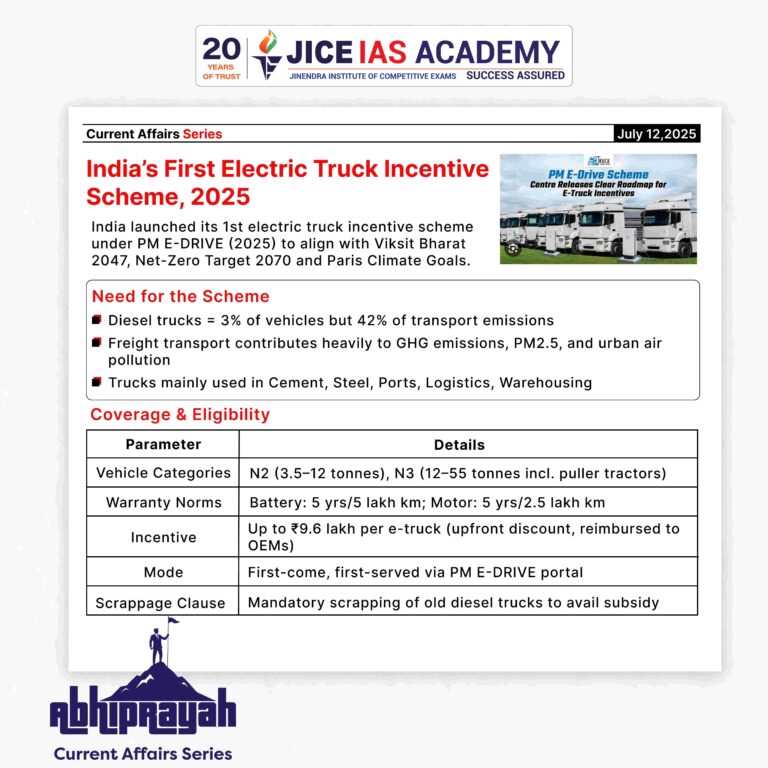
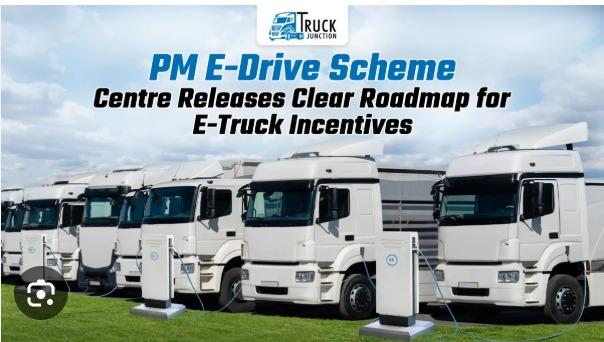
- India has launched its first-ever electric truck incentive scheme under the PM E-DRIVE initiative to promote green freight mobility and reduce transport-related emissions.
Introduction
- In a historic move to accelerate green mobility in the freight transport sector, the Ministry of Heavy Industries (MHI) has launched India’s first incentive scheme for electric trucks (e-trucks) under the PM E-DRIVE initiative.
- Spearheaded by Union Minister H.D. Kumaraswamy, under the leadership of Prime Minister Narendra Modi, this scheme aligns with India’s long-term objectives of achieving net-zero carbon emissions by 2070 and building a developed India (Viksit Bharat) by 2047.
Need for the Scheme
- The freight transport sector plays a crucial role in India’s economy, but it is also a major contributor to greenhouse gas (GHG) emissions. Diesel trucks, though making up only 3% of the total vehicle population, are responsible for nearly 42% of transport-related emissions.
- This poses serious challenges for air quality, public health, and climate change mitigation.
The e-truck incentive scheme is designed to address these challenges by:
- Reducing the carbon footprint of freight movement.
- Encouraging adoption of clean energy alternatives.
- Promoting indigenous manufacturing in the electric vehicle sector.
Coverage and Eligibility under the Scheme
Vehicle Categories Covered
The scheme covers electric trucks in the N2 and N3 categories, as per Central Motor Vehicle Rules (CMVR):
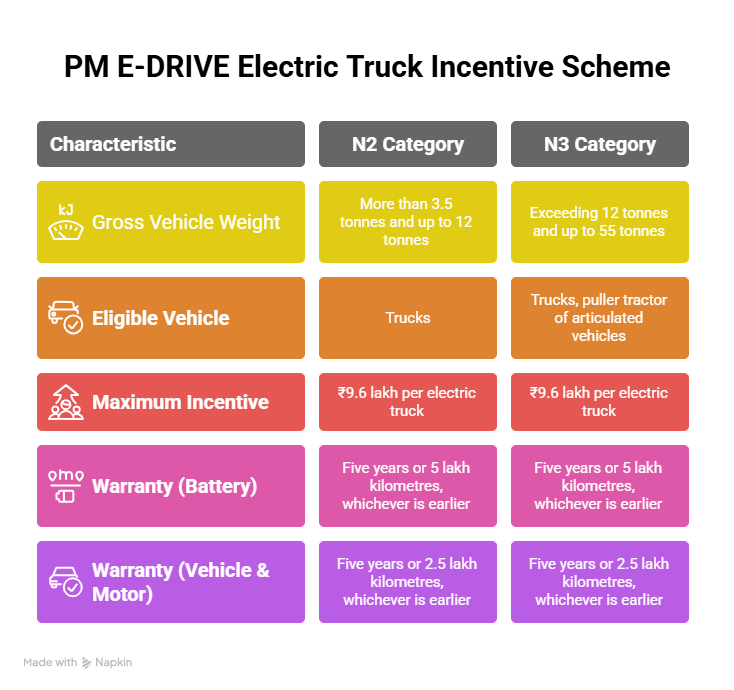
- N2 Category: Trucks with a Gross Vehicle Weight (GVW) of more than 3.5 tonnes and up to 12 tonnes.
- N3 Category: Trucks with GVW exceeding 12 tonnes and up to 55 tonnes.
- In the case of articulated vehicles, only the puller tractor of N3 category will be eligible.
Manufacturer-Backed Warranty Requirements
To ensure the durability and reliability of electric trucks, the scheme mandates:
- A battery warranty of five years or 5 lakh kilometres, whichever is earlier.
- A vehicle and motor warranty of five years or 2.5 lakh kilometres, whichever is earlier.
Incentive Amount and Distribution
- A maximum incentive of ₹9.6 lakh per electric truck will be offered.
- The incentive will be provided as an upfront discount on the purchase price and later reimbursed to OEMs through the PM E-DRIVE online portal.
- Incentive allocation will be on a first-come, first-served basis.
Scrappage Mandate
One of the significant features of the scheme is the mandatory scrapping of old, polluting trucks to avail the incentive. This dual approach serves to:
- Modernise vehicle fleets.
- Immediately reduce emissions from outdated diesel vehicles.
Scale of Implementation and Budget Allocation
- The scheme targets the deployment of approximately 5,600 electric trucks across India.
- A special provision for 1,100 e-trucks in Delhi has been made with a budget outlay of ₹100 crore, given the city’s severe air quality issues.
Targeted Sectors for Adoption
Key sectors that will benefit from the deployment of e-trucks include:
- Cement industry
- Steel industry
- Port operations
- Logistics and warehousing
These industries rely heavily on freight transport and can significantly reduce their environmental impact through electrification.
Expected Benefits and Long-Term Impact
Environmental Benefits
- Substantial reduction in carbon dioxide and particulate matter emissions from the transport sector.
- Improved urban air quality, especially in industrial and densely populated areas.
Economic Benefits
- Lower operating costs for fleet operators due to reduced fuel consumption and maintenance needs.
- Long-term cost savings and improved profitability for logistics companies.
Strategic and Policy Alignment
The scheme supports key national missions and goals, including:
- National Electric Mobility Mission Plan (NEMMP)
- Faster Adoption and Manufacturing of Hybrid and Electric Vehicles (FAME)
- National Action Plan on Climate Change (NAPCC)
- India’s international commitments under the Paris Climate Agreement

3rd UN conference on landlocked countries
UPSC CURRENT AFFAIRS – 08th August 2025 Home / 3rd UN conference on landlocked countries Why in News? At the

Issue of soapstone mining in Uttarakhand’s Bageshwar
UPSC CURRENT AFFAIRS – 08th August 2025 Home / Issue of soapstone mining in Uttarakhand’s Bageshwar Why in News? Unregulated

Groundwater Pollution in India – A Silent Public Health Emergency
UPSC CURRENT AFFAIRS – 08th August 2025 Home / Groundwater Pollution in India – A Silent Public Health Emergency Why
Universal banking- need and impact
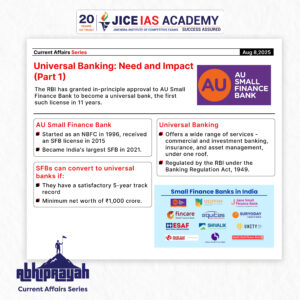
UPSC CURRENT AFFAIRS – 08th August 2025 Home / Universal banking- need and impact Why in News? The Reserve Bank

India’s “Goldilocks” Economy: A Critical Appraisal
UPSC CURRENT AFFAIRS – 08th August 2025 Home / India’s “Goldilocks” Economy: A Critical Appraisal Why in News? The Finance

U.S.-India Trade Dispute: Trump’s 50% Tariffs and India’s Oil Imports from Russia
UPSC CURRENT AFFAIRS – 07th August 2025 Home / U.S.-India Trade Dispute: Trump’s 50% Tariffs and India’s Oil Imports from

Eco-Friendly Solution to Teak Pest Crisis: KFRI’s HpNPV Technology
UPSC CURRENT AFFAIRS – 07th August 2025 Home / Eco-Friendly Solution to Teak Pest Crisis: KFRI’s HpNPV Technology Why in

New Species of Non-Venomous Rain Snake Discovered in Mizoram
UPSC CURRENT AFFAIRS – 07th August 2025 Home / New Species of Non-Venomous Rain Snake Discovered in Mizoram Why in

Economic Implications
For Indian Exporters
- These reforms reduce transaction costs and compliance hurdles
- Encourage a more competitive and efficient export environment
- Promote value addition in key sectors like leather
For Tamil Nadu
- The reforms particularly benefit the state’s leather industry, a major contributor to employment and exports
- Boost the marketability of GI-tagged E.I. leather, enhancing rural and traditional industries
For Trade Policy
- These decisions indicate a shift from regulatory controls to policy facilitation
Reinforce the goals of Make in India, Atmanirbhar Bharat, and India’s ambition to become a leading export power
Recently, BVR Subrahmanyam, CEO of NITI Aayog, claimed that India has overtaken Japan to become the fourth-largest economy in the world, citing data from the International Monetary Fund (IMF).
India’s rank as the world’s largest economy varies by measure—nominal GDP or purchasing power parity (PPP)—each with key implications for economic analysis.