
UPSC CURRENT AFFAIRS – 19th July 2025
EU’s Age Verification Plan to Protect Children Online
Why in News?
The European Commission is piloting a privacy-preserving age verification app to restrict children’s access to harmful online content, sparking a debate over adult privacy and digital rights.
What Is the EU’s Age Verification Plan?
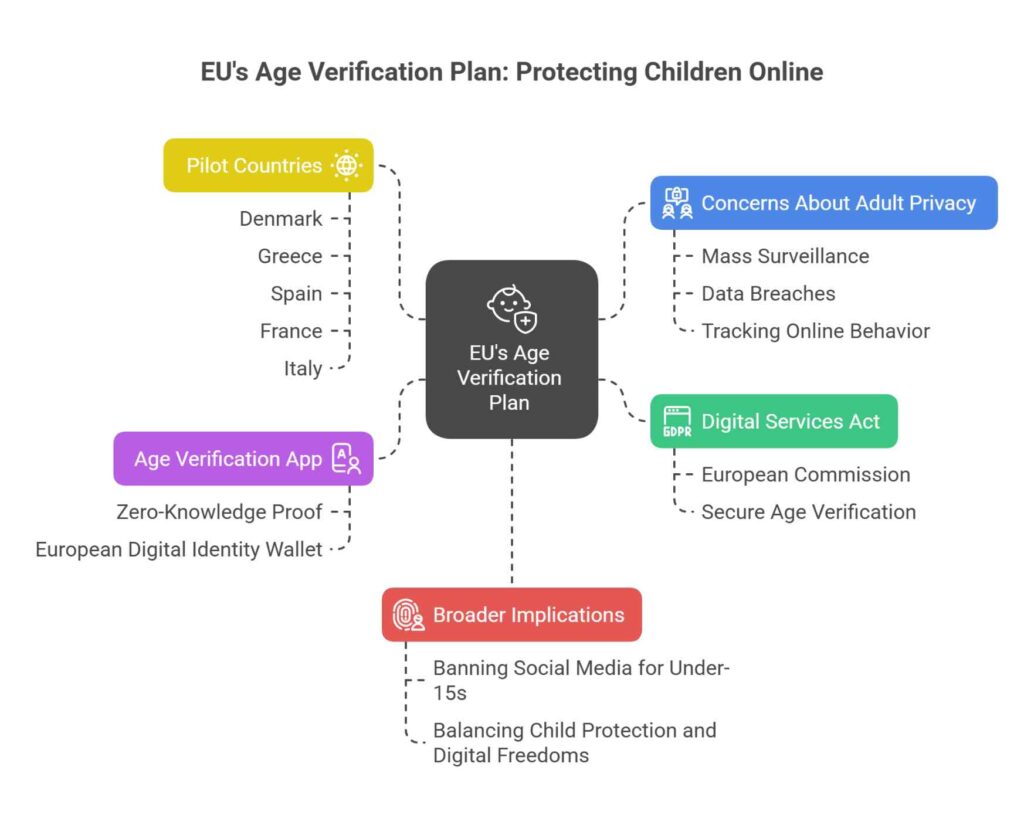
- Under the Digital Services Act (DSA), the European Commission is developing a secure age verification app to prevent minors from accessing harmful content such as pornography or unsafe social media platforms.
- The app is designed to verify if users are 18+ without revealing their exact age or identity.
- It is based on the European Digital Identity (eID) Wallet framework and will use zero-knowledge proof technology for privacy.
Pilot Countries
- Denmark, Greece, Spain, France, and Italy are the first to test national versions of the app.
- These versions will operate in local languages and integrate with national systems.
Why Is Age Verification Being Introduced?
To protect minors from:
- Explicit or harmful content
- Digital addiction and manipulative platform design
- Cyberbullying
- Unwanted contact from strangers
The initiative aligns with the EU’s broader legislative push to regulate big tech, enhance user safety, and ensure child protection online.
How Will It Work?
- Users can prove they’re over 18 via the app without disclosing identity or other personal data.
- No tracking or content reconstruction will be possible.
- Open-source specifications are published for transparency.
Concerns About Adult Privacy
- Critics argue the plan could:
- Lead to mass surveillance
- Enable data breaches
- Be misused for tracking online behavior
- The Commission claims it ensures full control to users and no access logs for individual content.
Broader Implications
- France may go further by banning social media for under-15s.
- The move raises questions about:
- Classification of platforms like X (formerly Twitter) as adult content providers
- Balancing child protection and digital freedoms

3rd UN conference on landlocked countries
UPSC CURRENT AFFAIRS – 08th August 2025 Home / 3rd UN conference on landlocked countries Why in News? At the

Issue of soapstone mining in Uttarakhand’s Bageshwar
UPSC CURRENT AFFAIRS – 08th August 2025 Home / Issue of soapstone mining in Uttarakhand’s Bageshwar Why in News? Unregulated

Groundwater Pollution in India – A Silent Public Health Emergency
UPSC CURRENT AFFAIRS – 08th August 2025 Home / Groundwater Pollution in India – A Silent Public Health Emergency Why
Universal banking- need and impact
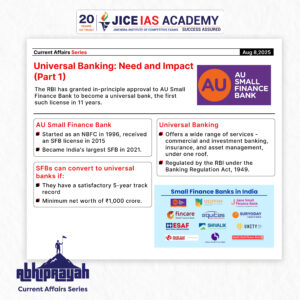
UPSC CURRENT AFFAIRS – 08th August 2025 Home / Universal banking- need and impact Why in News? The Reserve Bank
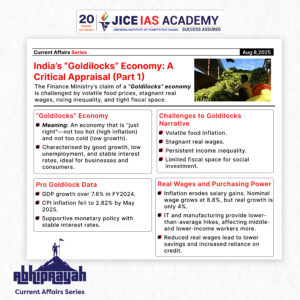
India’s “Goldilocks” Economy: A Critical Appraisal
UPSC CURRENT AFFAIRS – 08th August 2025 Home / India’s “Goldilocks” Economy: A Critical Appraisal Why in News? The Finance
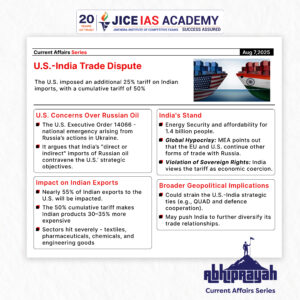
U.S.-India Trade Dispute: Trump’s 50% Tariffs and India’s Oil Imports from Russia
UPSC CURRENT AFFAIRS – 07th August 2025 Home / U.S.-India Trade Dispute: Trump’s 50% Tariffs and India’s Oil Imports from
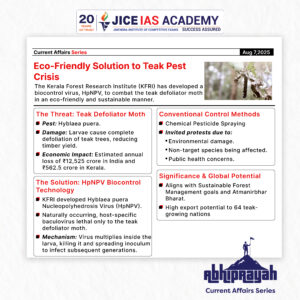
Eco-Friendly Solution to Teak Pest Crisis: KFRI’s HpNPV Technology
UPSC CURRENT AFFAIRS – 07th August 2025 Home / Eco-Friendly Solution to Teak Pest Crisis: KFRI’s HpNPV Technology Why in

New Species of Non-Venomous Rain Snake Discovered in Mizoram
UPSC CURRENT AFFAIRS – 07th August 2025 Home / New Species of Non-Venomous Rain Snake Discovered in Mizoram Why in

Economic Implications
For Indian Exporters
- These reforms reduce transaction costs and compliance hurdles
- Encourage a more competitive and efficient export environment
- Promote value addition in key sectors like leather
For Tamil Nadu
- The reforms particularly benefit the state’s leather industry, a major contributor to employment and exports
- Boost the marketability of GI-tagged E.I. leather, enhancing rural and traditional industries
For Trade Policy
- These decisions indicate a shift from regulatory controls to policy facilitation
Reinforce the goals of Make in India, Atmanirbhar Bharat, and India’s ambition to become a leading export power
Recently, BVR Subrahmanyam, CEO of NITI Aayog, claimed that India has overtaken Japan to become the fourth-largest economy in the world, citing data from the International Monetary Fund (IMF).
India’s rank as the world’s largest economy varies by measure—nominal GDP or purchasing power parity (PPP)—each with key implications for economic analysis.