
UPSC CURRENT AFFAIRS – 3rd June 2025
EV Import Duty Cuts Linked to Local Manufacturing Scheme
Why in News?
- The Ministry of Heavy Industries on June 2, 2025, notified detailed guidelines under the Scheme to Promote Manufacturing of Electric Passenger Cars in India.
Introduction
- Recently, the Ministry of Heavy Industries issued detailed guidelines under the Scheme to Promote Manufacturing of Electric Passenger Cars in India, a policy that was originally notified on March 15, 2024.
- The objective of the scheme is to promote domestic manufacturing of electric four-wheelers (e-4W) by offering incentives to global EV manufacturers willing to set up production facilities in India.
Key Features of the Scheme
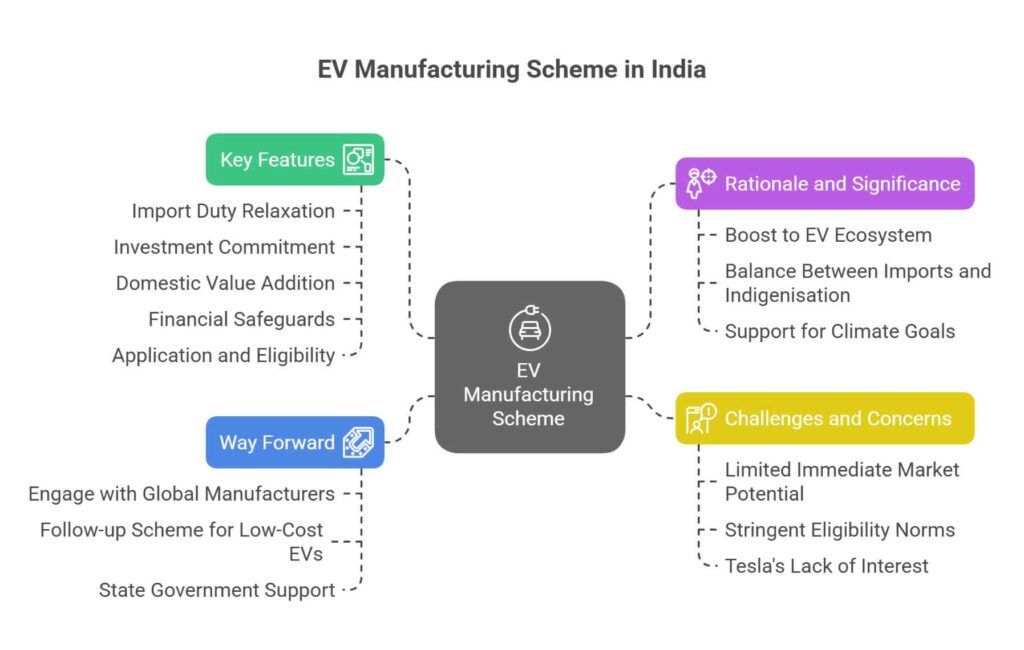
1. Import Duty Relaxation for EVs
- Eligible companies will be allowed to import up to 8,000 Completely Built Units (CBUs) of electric four-wheelers per year.
- These CBUs must have a minimum CIF (Cost, Insurance and Freight) value of $35,000.
- They will be charged a reduced customs duty of 15%, compared to the prevailing 70-100%.
- This benefit will be available for a period of 5 years from the date of application approval.
2. Investment Commitment
- The applicant must commit a minimum investment of ₹4,150 crore (approx. $500 million).
- This investment must be made within a 3-year window from the date of approval.
- The investment must be directed toward:
- Setting up manufacturing facilities
- Procuring new plant, machinery, and equipment
- Engineering Research & Development (ER&D)
- Charging infrastructure (up to 5% of committed investment)
- New buildings (limited to 10% of total investment)
- Expenditure on land is not eligible under the scheme.
3. Domestic Value Addition (DVA) Requirement
- Within 3 years: Minimum DVA of 25% must be achieved.
- Within 5 years: Minimum DVA of 50% must be achieved.
- This ensures progressive indigenisation of EV production in India.
4. Financial Safeguards
- The company must provide a bank guarantee from a scheduled commercial bank in India.
- The bank guarantee must be equal to the higher of:
- The total customs duty foregone, or
- ₹4,150 crore
- This acts as a safeguard to ensure that applicants fulfill their investment and localisation commitments.
5. Application and Eligibility Criteria
- The application window will open for at least 120 days and may be reopened multiple times until March 15, 2026.
- Application Fee: ₹5,00,000 (non-refundable)
- Eligibility Criteria:
- Global automotive manufacturing revenue of at least ₹10,000 crore
- Global fixed asset investment of at least ₹3,000 crore, based on the latest audited financial statements
Rationale and Significance
Boost to EV Ecosystem
- The scheme is designed to catalyze the growth of the EV ecosystem in India by:
- Attracting foreign direct investment (FDI) from global EV giants.
- Ensuring technology transfer, skill development, and vendor ecosystem creation.
- Supporting the development of domestic supply chains.
Balance Between Imports and Indigenisation
- By allowing a limited number of CBUs at reduced duties in return for high domestic investment and localisation, the scheme balances the need for technology introduction with the imperative of Atmanirbhar Bharat.
Support for Climate Goals
- The scheme supports India’s target of net-zero emissions by 2070 and contributes to reducing urban pollution and oil import dependency.
Challenges and Concerns
1. Limited Immediate Market Potential
- The requirement of a $35,000 minimum CIF value means only premium EVs will be initially eligible—restricting access to mass-market segments.
2. Stringent Eligibility Norms
- Many Indian startups and new entrants in the EV sector may not qualify due to revenue and investment thresholds.
3. Tesla’s Lack of Interest
- Despite the scheme being seen as favourable, Tesla has publicly expressed disinterest in manufacturing in India as per recent statements by Union Minister H. D. Kumaraswamy. This raises questions about the scheme’s realistic attractiveness.
Way Forward
- The government may need to actively engage with global EV manufacturers to address their concerns.
- A follow-up scheme targeting low-cost electric vehicles could help penetrate the mass market.
- State governments must complement the central scheme through ease of land acquisition, fast-track clearances, and power/water infrastructure to attract investments.

3rd UN conference on landlocked countries
UPSC CURRENT AFFAIRS – 08th August 2025 Home / 3rd UN conference on landlocked countries Why in News? At the

Issue of soapstone mining in Uttarakhand’s Bageshwar
UPSC CURRENT AFFAIRS – 08th August 2025 Home / Issue of soapstone mining in Uttarakhand’s Bageshwar Why in News? Unregulated
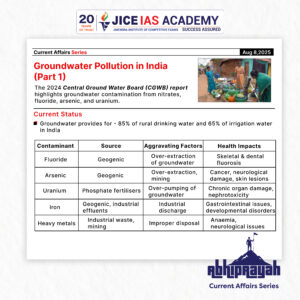
Groundwater Pollution in India – A Silent Public Health Emergency
UPSC CURRENT AFFAIRS – 08th August 2025 Home / Groundwater Pollution in India – A Silent Public Health Emergency Why
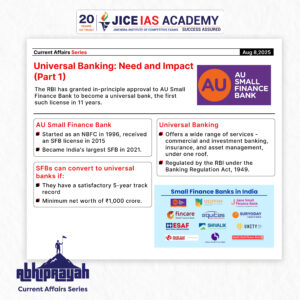
Universal banking- need and impact
UPSC CURRENT AFFAIRS – 08th August 2025 Home / Universal banking- need and impact Why in News? The Reserve Bank

India’s “Goldilocks” Economy: A Critical Appraisal
UPSC CURRENT AFFAIRS – 08th August 2025 Home / India’s “Goldilocks” Economy: A Critical Appraisal Why in News? The Finance

U.S.-India Trade Dispute: Trump’s 50% Tariffs and India’s Oil Imports from Russia
UPSC CURRENT AFFAIRS – 07th August 2025 Home / U.S.-India Trade Dispute: Trump’s 50% Tariffs and India’s Oil Imports from

Eco-Friendly Solution to Teak Pest Crisis: KFRI’s HpNPV Technology
UPSC CURRENT AFFAIRS – 07th August 2025 Home / Eco-Friendly Solution to Teak Pest Crisis: KFRI’s HpNPV Technology Why in

New Species of Non-Venomous Rain Snake Discovered in Mizoram
UPSC CURRENT AFFAIRS – 07th August 2025 Home / New Species of Non-Venomous Rain Snake Discovered in Mizoram Why in

Economic Implications
For Indian Exporters
- These reforms reduce transaction costs and compliance hurdles
- Encourage a more competitive and efficient export environment
- Promote value addition in key sectors like leather
For Tamil Nadu
- The reforms particularly benefit the state’s leather industry, a major contributor to employment and exports
- Boost the marketability of GI-tagged E.I. leather, enhancing rural and traditional industries
For Trade Policy
- These decisions indicate a shift from regulatory controls to policy facilitation
Reinforce the goals of Make in India, Atmanirbhar Bharat, and India’s ambition to become a leading export power
Recently, BVR Subrahmanyam, CEO of NITI Aayog, claimed that India has overtaken Japan to become the fourth-largest economy in the world, citing data from the International Monetary Fund (IMF).
India’s rank as the world’s largest economy varies by measure—nominal GDP or purchasing power parity (PPP)—each with key implications for economic analysis.