UPSC CURRENT AFFAIRS – 13th June 2025
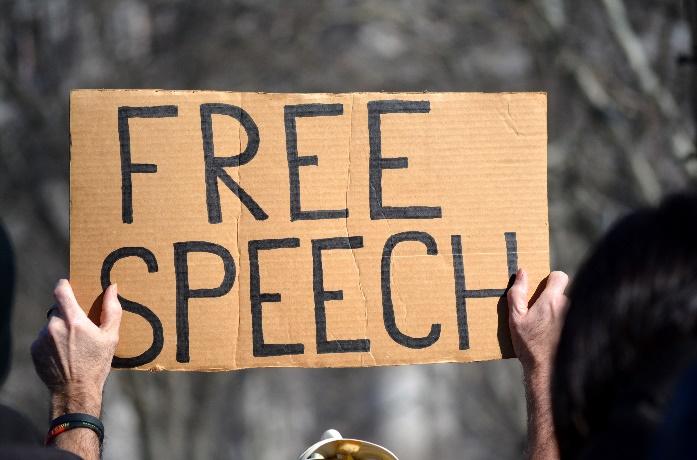
The Free Speech Framework
Why in News?
- The free speech regimes are fundamentally built on trust, not just legal protections, and questions whether censorship strengthens or weakens democratic inclusion and social cohesion.
Introduction
- Free speech is often hailed as the cornerstone of liberal democracies. However, it is not merely a legal provision—it is embedded in a deeper framework of trust, autonomy, and social judgement.
- The current crisis surrounding free speech is not merely about what is being said, but about how much trust we place in society and individuals to handle speech without the paternalistic intervention of the state.
- The debate, therefore, moves beyond the simplistic binary of free speech vs hate speech to more complex terrain—of societal maturity, democratic inclusion, and political mobilisation.
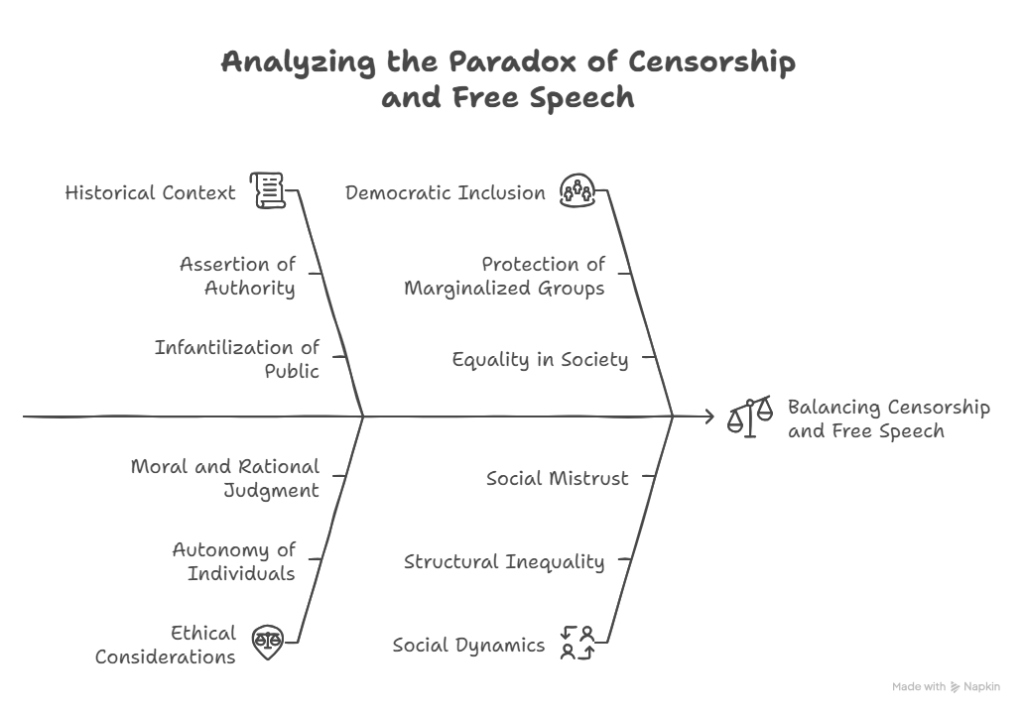
Censorship as an Assertion of Authority
- Historically, censorship has not necessarily aimed to make citizens believe in state-sponsored truth.
- Rather, it has functioned as a symbolic expression of authority—reinforcing the infantilisation of the public.
- The state, in asserting the right to censor, implies that individuals are incapable of discernment, unable to handle disturbing or offensive ideas, and hence must be protected.
Free Speech and the Ethic of Autonomy
The strongest defence of free speech is not instrumental—i.e., it is not because free speech leads to truth, democracy, or progress (although it may). Rather, it is moral and existential: No one should have the right to control what I think or say. This embodies the liberal ideal of the sovereign self, the individual as an autonomous agent, capable of moral and rational judgement.
However, freedom of speech does not mean all speech is equally valuable. Discernment and judgment must accompany liberty. Hence, free speech regimes rely on:
- Trust in individuals to handle offensive speech without being incited.
- Social mechanisms (debates, media, civil society) to call out harmful speech.
- Distinction between the right to speak and the value of what is spoken.
The Democratic Case for Restrictions
Critics argue that the sovereign self is a fiction in deeply unequal societies. Where historical injustices, discrimination, and exclusion prevail, marginalized groups cannot respond to hate speech “on their own terms.” Thus:
- Certain forms of speech (e.g., hate speech, incitement) may be proscribed to foster democratic inclusion.
- Banning such speech signals that society values all groups equally and will not tolerate targeting on identity grounds.
The Paradox: Does Censorship Address the Root Problem?
While the intent behind restrictions may be noble, the effectiveness is questionable. If the real problem is structural inequality and social mistrust, then banning speech becomes a symbolic diversion rather than a substantive solution.
Important Questions Raised:
- Does banning hate speech rectify historical inequalities?
- Or does it merely suppress a symptom without addressing the disease?
- Can trust in institutions and society reduce the impact of hateful speech?
The danger is that censorship may signal distrust in citizens’ ability to navigate speech, reinforcing the infantilisation of the public.
Political Mobilisation Through Speech Restrictions
In multicultural democracies, community identities are often built around taboos. Free speech becomes the battlefield for:
- Competitive victimhood – Every group demands equal protection of its sensitivities.
- Political mobilisation – Censorship becomes a tool to assert identity or power.
This leads to a “slippery slope”: once one taboo is legally protected (e.g., blasphemy laws), others demand the same, expanding the zone of censorship.
The Role of Trust in Communication Ecosystems
In the digital age, mistrust and misinformation travel faster than truth. The collapse of contextual communication due to social media, virality, and echo chambers has worsened the fragility of free speech regimes.
The solution is not legal censorship, but social rebuilding of trust:
- Citizens must trust that hate speech is not the societal norm.
- Minorities must be reassured that institutions protect them.
- Civil society must hold harmful speech accountable through discourse, not bans.
Conclusion:
The call for censorship often stems from legitimate concerns about social cohesion and minority protection. But in the long run, trust, not control, builds democratic resilience. Societies must invest in:
- Civic education and moral reasoning,
- Strengthening institutional credibility,
- Promoting dialogue over diktats.
Free speech is not merely about protecting the speaker—it is about cultivating a society that can listen, contest, and grow. Every act of censorship is a vote of no-confidence in citizens’ moral and intellectual capacity. Reclaiming that confidence is the true challenge of our times.

3rd UN conference on landlocked countries
UPSC CURRENT AFFAIRS – 08th August 2025 Home / 3rd UN conference on landlocked countries Why in News? At the

Issue of soapstone mining in Uttarakhand’s Bageshwar
UPSC CURRENT AFFAIRS – 08th August 2025 Home / Issue of soapstone mining in Uttarakhand’s Bageshwar Why in News? Unregulated

Groundwater Pollution in India – A Silent Public Health Emergency
UPSC CURRENT AFFAIRS – 08th August 2025 Home / Groundwater Pollution in India – A Silent Public Health Emergency Why
Universal banking- need and impact
UPSC CURRENT AFFAIRS – 08th August 2025 Home / Universal banking- need and impact Why in News? The Reserve Bank
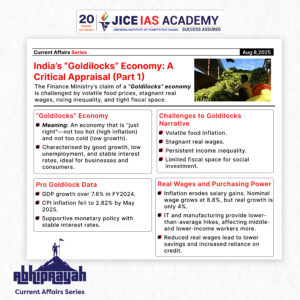
India’s “Goldilocks” Economy: A Critical Appraisal
UPSC CURRENT AFFAIRS – 08th August 2025 Home / India’s “Goldilocks” Economy: A Critical Appraisal Why in News? The Finance

U.S.-India Trade Dispute: Trump’s 50% Tariffs and India’s Oil Imports from Russia
UPSC CURRENT AFFAIRS – 07th August 2025 Home / U.S.-India Trade Dispute: Trump’s 50% Tariffs and India’s Oil Imports from
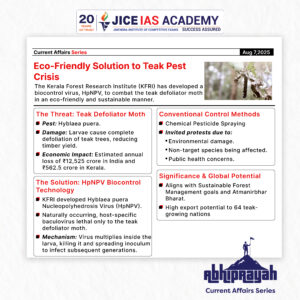
Eco-Friendly Solution to Teak Pest Crisis: KFRI’s HpNPV Technology
UPSC CURRENT AFFAIRS – 07th August 2025 Home / Eco-Friendly Solution to Teak Pest Crisis: KFRI’s HpNPV Technology Why in

New Species of Non-Venomous Rain Snake Discovered in Mizoram
UPSC CURRENT AFFAIRS – 07th August 2025 Home / New Species of Non-Venomous Rain Snake Discovered in Mizoram Why in

Economic Implications
For Indian Exporters
- These reforms reduce transaction costs and compliance hurdles
- Encourage a more competitive and efficient export environment
- Promote value addition in key sectors like leather
For Tamil Nadu
- The reforms particularly benefit the state’s leather industry, a major contributor to employment and exports
- Boost the marketability of GI-tagged E.I. leather, enhancing rural and traditional industries
For Trade Policy
- These decisions indicate a shift from regulatory controls to policy facilitation
Reinforce the goals of Make in India, Atmanirbhar Bharat, and India’s ambition to become a leading export power
Recently, BVR Subrahmanyam, CEO of NITI Aayog, claimed that India has overtaken Japan to become the fourth-largest economy in the world, citing data from the International Monetary Fund (IMF).
India’s rank as the world’s largest economy varies by measure—nominal GDP or purchasing power parity (PPP)—each with key implications for economic analysis.