
UPSC CURRENT AFFAIRS – 21th June 2025

Home / UPSC / Current Affairs / GENIUS Act Passed in US Senate

GENIUS Act Passed in US Senate

Why in News?

  • The United States Senate passed the GENIUS Act—short for Guiding and Establishing National Innovation for U.S. Stablecoins—with a 68-30 vote. This legislation marks a significant development in the global digital currency ecosystem, particularly in the formal regulation and endorsement of stablecoins—a class of cryptocurrencies backed by reserve assets such as the US Dollar.

What are Stablecoins?

Stablecoins are a form of cryptocurrency that maintain a stable value by being pegged to real-world assets, such as fiat currencies (USD) or commodities. The primary objective is to reduce the price volatility commonly associated with other cryptocurrencies like Bitcoin or Ethereum.

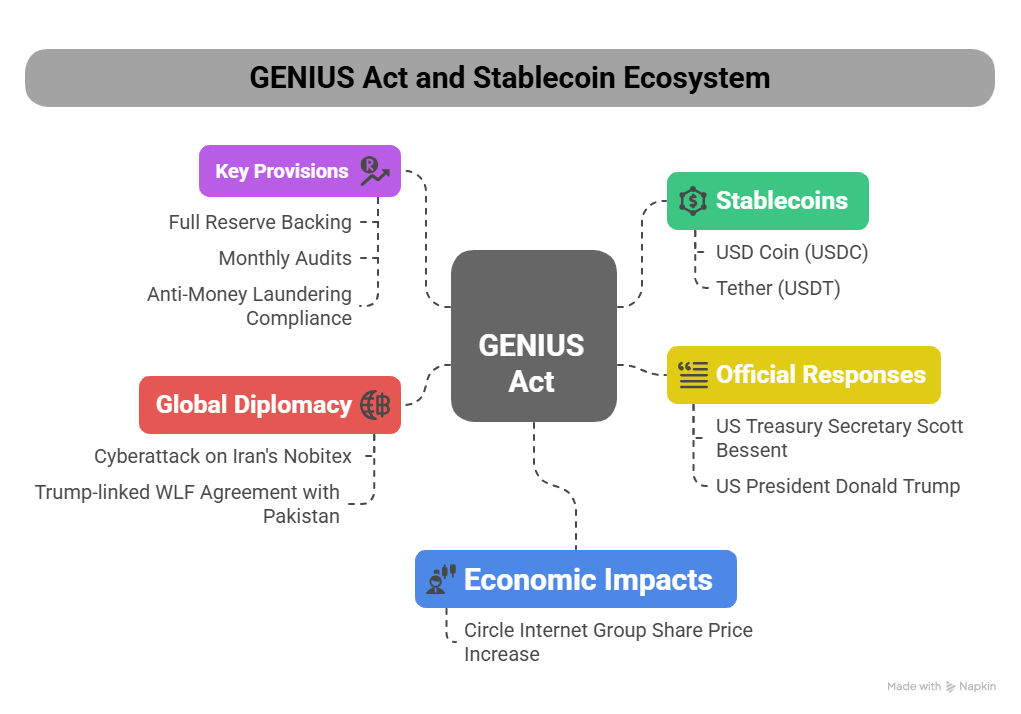
  • Current Market Capitalisation (2025): USD 251.7 billion
  • Growth in 2025: 22% increase
  • Examples: USD Coin (USDC), Tether (USDT)

Key Provisions of the GENIUS Act

  1. Full Reserve Backing: All stablecoins must be backed entirely by reserve assets.
  2. Monthly Audits: Issuers are required to undergo monthly independent audits to verify reserves.
  3. Anti-Money Laundering Compliance: Stringent measures to ensure that stablecoins are not misused for illegal activities.
  4. Support for US Treasuries: Encourages private sector investment in US government securities.
  5. Federal Oversight: Stablecoin activities will be monitored by federal financial institutions, including the Securities and Exchange Commission (SEC).

GENIUS Act vs STABLE Act: Key Differences

A separate version of the stablecoin regulation, known as the STABLE Act (Stablecoin Transparency and Accountability for a Better Ledger Economy), is being considered by the House of Representatives. Though similar in spirit, it differs in regulatory approach:

Feature

GENIUS Act

STABLE Act

Legislative Status

Passed by Senate

Yet to be passed by House

Reserve Requirements

Broad, including US Treasuries

Limited to select asset classes

Regulating Body

SEC and US Treasury

Office of the Comptroller of the Currency

Issuer Eligibility

More inclusive

More restricted

Exemptions

Allows broad federal guidance

Leaves scope for state-level oversight

Legal experts have expressed concerns that the STABLE Act may not go far enough in ensuring uniformity and transparency, potentially allowing state-level regulators to decide which stablecoins can be listed by licensed intermediaries.

Official Responses

US Treasury Secretary Scott Bessent

  • Predicted that the stablecoin market could grow to USD 3.7 trillion by 2030.
  • Argued that stablecoins will reinforce the dominance of the US dollar, rather than weaken it.
  • Highlighted that USD-backed stablecoins can be used even in developing countries such as Nigeria, increasing the reach of the US currency through digital platforms.
  • Explained how the increased use of stablecoins will drive up demand for US Treasury securities, thereby strengthening the American financial system.

US President Donald Trump

  • Applauded the Senate’s approval of the GENIUS Act, calling it a major step toward making the United States the global leader in digital assets.
  • Trump emphasized that digital assets are the future and that the legislation will attract “massive investment and big innovation.”
  • During his first term, Trump had been skeptical of cryptocurrencies, but has since reversed his stance and actively supported their expansion.

Economic Impacts

Following the passage of the GENIUS Act:

  • Circle Internet Group, the issuer of the USDC stablecoin, witnessed a 33.82 percent increase in its share price at market close.
  • During pre-market trading, the stock further surged by 24.75 percent, reaching USD 211.87 per share.

The Role of Stablecoins in Global Diplomacy and De-Dollarisation

Cryptocurrency as a Geopolitical Tool

  • A cyberattack by the hacker group Gonjeshke Darande (allegedly linked to Israeli entities) wiped out USD 90 million from Iran’s largest crypto exchange, Nobitex.
  • The attack reflects how cryptocurrency is increasingly being used as a weapon in geopolitical confrontations.

Crypto Diplomacy

  • Trump-linked World Liberty Financial (WLF) recently signed an agreement with the Pakistan Crypto Council to promote digital assets.
  • This agreement came shortly after the India-Pakistan ceasefire following Operation Sindoor, an Indian counterterror operation after a terror attack in Pahalgam.

Reinforcing Dollar Supremacy

  • In response to de-dollarisation efforts led by Russia and BRICS, stablecoins backed by the US dollar are being used as a strategic tool.
  • The US sanctions against Russia (freezing USD 300 billion in reserves) led several countries to reduce dependency on the dollar.
  • Russian President Vladimir Putin called for the use of national currencies within BRICS.
  • Trump warned BRICS nations against de-dollarisation, threatening tariffs.

President Trump’s Personal Involvement in Crypto Ventures

According to public financial disclosures, President Trump has significant financial interests in cryptocurrency-related ventures:

  • USD 320 million from $TRUMP Memecoin.
  • USD 400 million from the World Liberty Financial platform.
  • USD 57.35 million from the sale of WLF’s digital tokens.
  • Ownership of 15 billion governance tokens in WLF.
  • Investments in crypto-focused ETFs and mining companies such as American Bitcoin.

Economic Implications

For Indian Exporters

  • These reforms reduce transaction costs and compliance hurdles
  • Encourage a more competitive and efficient export environment
  • Promote value addition in key sectors like leather

For Tamil Nadu

  • The reforms particularly benefit the state’s leather industry, a major contributor to employment and exports
  • Boost the marketability of GI-tagged E.I. leather, enhancing rural and traditional industries

For Trade Policy

  • These decisions indicate a shift from regulatory controls to policy facilitation

Reinforce the goals of Make in India, Atmanirbhar Bharat, and India’s ambition to become a leading export power

Recently, BVR Subrahmanyam, CEO of NITI Aayog, claimed that India has overtaken Japan to become the fourth-largest economy in the world, citing data from the International Monetary Fund (IMF). 

India’s rank as the world’s largest economy varies by measure—nominal GDP or purchasing power parity (PPP)—each with key implications for economic analysis.

Significance and Applications

Leave a Reply

Your email address will not be published. Required fields are marked *

Call Us Now !

Copyright © JICE ACADEMY FOR EXCELLENCE PRIVATE LIMITED