UPSC CURRENT AFFAIRS – 29th July 2025
Glacial Lake Outburst Floods (GLOFs) and Emerging Transboundary Risk in the Himalayas
Why in News?
- Nepal’s recent Glacial Lake Outburst Flood (GLOF) highlights rising transboundary climate risks in the Himalayas.
Introduction
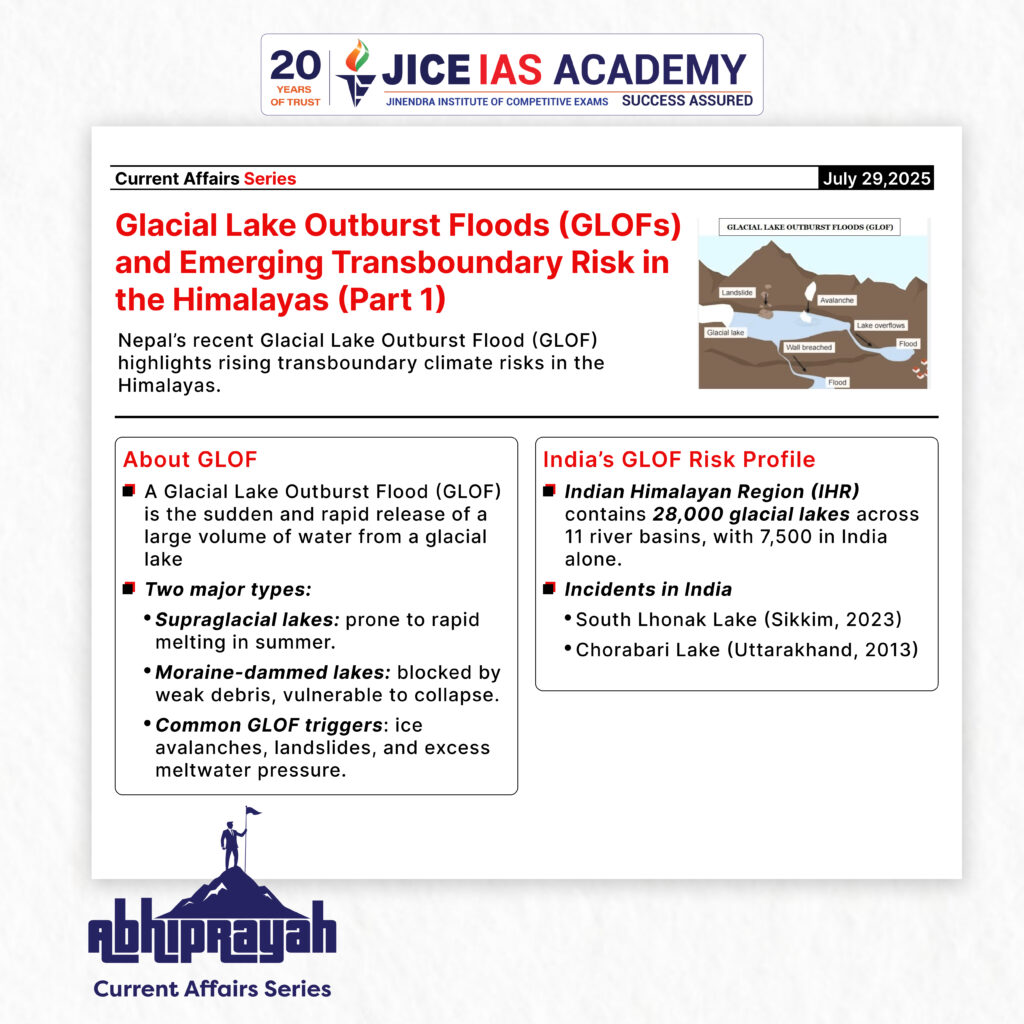
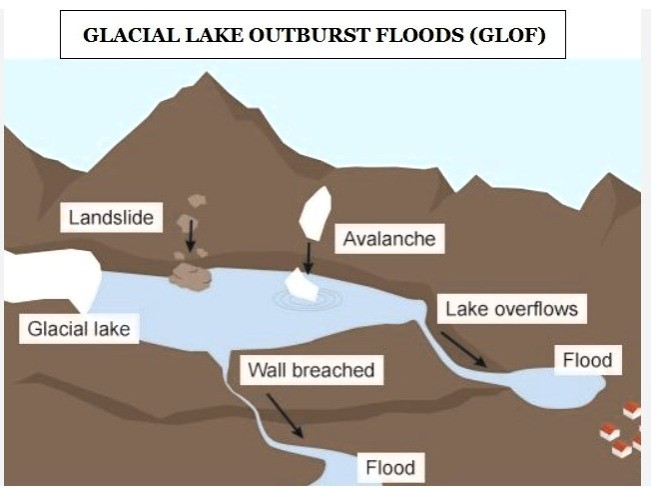
- A Glacial Lake Outburst Flood (GLOF) is the sudden and rapid release of a large volume of water from a glacial lake, typically caused by the failure of a natural dam of ice or moraine, leading to catastrophic downstream flooding
- Glacial Lake Outburst Floods (GLOFs) have become a recurring hazard in the Himalayan region, with rising global temperatures exacerbating glacial melt and threatening lives, infrastructure, and ecosystems across national borders.
- The recent GLOF in Nepal on July 8, 2025, and multiple similar events in previous years underscore the urgent need for early warning systems and cross-border collaboration, especially between China, Nepal, and India.
Recent GLOF Event in Nepal
- On July 8, 2025, a supra-glacial lake in Tibet burst, causing a GLOF along the Lende River, destroying a China-built friendship bridge and affecting the inland container port at Rasuwagadhi.
- The flood rendered four hydropower plants along the Bhote Koshi River inoperable, wiping out 8% of Nepal’s power supply.
- A second GLOF occurred the same day in Mustang district, and earlier events had affected Humla (2025) and Solukhumbu (2024).
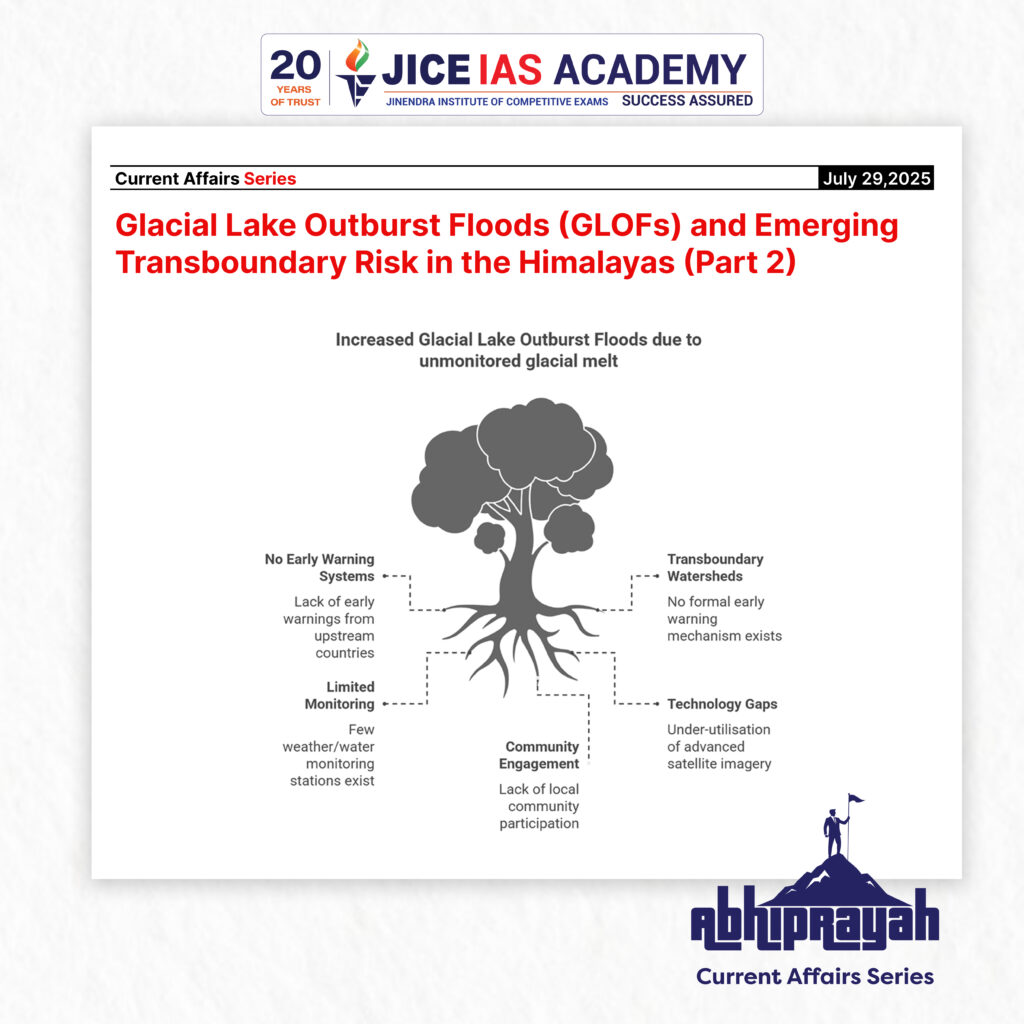
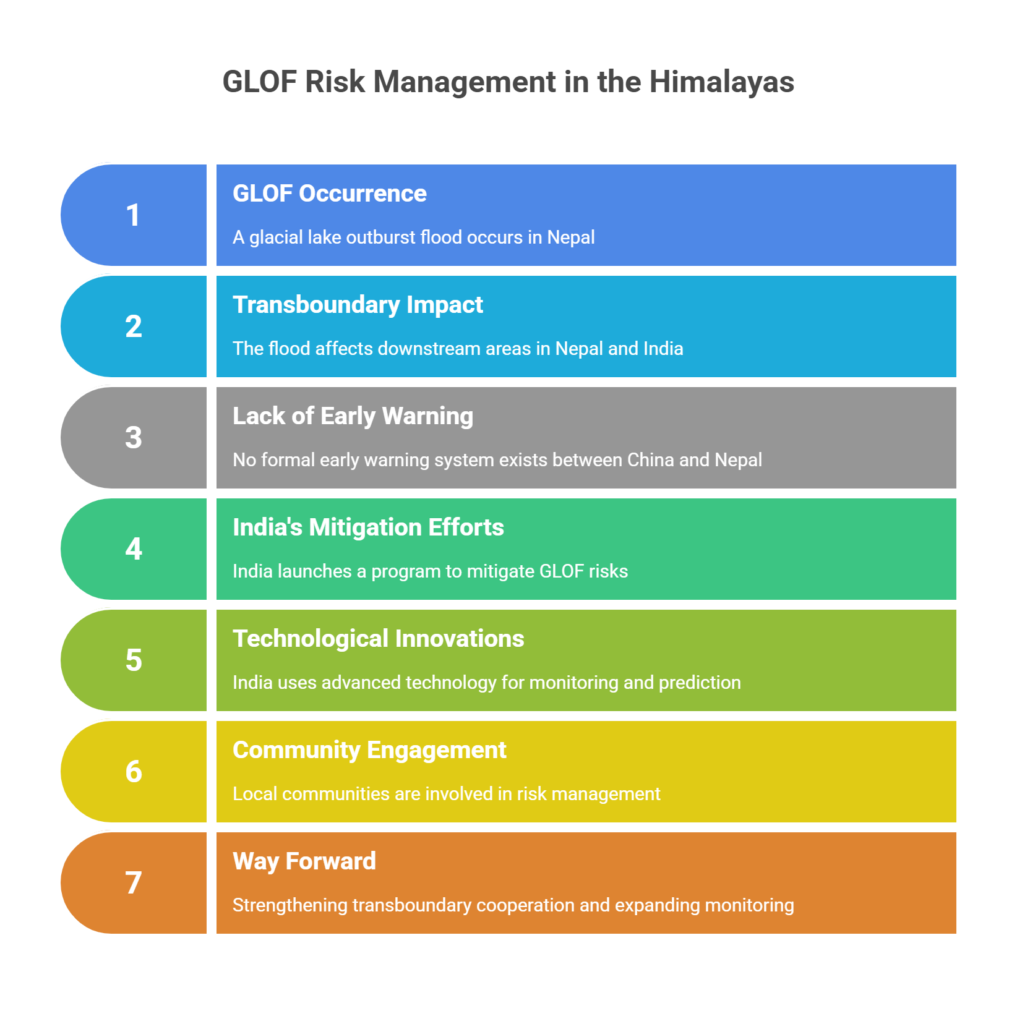
- These incidents highlight Nepal’s vulnerability and the lack of early warnings from upstream countries, notably China.
The Challenge of Transboundary Watersheds
- The GLOF originated in Tibet but devastated downstream areas in Nepal.
- Despite rising numbers of supra-glacial lakes in Tibet, no formal early warning mechanism exists between China and Nepal.
- Nepalese scientists confirmed the lake’s surface area dropped from 63 ha to 43 ha a day before the flood, but this data was not shared proactively.
- Lack of coordination between riparian nations hinders timely responses to such disasters.
History of GLOF Events in Nepal
- Cirenma Co (Tibet, 1981) raised Bhote Koshi’s water level by 30 metres.
- Digi Tsho (1985) and Tama Pokhari (1998) were other major GLOFs.
- Nepal has attempted mitigation by artificially lowering water levels in lakes like Imja Tsho and Tsho Rolpa, though such operations at 5,000+ m altitudes remain extremely challenging.
India’s GLOF Risk Profile
- The Indian Himalayan Region (IHR) contains 28,000 glacial lakes across 11 river basins, with 7,500 in India alone.
- Two major types:
- Supraglacial lakes: prone to rapid melting in summer.
- Moraine-dammed lakes: blocked by weak debris, vulnerable to collapse.
- Common GLOF triggers: ice avalanches, landslides, and excess meltwater pressure.
Incidents in India
- South Lhonak Lake (Sikkim, 2023): destroyed the Chungthang dam (₹16,000 crore/$2B loss).
- Chorabari Lake (Uttarakhand, 2013): caused the Kedarnath disaster, killing hundreds and damaging infrastructure.
Challenges in Monitoring
- Most lakes lie above 4,500 metres, limiting field surveys to short summer windows.
- Few weather/water monitoring stations exist in high-altitude regions.
- Current monitoring relies heavily on remote sensing, which provides post-event data, not early warnings.
India’s Mitigation Efforts
NDMA’s National GLOF Mitigation Programme
- Launched with an initial budget of $20 million, targeting 56 high-risk glacial lakes (later expanded to 195).
- Focus Areas:
- Hazard assessment of glacial lakes.
- Installation of Automated Weather and Water Stations (AWWS).
- Setting up Early Warning Systems (EWS) downstream.
- Risk mitigation: water drawdown/retention structures.
- Community engagement in high-risk zones.
- Expeditions in 2024 assessed 40 high-risk lakes across J&K, Ladakh, Himachal Pradesh, Uttarakhand, Sikkim, Arunachal Pradesh.
Technological Innovations and Gaps
- Encouragement of Indian tech such as SAR Interferometry for monitoring slope stability and pre-disaster prediction.
- Use of bathymetry, Electrical Resistivity Tomography (ERT), UAV surveys, and real-time weather & water data systems.
- Example: Sikkim now has real-time lake monitoring systems that transmit data and photographs every 10 minutes.
- Identified Gaps:
- Absence of Indian tech firms and foundations in GLOF-risk management.
- Under-utilisation of advanced satellite imagery for predictive purposes.
Need for Community Engagement
- Cultural sensitivities: Expedition members in Sikkim had to respect local customs, e.g., not entering sacred lakes.
- Highlights the need for:
- Local community participation.
- Building trust in scientific missions.
- Ensuring sustainable and culturally sensitive interventions.
Way Forward
- Strengthening transboundary cooperation with China and Nepal for early warning sharing.
- Expanding real-time monitoring infrastructure and remote sensing analytics.
- Institutionalising the use of indigenous technology for glacial risk mapping and prediction.
- Building local capacities through community engagement, education, and preparedness exercises.
- Scaling up under the upcoming 16th Finance Commission (FY2027–31) to cover more lakes and risk zones.

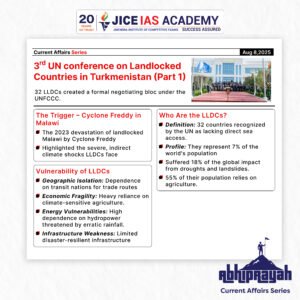
3rd UN conference on landlocked countries
UPSC CURRENT AFFAIRS – 08th August 2025 Home / 3rd UN conference on landlocked countries Why in News? At the
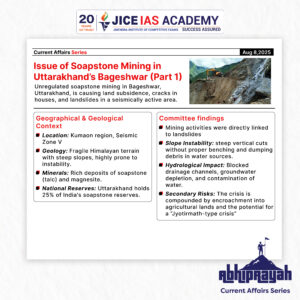
Issue of soapstone mining in Uttarakhand’s Bageshwar
UPSC CURRENT AFFAIRS – 08th August 2025 Home / Issue of soapstone mining in Uttarakhand’s Bageshwar Why in News? Unregulated
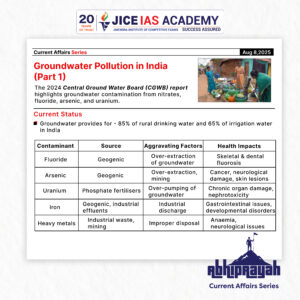
Groundwater Pollution in India – A Silent Public Health Emergency
UPSC CURRENT AFFAIRS – 08th August 2025 Home / Groundwater Pollution in India – A Silent Public Health Emergency Why

Universal banking- need and impact
UPSC CURRENT AFFAIRS – 08th August 2025 Home / Universal banking- need and impact Why in News? The Reserve Bank

India’s “Goldilocks” Economy: A Critical Appraisal
UPSC CURRENT AFFAIRS – 08th August 2025 Home / India’s “Goldilocks” Economy: A Critical Appraisal Why in News? The Finance

U.S.-India Trade Dispute: Trump’s 50% Tariffs and India’s Oil Imports from Russia
UPSC CURRENT AFFAIRS – 07th August 2025 Home / U.S.-India Trade Dispute: Trump’s 50% Tariffs and India’s Oil Imports from
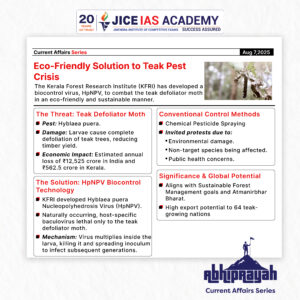
Eco-Friendly Solution to Teak Pest Crisis: KFRI’s HpNPV Technology
UPSC CURRENT AFFAIRS – 07th August 2025 Home / Eco-Friendly Solution to Teak Pest Crisis: KFRI’s HpNPV Technology Why in

New Species of Non-Venomous Rain Snake Discovered in Mizoram
UPSC CURRENT AFFAIRS – 07th August 2025 Home / New Species of Non-Venomous Rain Snake Discovered in Mizoram Why in
Introduction
Economic Implications
For Indian Exporters
- These reforms reduce transaction costs and compliance hurdles
- Encourage a more competitive and efficient export environment
- Promote value addition in key sectors like leather
For Tamil Nadu
- The reforms particularly benefit the state’s leather industry, a major contributor to employment and exports
- Boost the marketability of GI-tagged E.I. leather, enhancing rural and traditional industries
For Trade Policy
- These decisions indicate a shift from regulatory controls to policy facilitation
Reinforce the goals of Make in India, Atmanirbhar Bharat, and India’s ambition to become a leading export power
Recently, BVR Subrahmanyam, CEO of NITI Aayog, claimed that India has overtaken Japan to become the fourth-largest economy in the world, citing data from the International Monetary Fund (IMF).
India’s rank as the world’s largest economy varies by measure—nominal GDP or purchasing power parity (PPP)—each with key implications for economic analysis.