

UPSC CURRENT AFFAIRS – 25th June 2025
Governance Reforms for Market Infrastructure Institutions (MIIs)
Why in News?
- SEBI released a consultation paper on June 24, 2025, proposing key governance reforms for Market Infrastructure Institutions (MIIs) such as stock exchanges and clearing corporations.
Introduction
- The Securities and Exchange Board of India (SEBI) released a consultation paper proposing a series of measures to reform the governance structure of Market Infrastructure Institutions (MIIs).
- These reforms are aimed at ensuring stronger oversight, accountability, and stability within these critical financial entities.
Market Infrastructure Institutions (MIIs
- Market Infrastructure Institutions (MIIs) are essential components of the capital markets ecosystem. They include stock exchanges, clearing corporations, and depositories.
- These institutions ensure the smooth functioning of trading, clearing, settlement, and record-keeping in the securities market.
- Given their systemic importance, any governance failure in MIIs can have far-reaching consequences on investor confidence and the broader economy.
- SEBI’s proposals come in response to the expanding scope and complexity of the securities market, as well as concerns about possible governance lapses within MIIs.
Key Proposals in the SEBI Consultation Paper
1. Creation of Executive Director Positions
SEBI has proposed the mandatory appointment of at least two Executive Directors (EDs) in each MII. These EDs will report to the Managing Director (MD) and will be responsible for overseeing specific functional areas within the MII.
2. Three-Vertical Governance Structure
SEBI formalized a framework that divides the responsibilities of MIIs into three verticals:
- Critical Operations: This includes core activities essential for the functioning of the market, such as trade execution and settlement operations.
- Regulatory, Compliance, Risk Management, and Investor Grievances: This vertical ensures adherence to laws, regulatory norms, risk mitigation frameworks, and resolution of investor complaints.
- Commercial Interests and Business Development: This includes strategic initiatives aimed at expanding the institution’s operations and financial performance.
SEBI has proposed that the two Executive Directors must lead the first two verticals—Critical Operations and Regulatory/Compliance. The appointment of an Executive Director for the third vertical is left to the discretion of the MII.
3. Board Representation and Status of Executive Directors
Currently, only Managing Directors are allowed to be part of the Governing Board of MIIs. SEBI now proposes that the Executive Directors of the first two verticals should also be included on the Board. These EDs will hold a status comparable to that of the MD.
Their appointment and reappointment will follow the same regulatory procedures as that of the MD and will require SEBI’s approval.
4. Reporting Obligations
The Executive Directors will be required to submit quarterly reports to both the Governing Board of the MII and to SEBI. These reports must address matters related to their respective verticals, thereby enhancing transparency and accountability.
5. Rules on External Directorships
SEBI has introduced new norms regarding external directorships:
- Managing Directors may hold non-executive directorships in unlisted government-owned companies (either central or state) or in not-for-profit organizations.
- Executive Directors, however, will not be allowed to hold directorships in any external entities, except for subsidiaries of the MII.
6. Public Consultation
The proposals outlined in the consultation paper are open for public comments and suggestions until July 15, 2025.
Significance of the Proposals
These proposed reforms are significant for several reasons:
- Improved Accountability: Including Executive Directors in the board structure ensures that the leaders of critical and compliance functions are directly accountable to the highest decision-making body of the MII.
- Enhanced Regulatory Oversight: Quarterly reporting to SEBI will improve surveillance over the functioning of MIIs and enable early detection of irregularities.
- Risk Management: A dedicated vertical for risk and compliance headed by an ED ensures better institutional focus on market integrity and investor protection.
- Balanced Governance: The reforms aim to balance commercial objectives with regulatory responsibilities, thereby reducing potential conflicts of interest.
- Clarity in Leadership Structure: Clearly defined verticals and leadership roles promote professionalism and clarity in management responsibilities.
Broader Regulatory Context
These reforms are consistent with SEBI’s broader efforts to modernize and strengthen India’s financial regulatory architecture. Previous initiatives include:
- Enhanced disclosure norms for listed companies,
- Cybersecurity and technology governance frameworks for MIIs,
- Stricter compliance mandates for mutual funds and alternative investment funds.
The current proposals further align SEBI’s governance framework with international best practices in financial market infrastructure regulation.
Conclusion
- The proposed governance reforms by SEBI aim to create a more robust, accountable, and transparent framework for Market Infrastructure Institutions.
- By emphasizing independent oversight, structural clarity, and regulatory alignment, SEBI is seeking to ensure the long-term stability and integrity of India’s capital markets.
- These proposals, if implemented effectively, will strengthen investor confidence and support the orderly development of the securities market.

3rd UN conference on landlocked countries
UPSC CURRENT AFFAIRS – 08th August 2025 Home / 3rd UN conference on landlocked countries Why in News? At the

Issue of soapstone mining in Uttarakhand’s Bageshwar
UPSC CURRENT AFFAIRS – 08th August 2025 Home / Issue of soapstone mining in Uttarakhand’s Bageshwar Why in News? Unregulated

Groundwater Pollution in India – A Silent Public Health Emergency
UPSC CURRENT AFFAIRS – 08th August 2025 Home / Groundwater Pollution in India – A Silent Public Health Emergency Why
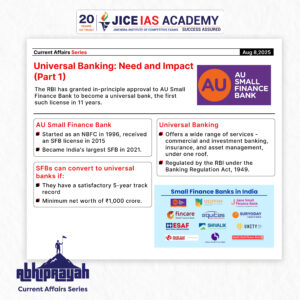
Universal banking- need and impact
UPSC CURRENT AFFAIRS – 08th August 2025 Home / Universal banking- need and impact Why in News? The Reserve Bank

India’s “Goldilocks” Economy: A Critical Appraisal
UPSC CURRENT AFFAIRS – 08th August 2025 Home / India’s “Goldilocks” Economy: A Critical Appraisal Why in News? The Finance

U.S.-India Trade Dispute: Trump’s 50% Tariffs and India’s Oil Imports from Russia
UPSC CURRENT AFFAIRS – 07th August 2025 Home / U.S.-India Trade Dispute: Trump’s 50% Tariffs and India’s Oil Imports from

Eco-Friendly Solution to Teak Pest Crisis: KFRI’s HpNPV Technology
UPSC CURRENT AFFAIRS – 07th August 2025 Home / Eco-Friendly Solution to Teak Pest Crisis: KFRI’s HpNPV Technology Why in

New Species of Non-Venomous Rain Snake Discovered in Mizoram
UPSC CURRENT AFFAIRS – 07th August 2025 Home / New Species of Non-Venomous Rain Snake Discovered in Mizoram Why in
Economic Implications
For Indian Exporters
- These reforms reduce transaction costs and compliance hurdles
- Encourage a more competitive and efficient export environment
- Promote value addition in key sectors like leather
For Tamil Nadu
- The reforms particularly benefit the state’s leather industry, a major contributor to employment and exports
- Boost the marketability of GI-tagged E.I. leather, enhancing rural and traditional industries
For Trade Policy
- These decisions indicate a shift from regulatory controls to policy facilitation
Reinforce the goals of Make in India, Atmanirbhar Bharat, and India’s ambition to become a leading export power
Recently, BVR Subrahmanyam, CEO of NITI Aayog, claimed that India has overtaken Japan to become the fourth-largest economy in the world, citing data from the International Monetary Fund (IMF).
India’s rank as the world’s largest economy varies by measure—nominal GDP or purchasing power parity (PPP)—each with key implications for economic analysis.