
UPSC CURRENT AFFAIRS – 21th June 2025

Home / UPSC / Current Affairs / India to be world’s 4th largest electric car maker by 2030: Report

India to be world’s 4th largest electric car maker by 2030: Report

Why in News?

  • India is set to become the fourth-largest electric four-wheeler manufacturer globally by 2030, with a projected capacity of 2.5 million units.

Background

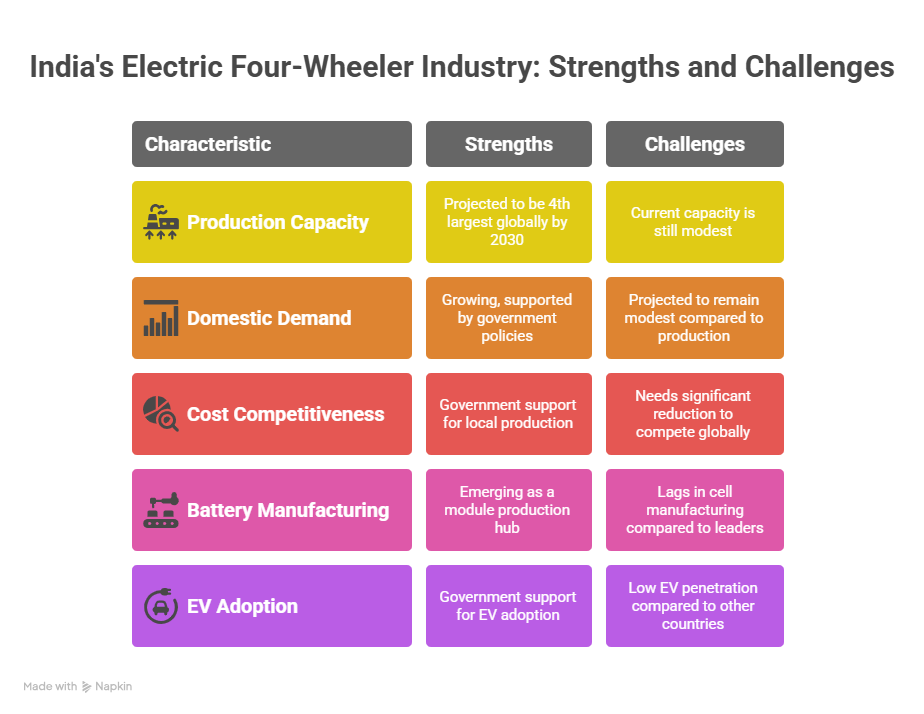
  • India is poised to become the fourth-largest global hub for electric four-wheeler manufacturing by 2030, following China, the European Union, and the United States. According to the Global Clean Investment Monitor report by the Rhodium Group, India’s production capacity is set to rise over tenfold — from a modest 0.2 million units in 2024 to a projected 2.5 million units by the end of the decade.
  • This significant expansion reflects India’s strategic focus on electric mobility as part of its broader industrial and climate goals. However, the journey toward global competitiveness in this sector will require overcoming major challenges related to costs, exports, and infrastructure.

Growth Trajectory: From Nascent to Global Player

As of 2024, India’s operational electric car manufacturing capacity stands at just 0.2 million units. However, a wave of new investments and industrial announcements is expected to radically reshape this landscape. The cumulative manufacturing capacity by 2030 is projected at 2.5 million units, comprising:

  • 0.2 million currently operational
  • 0.3 million ready but not yet active
  • 1.3 million under construction
  • 0.7 million announced

This exponential growth positions India ahead of South Korea and Japan in terms of anticipated capacity, marking a strategic shift in the global EV supply chain.

Mismatch Between Production and Demand

  • Despite this manufacturing boom, domestic demand for electric four-wheelers in India is projected to remain modest. Rhodium Group estimates that India’s E4W demand will grow from 0.1 million in 2024 to between 0.4 million and 1.4 million by 2030. This implies an electric vehicle penetration rate of just 7–23% in total car sales, which are projected to reach around 6 million units by 2030.
  • This indicates a surplus production capacity of 1.1–2.1 million vehicles, highlighting a critical need for Indian manufacturers to explore export markets to fully utilize their capacity.

Export Opportunity vs Cost Challenge

  • The surplus production opens the door for “Make in India for the World”, aligning with the government’s industrial vision. However, tapping into global EV markets will not be easy. 
  • Indian companies must significantly reduce production costs to compete with dominant exporters, particularly China, which currently benefits from economies of scale, advanced battery technology, and strong global market integration.
  • Without addressing cost structures and competitiveness, India’s manufacturing advantage could remain underutilized.

Domestic Market Dynamics and Policy Support

India’s domestic E4W market is currently dominated by homegrown and localized players:

  • Tata Motors, MG Motor, and Mahindra together account for nearly 90% of market share in 2024–25.

To support domestic production and promote localization, the government has implemented several policy tools:

  • Consumer subsidies tied to local value addition
  • Production-linked incentives (PLIs) for EVs and advanced battery manufacturing
  • Tariffs of 70–100% on fully built imported EVs
  • Investment in EV charging infrastructure

These measures have helped create a robust domestic manufacturing base but have also led to higher consumer prices and limited variety, as almost 100% of EVs sold are produced locally.

Comparative Perspective: India vs Global Players

  • India’s E4W production capacity by 2030: 2.5 million units
  • China: 29 million units
  • EU: 9 million units
  • US: 6 million units

While India is far behind these EV giants, it surpasses Japan (1.4 million units) and South Korea (1.9 million units) in terms of projected capacity. However, both Japan and South Korea currently have higher operational bases but limited new capacity under construction.

In terms of EV adoption, India lags:

  • India’s EV penetration in 2024: ~2%
  • Vietnam’s penetration rose from 3% (2022) to 17% (2024), largely driven by the domestic automaker VinFast

Battery Manufacturing: Rapid Rise, But Delivery Risks

On the battery front, India has emerged as a standout player, particularly in module assembly. It is projected to become the largest module producer outside of China, Europe, and the US, with several large-scale projects under development.

However, when it comes to battery cell manufacturing, India still lags:

  • China: 4,818 GWh
  • US: 1,169 GWh
  • EU: 997 GWh
  • India and rest of world: 567 GWh

Much of India’s projected growth in battery manufacturing depends on plants that are under construction or recently announced, raising questions about execution and timelines.

Conclusion:

  • India’s electric four-wheeler industry is undergoing a historic transformation, powered by proactive government policies, industrial investment, and localization incentives. By 2030, the country will have one of the world’s largest manufacturing capacities, setting the stage for potential export leadership.
  • However, cost competitiveness, infrastructure readiness, and battery supply chain development remain critical. To fully realize this potential, India must not only scale up production but also integrate into the global EV value chain with high-quality, affordable, and innovative offerings.

Economic Implications

For Indian Exporters

  • These reforms reduce transaction costs and compliance hurdles
  • Encourage a more competitive and efficient export environment
  • Promote value addition in key sectors like leather

For Tamil Nadu

  • The reforms particularly benefit the state’s leather industry, a major contributor to employment and exports
  • Boost the marketability of GI-tagged E.I. leather, enhancing rural and traditional industries

For Trade Policy

  • These decisions indicate a shift from regulatory controls to policy facilitation

Reinforce the goals of Make in India, Atmanirbhar Bharat, and India’s ambition to become a leading export power

Recently, BVR Subrahmanyam, CEO of NITI Aayog, claimed that India has overtaken Japan to become the fourth-largest economy in the world, citing data from the International Monetary Fund (IMF). 

India’s rank as the world’s largest economy varies by measure—nominal GDP or purchasing power parity (PPP)—each with key implications for economic analysis.

Significance and Applications

Leave a Reply

Your email address will not be published. Required fields are marked *

Call Us Now !

Copyright © JICE ACADEMY FOR EXCELLENCE PRIVATE LIMITED