UPSC CURRENT AFFAIRS – 19th June 2025

Home / UPSC / Current Affairs / India and Canada to reinstate High Commissioners, restart trade talks

India and Canada to reinstate High Commissioners, restart trade talks

Why in News?

  • India and Canada have agreed to reinstate High Commissioners and resume stalled trade talks, marking the first diplomatic thaw after tensions over the killing of a Khalistan separatist.

Introduction

  • After almost two years of diplomatic hostilities following the assassination of Khalistan separatist Hardeep Singh Nijjar in Canada, India and Canada have initiated steps to restore normalcy in bilateral ties. 
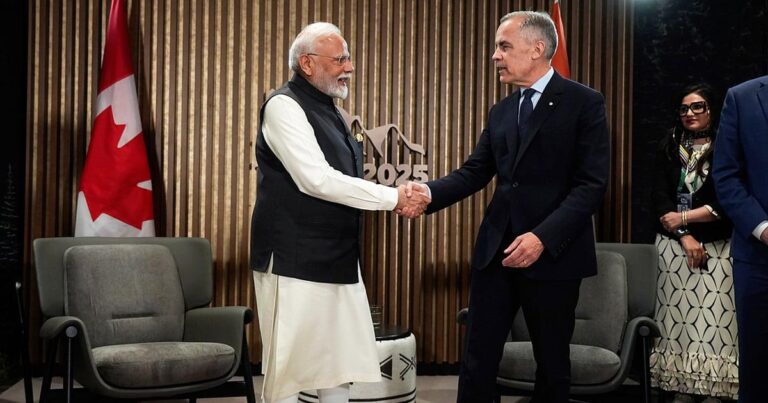
  • On the sidelines of the G7 Summit 2025, Prime Minister Narendra Modi met his Canadian counterpart Mark Carney, marking the first high-level bilateral engagement since the breakdown in relations.

Background of the Diplomatic Rift:

  • In 2023, Canadian PM Justin Trudeau publicly accused Indian agents of involvement in the killing of Nijjar, a Canadian citizen and pro-Khalistan separatist, in British Columbia.
  • India strongly denied the allegations and termed them politically motivated, targeting Trudeau’s vote-bank politics.
  • This led to:
    • Expulsion of Indian diplomats by Canada.
    • Reciprocal expulsion of Canadian diplomats by India.
    • Suspension of trade negotiations, people-to-people services, and diplomatic engagement.

Key Highlights:

The 40-minute meeting was described as “positive and constructive” by Indian Foreign Secretary Vikram Misri. Agreement on:

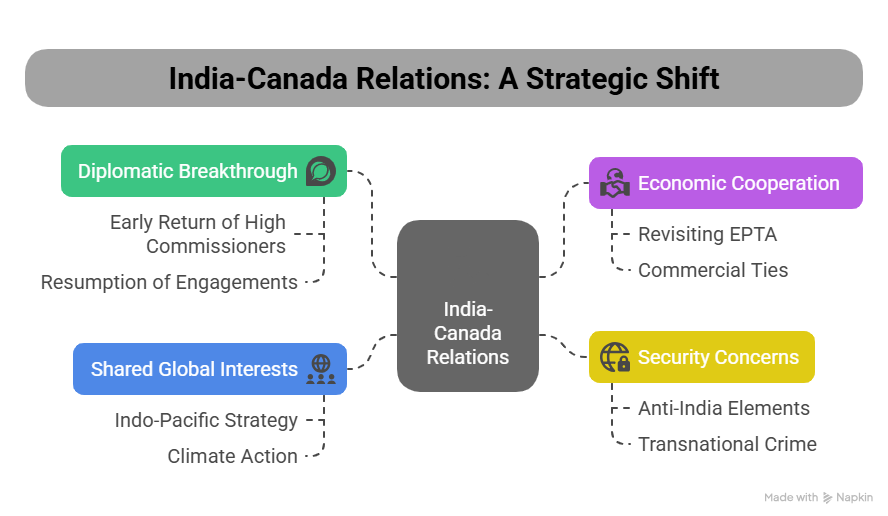
  • Early return of High Commissioners.
  • Resumption of senior-level and ministerial engagements.
  • Restarting of stalled trade negotiations, including Early Progress Trade Agreement (EPTA) talks.
  • Building trust and stability through calibrated steps.

Mutually Acknowledged Principles:

  • Mutual respect for concerns and sensitivities.
  • Strong people-to-people links – referred to as the “living bridge” between both countries.
  • Shared commitment to democratic values, rule of law, sovereignty, and territorial integrity.
  • Economic complementarities including clean energy, AI, digital infrastructure, and critical minerals.

Trade and Economic Cooperation:

  • India and Canada agreed to revisit EPTA, which was stalled in 2023, as a precursor to a Comprehensive Economic Partnership Agreement (CEPA).
  • Though the Canadian readout avoided direct mention of trade talks, it highlighted:
    • Significant commercial ties.
    • Cooperation in supply chains, clean energy, and energy transformation.

Security and Transnational Concerns:

  • India emphasized Ottawa’s inaction on anti-India elements (Khalistani groups) but kept it out of the official readout, signaling quiet diplomacy.
  • Canada, under PM Carney, raised transnational crime and repression as priorities, aligning with the G7 joint condemnation of transnational repression.
  • The issue of Nijjar’s killing was not mentioned explicitly, showing both sides wanted to avoid reigniting tensions.

Shared Global Interests:

  • Free and open Indo-Pacific strategy.
  • Climate action, sustainable development, inclusive growth.
  • Connectivity, clean energy, AI, food security, and critical mineral supply chains discussed as areas of cooperation.

Significance for India’s Diplomacy:

  • A diplomatic breakthrough in restoring normalcy without compromising on core concerns (anti-India extremism).
  • Strategic balancing between national interest and diaspora management.
  • Potential to re-energize economic engagement with a key G7 partner.
  • Soft reset of ties under PM Carney, moving away from Trudeau’s confrontational stance.

Conclusion:

  • The Modi-Carney meeting marks a strategic shift in India-Canada relations, moving from confrontation to calibrated cooperation. 
  • While deep-rooted trust deficits remain, particularly around the Khalistan issue, the decision to restore diplomatic presence and resume trade talks is a crucial confidence-building measure. 
  • Success will depend on mutual willingness to address each other’s core concerns and institutionalizing cooperation across domains like trade, technology, and climate.

Economic Implications

For Indian Exporters

  • These reforms reduce transaction costs and compliance hurdles
  • Encourage a more competitive and efficient export environment
  • Promote value addition in key sectors like leather

For Tamil Nadu

  • The reforms particularly benefit the state’s leather industry, a major contributor to employment and exports
  • Boost the marketability of GI-tagged E.I. leather, enhancing rural and traditional industries

For Trade Policy

  • These decisions indicate a shift from regulatory controls to policy facilitation

Reinforce the goals of Make in India, Atmanirbhar Bharat, and India’s ambition to become a leading export power

Recently, BVR Subrahmanyam, CEO of NITI Aayog, claimed that India has overtaken Japan to become the fourth-largest economy in the world, citing data from the International Monetary Fund (IMF). 

India’s rank as the world’s largest economy varies by measure—nominal GDP or purchasing power parity (PPP)—each with key implications for economic analysis.

Significance and Applications

Leave a Reply

Your email address will not be published. Required fields are marked *

Call Us Now !

Copyright © JICE ACADEMY FOR EXCELLENCE PRIVATE LIMITED