
UPSC CURRENT AFFAIRS – 3rd June 2025
India & COVID-19: Focus on Readiness, Not Panic
Why in News?
- India has reported over 3,900 COVID-19 cases in 2025, prompting experts and public health authorities to advise precautionary measures for vulnerable populations.
Introduction
- India has observed a mild rise in COVID-19 cases in early 2025.
- While the numbers may seem concerning at first glance, they are still relatively low when compared to previous pandemic waves and must be interpreted in context.
- This data reflects that the current situation is not critical but does demand a proactive and measured response.
Key Issues and Insights
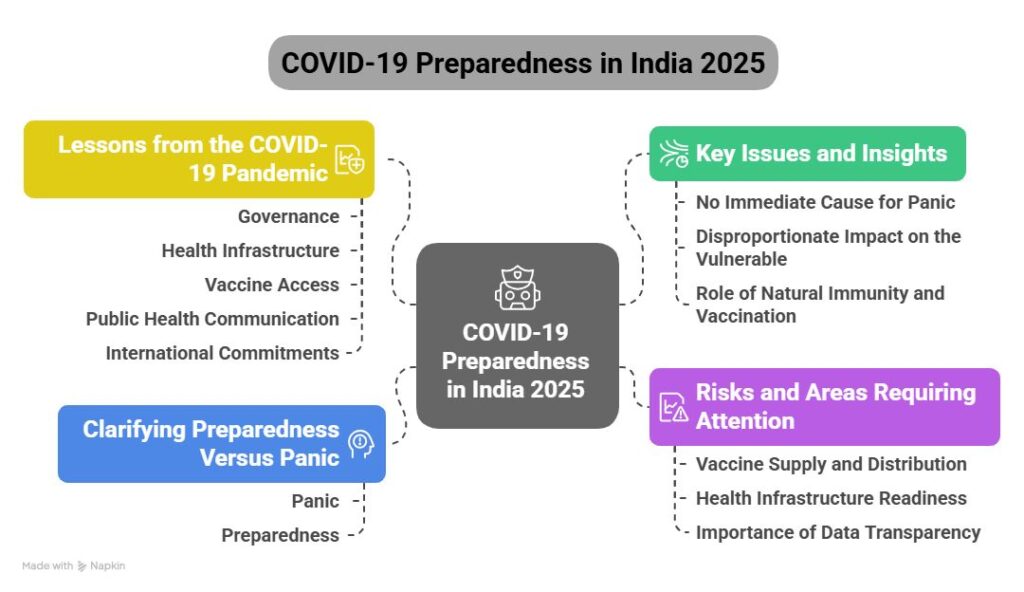
1. No Immediate Cause for Panic, But Caution is Essential
- Although the rise in cases may seem alarming, the absolute numbers remain low in a country with over 1.4 billion people. Moreover, not all states are seeing consistent day-on-day increases, and wherever increases occur, they are in single- or low double-digits.
- Thus, public anxiety or panic is not warranted. However, a cautious and vigilant approach is advisable, especially in light of past experiences.
2. Disproportionate Impact on the Vulnerable
People with pre-existing health conditions continue to face higher risks of severe illness if infected. Common co-morbidities include:
- Hypertension
- Diabetes
- Cardiovascular diseases
- Kidney diseases
- Obesity
- Advanced age (above 60 years)
These groups are advised to resume safety practices such as wearing masks in public and maintaining regular hand hygiene.
3. The Role of Natural Immunity and Vaccination
- The population has acquired considerable immunity from past infections and vaccinations.
- However, she emphasized the importance of continuing preventive strategies, including booster vaccinations for vulnerable groups.
- The challenge lies in vaccine availability. Even in urban areas, vaccine and booster supply is insufficient. This raises concerns about equitable access and preparedness.
Risks and Areas Requiring Attention
1. Vaccine Supply and Distribution
- The government must ensure the availability of COVID-19 vaccines and diagnostic kits across the country.
- These should be stockpiled and distributed in advance to avoid shortages.
2. Health Infrastructure Readiness
Hospitals in both public and private sectors must be prepared for any potential surge. This includes:
- Maintaining a steady supply of medical oxygen
- Ensuring the availability of hospital beds
- Training and deploying adequate healthcare personnel
3. Importance of Data Transparency
- One of the major criticisms during the previous waves of the pandemic was the lack of transparent and accurate data reporting. It is critical to avoid repeating this mistake.
- Both the central and state governments must ensure real-time, transparent dissemination of data related to infections, recoveries, and fatalities.
Lessons from the COVID-19 Pandemic: Policy Implications
Domain | Past Mistake/Challenge | Required Action |
Governance | Data suppression and poor coordination | Ensure transparency and Centre-State cooperation |
Health Infrastructure | Shortage of oxygen and hospital beds | Maintain emergency preparedness protocols |
Vaccine Access | Uneven distribution and hesitancy | Ensure widespread availability and awareness |
Public Health Communication | Misinformation and confusion | Disseminate clear, scientific, and consistent messages |
International Commitments | Passive participation in global treaties | Actively uphold obligations under WHO agreements |
Clarifying Preparedness Versus Panic
A crucial distinction between panic and preparedness:
- Panic is driven by fear, leading to irrational behavior and societal disruption.
- Preparedness involves systematic planning, resource allocation, and informed decision-making.
This distinction is important in policy formulation and public communication.
Quote to remember: “Panic is not the same as preparedness: one is debilitating, the other is enabling.”

3rd UN conference on landlocked countries
UPSC CURRENT AFFAIRS – 08th August 2025 Home / 3rd UN conference on landlocked countries Why in News? At the

Issue of soapstone mining in Uttarakhand’s Bageshwar
UPSC CURRENT AFFAIRS – 08th August 2025 Home / Issue of soapstone mining in Uttarakhand’s Bageshwar Why in News? Unregulated
Groundwater Pollution in India – A Silent Public Health Emergency
UPSC CURRENT AFFAIRS – 08th August 2025 Home / Groundwater Pollution in India – A Silent Public Health Emergency Why
Universal banking- need and impact
UPSC CURRENT AFFAIRS – 08th August 2025 Home / Universal banking- need and impact Why in News? The Reserve Bank

India’s “Goldilocks” Economy: A Critical Appraisal
UPSC CURRENT AFFAIRS – 08th August 2025 Home / India’s “Goldilocks” Economy: A Critical Appraisal Why in News? The Finance

U.S.-India Trade Dispute: Trump’s 50% Tariffs and India’s Oil Imports from Russia
UPSC CURRENT AFFAIRS – 07th August 2025 Home / U.S.-India Trade Dispute: Trump’s 50% Tariffs and India’s Oil Imports from

Eco-Friendly Solution to Teak Pest Crisis: KFRI’s HpNPV Technology
UPSC CURRENT AFFAIRS – 07th August 2025 Home / Eco-Friendly Solution to Teak Pest Crisis: KFRI’s HpNPV Technology Why in

New Species of Non-Venomous Rain Snake Discovered in Mizoram
UPSC CURRENT AFFAIRS – 07th August 2025 Home / New Species of Non-Venomous Rain Snake Discovered in Mizoram Why in

Economic Implications
For Indian Exporters
- These reforms reduce transaction costs and compliance hurdles
- Encourage a more competitive and efficient export environment
- Promote value addition in key sectors like leather
For Tamil Nadu
- The reforms particularly benefit the state’s leather industry, a major contributor to employment and exports
- Boost the marketability of GI-tagged E.I. leather, enhancing rural and traditional industries
For Trade Policy
- These decisions indicate a shift from regulatory controls to policy facilitation
Reinforce the goals of Make in India, Atmanirbhar Bharat, and India’s ambition to become a leading export power
Recently, BVR Subrahmanyam, CEO of NITI Aayog, claimed that India has overtaken Japan to become the fourth-largest economy in the world, citing data from the International Monetary Fund (IMF).
India’s rank as the world’s largest economy varies by measure—nominal GDP or purchasing power parity (PPP)—each with key implications for economic analysis.