
UPSC CURRENT AFFAIRS – 18th July 2025

Home / UPSC / Current Affairs / India’s Dilemma in US-China Trade Conflict

India's Dilemma in US-China Trade Conflict

india dilemma in the us-china trade conflict

Why in News?

  • The US is increasing scrutiny on transhipped Chinese goods through countries like India, raising concerns amid India’s growing trade with both China and the US.

indian and american flag

Introduction

  • In the evolving landscape of global trade, the United States has intensified scrutiny over transhipped goods to curb the backdoor entry of Chinese products into its markets. 
  • Countries like India, deeply reliant on Chinese imports while simultaneously increasing exports to the US, are now caught in a complex web of geopolitics, trade policy, and industrial dependencies.

Understanding Transhipment and US Concerns

  • Transhipment refers to the practice of importing goods from one country and exporting them to another without significant processing or value addition. 
  • This has raised concerns in Washington as it seeks to prevent China from bypassing punitive tariffs by routing goods through intermediary countries.
  • The US, under both the Trump and Biden administrations, has issued warnings to countries such as Vietnam, Thailand, and even close allies like Canada and South Korea about acting as conduits for Chinese exports. 
  • India now finds itself under similar scrutiny, especially after US Vice President JD Vance cautioned New Delhi during his April 2025 visit.

Challenges in Reducing Dependence on China

India’s dependence on Chinese imports spans critical sectors like electronics, machinery, and renewable energy. Despite national efforts to boost local manufacturing and self-reliance, Chinese goods continue to dominate due to:

  • Lower costs and large-scale production in China.
  • Industrial overcapacity in China driving the need to export surplus production.
  • India’s limited domestic industrial capabilities, logistical challenges, and lack of economies of scale.

In sectors like solar energy, Indian firms struggle to match the pricing and volume of Chinese products, which disrupts the growth of indigenous industries.

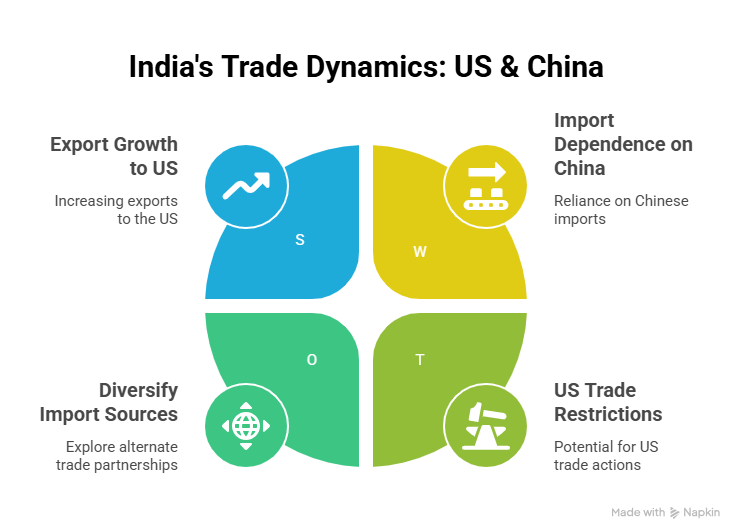
india trade dynamics us and china

China’s Economic Strategy and Global Impact

  • China’s economic structure is marked by low domestic consumption and high export dependence, backed by state subsidies and supply-side focus
  • The “dual circulation” strategy, intended to strengthen internal demand and reduce external vulnerabilities, has not alleviated industrial overcapacity.
  • Instead, overproduction has pushed Chinese firms to seek aggressive entry into foreign markets, often at prices that undercut local industries elsewhere — leading to distorted trade dynamics globally.

US Strategic Responses and Implications for India

The US may impose:

  • Stricter tariff measures on countries suspected of enabling transhipment.
  • Enhanced monitoring and enforcement of rules of origin under existing trade frameworks.
  • Targeted trade restrictions on goods exported from India suspected to be of Chinese origin.

For India, such actions could have serious consequences:

  • Erosion of export competitiveness in the US market.
  • Reputational risks in global trade.
  • Potential barriers to future trade deals with the US.

India’s Countermeasures and Policy Options

To address these challenges, India needs a multi-pronged strategy:

  1. Strengthen Domestic Manufacturing
    • Focus on sectors where Chinese dominance is strong, such as electronics and machinery.
    • Enhance production-linked incentive (PLI) schemes and develop logistics ecosystems.
  2. Enforce Origin Transparency
    • Strengthen customs mechanisms to ensure traceability of value-added components.
    • Implement strict compliance with rules of origin in exports.
  3. Diversify Import Sources
    • Explore alternate trade partnerships in Southeast Asia, Latin America, and Africa.
    • Reduce overdependence on a single source country like China.
  4. Bilateral Engagement with the US
    • Address concerns through diplomatic and trade dialogues.
    • Emphasize India’s commitment to value addition and compliance with international trade norms.

Conclusion

  • India’s trade conundrum with the US and China reflects the broader complexities of geopolitics, industrial policy, and global economic restructuring
  • As the US tightens its grip on transhipment practices to counter China’s economic strategies, India must balance its developmental needs with diplomatic agility. 
  • The path forward demands a bold recalibration of industrial capability, trade integrity, and strategic autonomy.

Economic Implications

For Indian Exporters

  • These reforms reduce transaction costs and compliance hurdles
  • Encourage a more competitive and efficient export environment
  • Promote value addition in key sectors like leather

For Tamil Nadu

  • The reforms particularly benefit the state’s leather industry, a major contributor to employment and exports
  • Boost the marketability of GI-tagged E.I. leather, enhancing rural and traditional industries

For Trade Policy

  • These decisions indicate a shift from regulatory controls to policy facilitation

Reinforce the goals of Make in India, Atmanirbhar Bharat, and India’s ambition to become a leading export power

Recently, BVR Subrahmanyam, CEO of NITI Aayog, claimed that India has overtaken Japan to become the fourth-largest economy in the world, citing data from the International Monetary Fund (IMF). 

India’s rank as the world’s largest economy varies by measure—nominal GDP or purchasing power parity (PPP)—each with key implications for economic analysis.

Significance and Applications

Leave a Reply

Your email address will not be published. Required fields are marked *

Call Us Now !

Copyright © JICE ACADEMY FOR EXCELLENCE PRIVATE LIMITED