
UPSC CURRENT AFFAIRS – 06th July 2025

Home / UPSC / Current Affairs / India’s First National Cooperative University — Tribhuvan Sahkari University

India’s First National Cooperative University — Tribhuvan Sahkari University

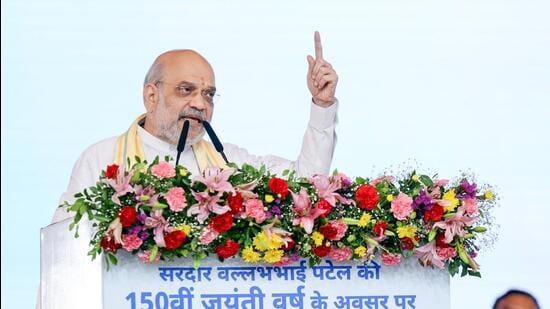
home minister amit shah giving speech

Why in News?

  • Union Home and Cooperation Minister laid the foundation stone for India’s first national cooperative university — Tribhuvan Sahkari University — in Anand, Gujarat (July 5, 2025).
  • It marks a significant step to strengthen the cooperative sector’s capacity and professionalism in line with the government’s vision of Sahkar se Samriddhi (Prosperity through Cooperation).

Background: Cooperatives in India

  • India has more than 8.5 lakh cooperatives, covering sectors like dairy (Amul), sugar, credit societies, housing, fisheries, and marketing.
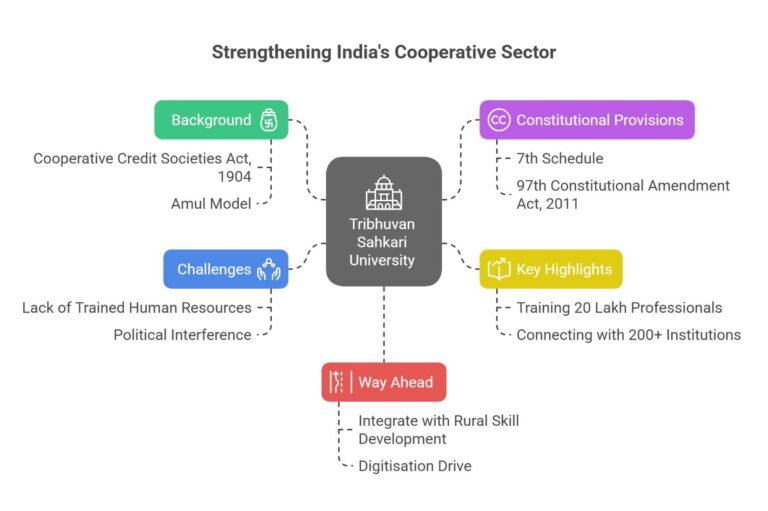
  • The cooperative movement began in the early 20th century with the Cooperative Credit Societies Act, 1904.
  • The Amul model in Gujarat is one of the world’s largest and most successful dairy cooperatives, credited to pioneers like Tribhuvandas Patel and Verghese Kurien.
  • Tribhuvandas Kishibhai Patel, after whom the university is named, was the first Chairman of the Kaira District Co-operative Milk Producers’ Union, which later became Amul.

Constitutional Provisions on Cooperatives

  • 7th Schedule: ‘Cooperative societies’ are a State Subject (Entry 32, List II).
  • 97th Constitutional Amendment Act, 2011:
    • Inserted Part IXB (Articles 243ZH to 243ZT) to give constitutional status to cooperatives.
    • Article 19(1)(c) expanded to include the right to form cooperative societies.
    • Added Article 43B (Directive Principles) to promote voluntary formation, democratic control, and professional management of cooperatives.
  • In 2021, the Supreme Court partly struck down the 97th Amendment related to State cooperatives, upholding it only for Multi-State Cooperative Societies.
strengthening india cooperative sector

Key Highlights of the News

Tribhuvan Sahkari University:

  • Will train over 20 lakh cooperative professionals in 5 years.
  • Will offer specialised courses in cooperative management, law, finance, rural development, and technical skills like marketing, accounting, and digitisation.
  • Plans to connect with 200+ existing cooperative institutions within 4 years.
  • Aims to become an R&D hub for innovation in the cooperative sector.

School-Level Cooperative Education:

  • CBSE has launched a course on cooperatives.
  • Gujarat urged to add cooperatives as a subject for Classes 9–12 in State Board schools.
  • Seeks to instil cooperative values and awareness early among students.

Operation Flood was one of the world’s largest rural development programmes launched by the National Dairy Development Board (NDDB) in 1970 to create a nationwide milk grid and transform India from a milk-deficient nation into the world’s largest milk producer. Popularly called the White Revolution, it was inspired by the success of the Amul cooperative model in Gujarat under the leadership of Verghese Kurien.

  • Launched in three phases between 1970 and 1996, funded by the sale of donated EEC skimmed milk powder and butter oil.
  • Organised rural milk producers into dairy cooperatives to ensure fair prices and eliminate middlemen.
  • Established an integrated network of milk collection, processing, and distribution.
  • Created brands like Amul and Mother Dairy, empowering millions of farmers, especially women.
  • By connecting producers to consumers, it raised rural incomes and ensured urban milk supply.

Operation Flood is considered a landmark example of cooperative-led rural development and food security in India.

Challenges

  • Lack of trained human resources — Many societies rely on outdated practices and lack modern managers and accountants.

  • Ensuring uniformity in cooperative laws — Regulatory overlap exists between State and Multi-State Cooperative Societies Acts.
     
  • Need for modern governance and digitisation — Limited use of ERP systems, e-governance, real-time audits, or MIS tools.

  • Making cooperative education aspirational — Lack of awareness about career prospects and limited research avenues.

  • Political interference and poor regulatory oversight in some societies.

Way Ahead — Specific Aspects

  • Integrate with Rural Skill Development: Link cooperative education with the Skill India Mission, KVKs, and Rural Livelihood Missions; offer field training with FPOs and dairy co-ops.

  • Research Ecosystem: Establish research chairs for digital cooperatives, impact financing, and supply chain modernisation; collaborate with IRMA and NABARD.

  • Digitisation Drive: Develop cooperative-specific ERP software, online voting, e-audit systems; use Sahakar Pragya Portal for e-training.

  • Model Curriculum: Develop standard modules via NCERT and promote successful case studies like Amul and IFFCO for wider adoption.

  • Global Linkages: Partner with the International Cooperative Alliance (ICA) and similar universities abroad; run exchange programmes for students and managers.

  • Youth Incentives: Launch start-up incubators for new-age cooperatives in areas like renewable energy, digital platforms, and social enterprises.

Significance

  • Builds a pool of trained professionals to manage India’s diverse cooperative ecosystem.
  • Bridges the gap between traditional cooperative practices and modern governance.
  • Aligns with the government’s vision of Atmanirbhar Bharat by promoting community-led growth.
  • Strengthens the cooperative movement’s contribution to rural income, employment, and inclusive growth.

Economic Implications

For Indian Exporters

  • These reforms reduce transaction costs and compliance hurdles
  • Encourage a more competitive and efficient export environment
  • Promote value addition in key sectors like leather

For Tamil Nadu

  • The reforms particularly benefit the state’s leather industry, a major contributor to employment and exports
  • Boost the marketability of GI-tagged E.I. leather, enhancing rural and traditional industries

For Trade Policy

  • These decisions indicate a shift from regulatory controls to policy facilitation

Reinforce the goals of Make in India, Atmanirbhar Bharat, and India’s ambition to become a leading export power

Recently, BVR Subrahmanyam, CEO of NITI Aayog, claimed that India has overtaken Japan to become the fourth-largest economy in the world, citing data from the International Monetary Fund (IMF). 

India’s rank as the world’s largest economy varies by measure—nominal GDP or purchasing power parity (PPP)—each with key implications for economic analysis.

Significance and Applications

8 Responses

  1. Hi, I think your blog might be having browser compatibility issues. When I look at your website in Ie, it looks fine but when opening in Internet Explorer, it has some overlapping. I just wanted to give you a quick heads up! Other then that, awesome blog!

  2. Thanks for a marvelous posting! I definitely enjoyed reading it, you
    can be a great author. I will remember to bookmark your blog and will
    come back later in life. I want to encourage
    that you continue your great posts, have a nice morning!

  3. Woah! I’m really digging the template/theme of this website. It’s simple, yet effective. A lot of times it’s difficult to get that “perfect balance” between usability and visual appeal. I must say you’ve done a excellent job with this. Additionally, the blog loads super quick for me on Chrome. Superb Blog!

  4. hey there and thank you for your info – I’ve definitely picked up anything new from right here. I did however expertise a few technical issues using this web site, since I experienced to reload the web site many times previous to I could get it to load correctly. I had been wondering if your web host is OK? Not that I am complaining, but sluggish loading instances times will often affect your placement in google and can damage your high quality score if ads and marketing with Adwords. Anyway I’m adding this RSS to my e-mail and can look out for a lot more of your respective fascinating content. Make sure you update this again very soon.

Leave a Reply to gbg bet Cancel reply

Your email address will not be published. Required fields are marked *

Call Us Now !

Copyright © JICE ACADEMY FOR EXCELLENCE PRIVATE LIMITED